Colour to Colour Theatre Company reflect on their Remix Residency at Talking Birds
The plan: Start the R&D phase of creating a show that can be toured. Play with all the resources that The Nest have provided us, and look for texts to adapt and work from. By the end of the residency we plan to have a few scenes ready to perform. We also plan to be ready to provide workshops for students at Coventry University.
WEEK ONE:
After our lovely tour around The Nest, we started with a day of playing and devising. We printed out the stimuli from Nick, got Derek’s piece of music playing and started mind-mapping and sharing our dream experiences. We made a list of the locations that we all mentioned and started exploring creative ways to link them. Following that, we started doing some improv. We placed the props around the room, and Liv started teaching us some ‘flocking’. In this, the actors had to keep their peripheral visions strong and be able to join the flock whenever a clap was heard. During this, the props from TB were placed around the room, and actors were asked to interact with these items in as many creative ways as possible. For example, there was a briefcase which then turned into a boombox, which then was a bomb, then it was a seat at a bus stop. We did this for a few hours, just to see what we made from it. We used the locations we spoke about too, and had a go at creating links between everything we created. It was really nice to have a safe space to be silly and try a bunch of things out. The kind of ideas that sprung from this were so fun and exactly the kind of thing we wanted to do with the residency.

Throughout this, we were also looking at the texts we wanted to work from. Peer Gynt, a play from Ibsen, was the first text we looked at as the main character is always looking for a new lease of life; this links to the text stimuli from Nick, as it shows off the idea of the 7th dream. The thing we found with this text was that there wasn’t much room for us to adapt the script as it is all written in verse. The language of the text felt much older too, which we agreed takes away from the idea of a ‘new lease of life’. We’d like the words to seem more modern to suit the themes we most want to explore. So, we spent the next few days reading Gnit from Will Eno, which was a modern adaptation of Peer Gynt (the text from the day before). This instantly felt more suited to what we were trying to achieve. It was also incredibly funny and we spent a lot of the day in laughing fits just from reading the script. As a company we all felt like this was the way to go, and started researching the play and its themes.
On the Friday at the end of the first week, we had a discussion with Janet and Derek about what we had been doing. It was a great conversation where we learned that the best way to use the Nest was to play and devise around the themes we wanted to address in the project. The text is a great resource, but it’s very easy to get bogged down and chained to it, forgetting to go back to playing and devising. This was a really great insight for us, as we were sure to have fallen victim to the script, and gave us a push in the right direction.
WEEK TWO:
Monday came along and we started with lots of games to get our energy up; beginning with a props game, we were aiming to use them in many different scenarios. We started to run out of ideas and energy, with it being a groggy Monday, so we decided to sit and note how each character in Gnit may hold themselves, using the form of Commedia dell Arte for reference. This is always a great way to start out character building, which leads to more embellishment when it gets more and more detailed. Despite knowing that we were moving away from the script, having it as a reference was incredibly useful as it meant there were things to start building from. The characters from the text could be clearly used for all sorts of things and were a great starting point for any improv activities we did following that.

The next day, we were trying to make some good photo opportunities for social media, and this is exactly what sparked a new idea. We had a photo which played with perspective, and Kieran posed for a photo lying on the floor, taken from top down and staged in a way where it looked like he was sitting on a chair. This reminded us instantly of ‘Whose Line is it Anyway’ and their game ‘Sideways Scenes’. So we started exploring how exactly that worked, and what was possible to show from the floor. We did a few basics first; trialling different positions of standing, sitting, walking, eating etc, whilst taking pictures to reflect on and see what needed changing.
With the floor work we tried to figure out how we would move on the floor and make it look like we were moving standing up. To do this we filmed ourselves trying to walk on the floor, then we’d watch it and see which parts work and which don’t. This helped us to practise and try to perfect the floor work. During one session of floor work Finley and Gabbii were doing floor work and given a task, by Kieran, to try to go over, under and through each other. The one that caused the most issue was through. As they were struggling on the floor, Keiran mentioned one of the scenes from ‘Whose Line is it Anyway’ where they passed each other as if it was a really tight corridor. Having a resource to fall back on and reference helped Finley and Gabbii to figure out how to go through each other. This then led onto the idea of creating a short film based on these principles, where we took scenes/monologues/characters from Gnit, and tried them out on the floor.

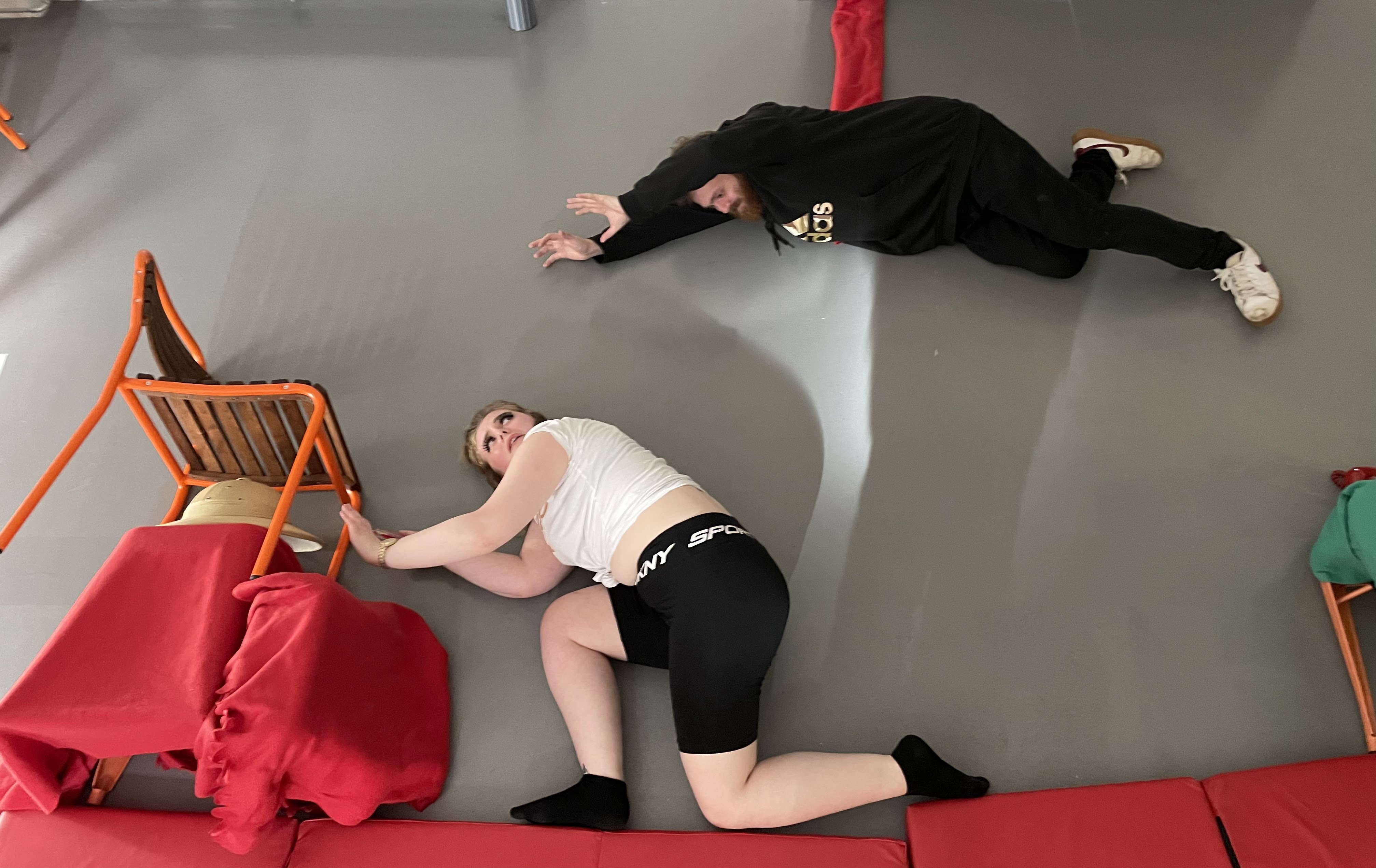
Throughout the two weeks we found new ways to play around with and without the script. Especially during the second week we were figuring out different ways to perform, stage and adapt the script and our devising. This led to some really great ideas that we have noted down and plan to use later on in the process. Whilst we were playing we were using lots of workshop activities that we had encountered and eventually decided to use them to make our own workshop that we can take to schools, community centres, etc. We most likely wouldn’t have gotten this idea if we hadn’t been encouraged to play more and this will help us later on down the line, when we perform at a venue we can offer a workshop as well to show our process.
 Words from the Birds