Nicky Bellenger reflects on her Nest Residency
This morning, in the fresh field,
I came upon a hidden nest.
It held four warm, speckled eggs.
I touched them.
Then went away softly,
having felt something more wonderful
than all the electricity of New York City.
From Mary Oliver’s poem, With Thanks to the Field Sparrow, Whose Voice Is So Delicate and Humble.
I am writing a play.
A play about dementia, for young people to perform, that will challenge stigma and give hope.
These are words that I have been saying since the idea was put into action in June 2021, but very little writing has happened – until now!
I have been hesitant. Hesitant to write on behalf of people with lived experience of dementia, and to get the story ‘wrong’. I have personal experience, with two family members having received a diagnosis, but there are currently an estimated 900,000 people living with dementia in the UK, and that doesn’t include family, friends and carers who support those people to live well. My experience of dementia is a tiny drop in a very big, ever growing ocean.
As part of the process, I am running a Carers’ Café with Derby Theatre, specifically for carers of people living with dementia, to provide them with a safe and supportive space and to give people the opportunity to help inform the content of the play. Their input continues to be so generous and deeply honest.
Earlier in the year, one of the attendees asked me how the play was ‘coming along’. Although I had shared some early ideas with the group, it made me realise I needed to find some ‘proper time’ to process their feedback and read through the pages of notes I had been making after every café. I am grateful that the group is holding me accountable and are invested in the process.
This all coincided perfectly with a tweet from Talking Birds, promoting the Nest Residencies. Just what I needed – time and space to ‘download’ everything, and to see what would rise to the surface.
Day 1 – Solid Blue.

I was welcomed to the nest by Derek and Dom, who took me through all of the important information, and showed me how to make a decent cup of coffee (crucial). I had spent time in The Nest before and love the space, so it was nice to think of it as home for the next 2 weeks.
I anticipated it would take some time to adjust to being on my own in a big, empty studio and so I packed lots of books and big sheets of paper, just to make the space feel ‘full’ and lived in from day 1. There were two desks in the room. I think I spent most of my first morning questioning which desk would be best for me, laying out my books and getting things on the wall! I got to lunch time and wondered what I had achieved, but took myself for a walk along the canal and reminded myself there were no expectations from Talking Birds. The pressure was off. What a luxury.
Week 1: making space for ideas.
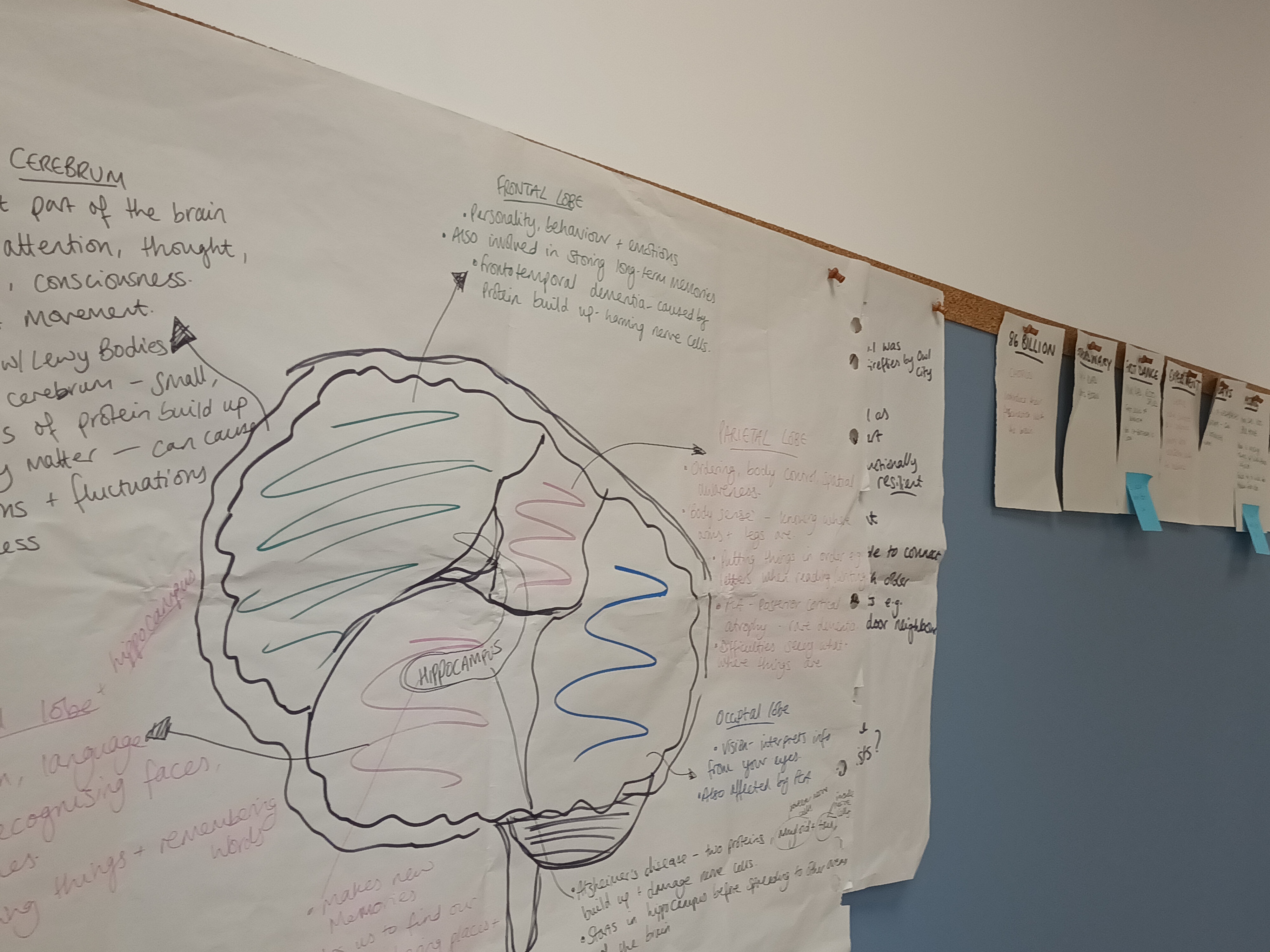

I wasn’t certain of what I wanted to achieve in week 1, but what emerged was lots of reading, (largely books about neuroscience and books written by people with dementia), drawing, and putting thoughts and ideas into the space, which I divided into areas. ‘Brain stuff’, ‘story stuff’, and all the ‘other stuff’! The big, empty space that I initially felt a little uncertain of needing was starting to feel like the perfect shell (or nest, of course) to keep hold of my ideas. As it happens, I solved the desk uncertainty by using both!
It was a treat to be able to lock the door at the end of week 1, leaving things exactly where they were. When I entered the space again the following week, it felt like I had pressed pause inside my brain and hit play again on return. Walking around the space, reading my notes, felt like walking around the inside of my brain, as I had left it the previous Friday. This meant it didn’t take long to get back into the swing of things. Very helpful.
Week 2: armchair writing

Week 2 saw the introduction of the armchair writing sessions! Turns out I have a need to assign areas of a room to different tasks or modes of working: a helpful discovery and proof of how important it is to be working in appropriate environments. I’m definitely not a productive café writer – there are too many interesting distractions for me (in other words, I’m too nosey).
On this comfy little armchair in the corner of the room I began to write some scenes. Many of which are unlikely to end up in the final draft, but it was here that the characters’ lives started to grow and come into focus. Difficult dialogue, mannerisms, relationships, heartache, humour and a family whose lives will change after a diagnosis of dementia were all appearing in the room in front of me. Welcome to the Nest, new friends. We’re safe here.
In fact, I had company throughout my residency. Every single person affected by dementia who I have met, no matter how small our interaction, has contributed to my understanding of this complicated disease and the impact it has on people’s lives. The hesitancy I had been feeling, caused by my concern of getting the story ‘wrong’, had been lifted. I had started to write, and trust in the story I was creating. I may not be able to tell everyone’s story, but I can share the generosity, care and love that so many people living with dementia have shown when sharing their stories with me; families, friends and carers included.
And humour, and hope, and people living well, and people working hard to research causes and cures. Those bits. Those are the bits that deserve to take centre stage. And I can do that. I can tell those stories, for younger generations to hold onto and take forward, and for people living with dementia to know they have been seen and that their stories will help so many people.
Farewell Solid Blue
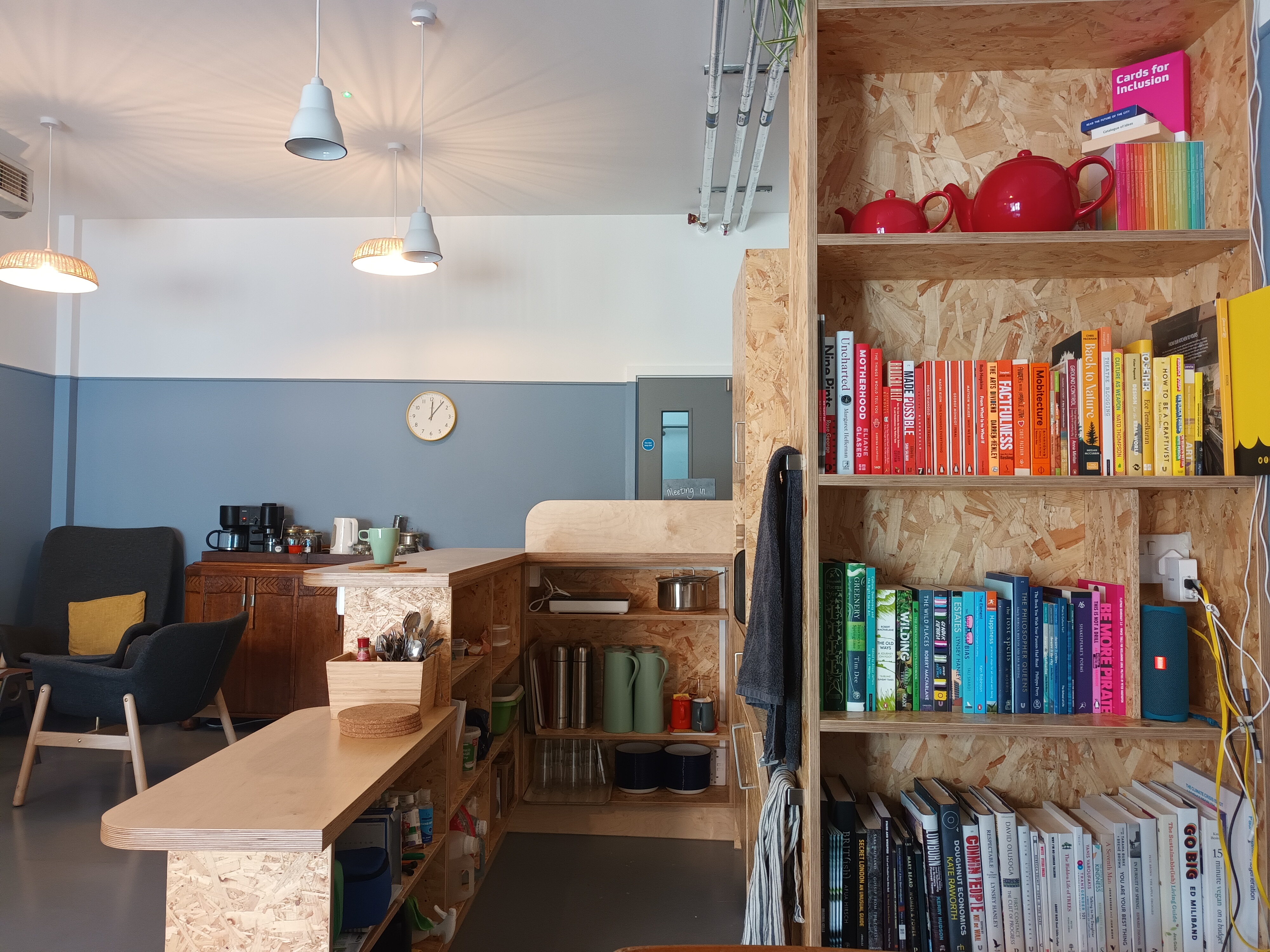
My time at the Nest not only helped to move me through a crucial part of a delicate, long-term creative process, but it had an impact on my lifestyle too. The ‘Nest Handbook’, sent out in advance of the residency, had the following, brilliant statement in it:
‘We are building The Nest as a regenerative community, rather than an extractive community – this means that we aim to be careful stewards and leave the world a better place than we found it, to think about those that come afterwards, and to be good ancestors.’
I was encouraged to bring my own homemade lunch, avoiding single use plastics, and to eat in the communal space every day, making the most of conversations with the TB team and other artists. I took my bike and enjoyed cycling along the canal every day, whatever the weather! I was conscious of the materials I was taking into the Nest and how best to reduce waste throughout my residency. And I have taken these things forward into my day to day life, inspired by TB’s commitment to ‘treading lightly on the world’. Just as Mary Oliver touched those warm, speckled eggs in the field sparrow’s nest and then ‘went away softly’, I hope I left very little trace of my time at the Nest.
Those two weeks were the most creative I have felt in some time, and I am certain that is because I had permission to focus on just one project, which is such a rare opportunity as a freelancer, and because all pressure to produce and share something at the end of the residency was removed.
A huge thank you to all of the team at Talking Birds, for your support during my residency and for your commitment to giving such valuable time and space to artists.
Much love,
Nicky x
 Words from the Birds
2 thoughts on “Time to Write”