Veronica Grant reflects on her Hatching Residency
During my Nest residency, I found myself filled with a mixture of excitement and trepidation. I had eagerly applied and been accepted, but I also felt the weight of my own expectations and the pressure to create something great during my time there.
In the beginning, I had great expectations for what I wanted to achieve. I envisioned myself prolifically producing a series of masterpieces, and I hoped to find inspiration and connections that would propel my career to new heights at The Nest. However, as the days went on, I began to realise that my expectations were limiting my experience there. Instead of allowing myself to be open to whatever came my way, I was fixated on a predetermined outcome.

It was during a particularly frustrating week, when my creative juices seemed to have run dry, that I experienced an unexpected shift. I found myself drawn to a new medium and style that I had never considered before: using lights and audio. This unexpected turn of events opened up new doors for my art and reignited my passion in a way I had never anticipated. The experience taught me the value of staying open to the unexpected and embracing the unknown.
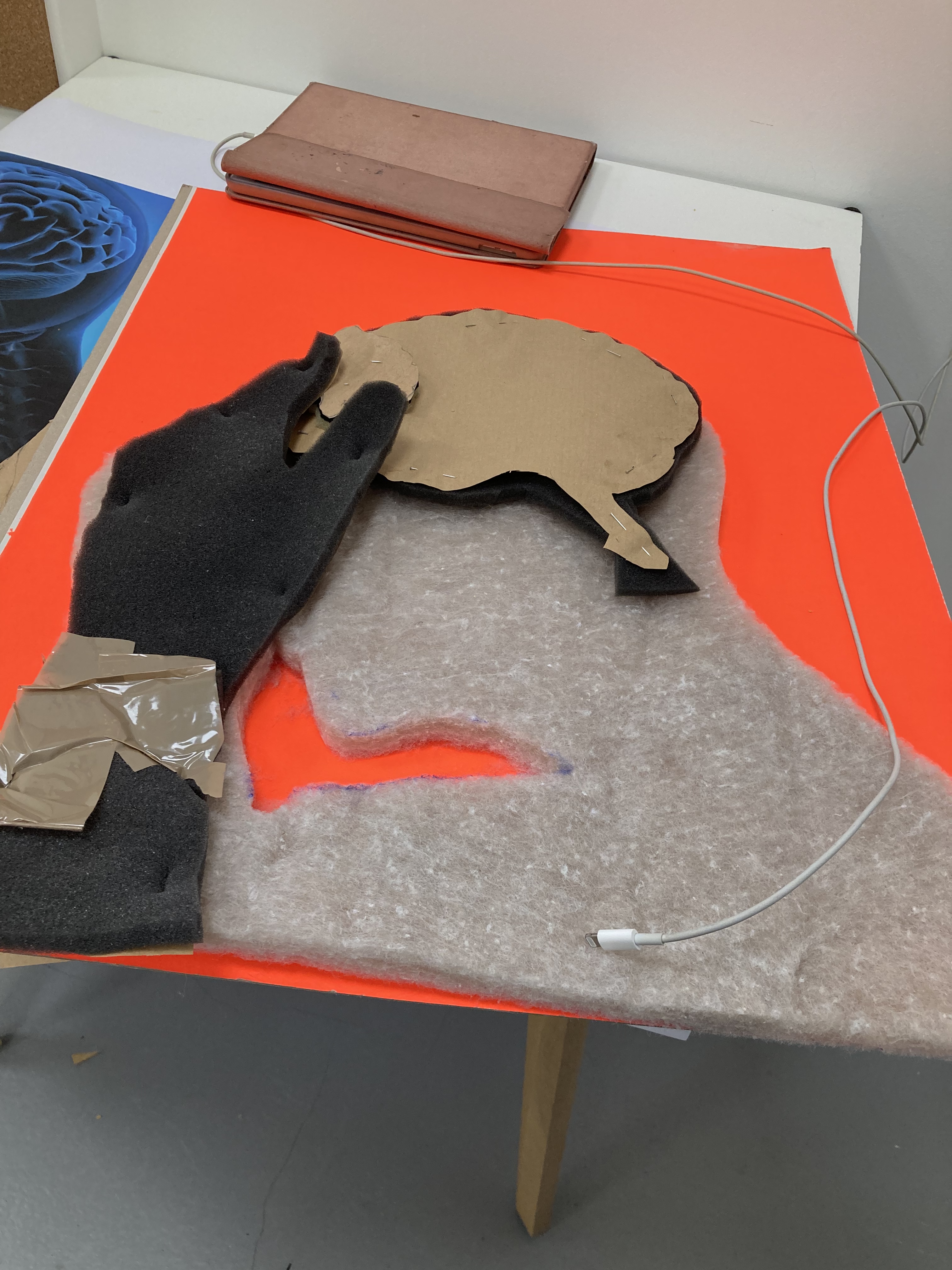
The artwork that I undertook at the Nest looked at the link between colour, pain and sound. Firstly l identified the areas in the body where the majority of the people I spoke to had pain in their body, such as headaches, stomach ache and back ache. I spent time drawing parts of the body that experienced pain such as the hands, feet, fingers, back and head.
I wanted my work to have a 3D effect so l spent time thinking how l could do a soft sculpture. I drew several pictures of the head and the brain and cut them out. What l wanted to do was to build up the structure quite tall so I used sheets of wadding and cut the shape out of this, which I put on top of each other. Once l achieved this. I was stuck on the next bit.
This is where my mentor steps in.
Talking Birds arranged for me to meet an artist, Indira Lakshmi from Fab Lab, who is familiar with digital music, sound and lighting. I spent several hours with her and she explained how to do what I wanted in my artwork. I told her I wanted parts of my project to light up and give out sounds. Indie show me how to make a circuit with wire thread and added several LED bulbs. The thread was stitched into my art and it lit up when a battery was added.


She showed me how to add sound onto a touch board with a computer, and to attach leads to the board. Again we stitched conductive thread into my artwork so that when a small area was tightly packed together with the stitches it would make a sound. This is what I wanted the artwork to do – to be interactive with the audience.
As the residency came to a close, I realised that I had also learned a great deal about myself. I had discovered my resilience in the face of creative challenges and had gained a deeper understanding of my own artistic process. This newfound self-awareness was invaluable and has continued to shape my work.
Looking back, there are certainly things I could have done differently. I wish I had approached the residency with a more open mind and a willingness to let go of my preconceived notions of success. I could have also been more open to some feedback from the others. However, I know that these realisations have made me a better artist and have influenced the way I approach creative opportunities in the future.
Ultimately, the art residency was a transformative experience that challenged and changed me in ways I never expected. It taught me valuable lessons about the nature of creativity, the importance of flexibility, and the power of self-discovery. I am grateful for the experience and the ways in which it has shaped my artistic journey.
 Words from the Birds