‘How fragile time is…’ Chloe Allen reflects on her Nest Residency

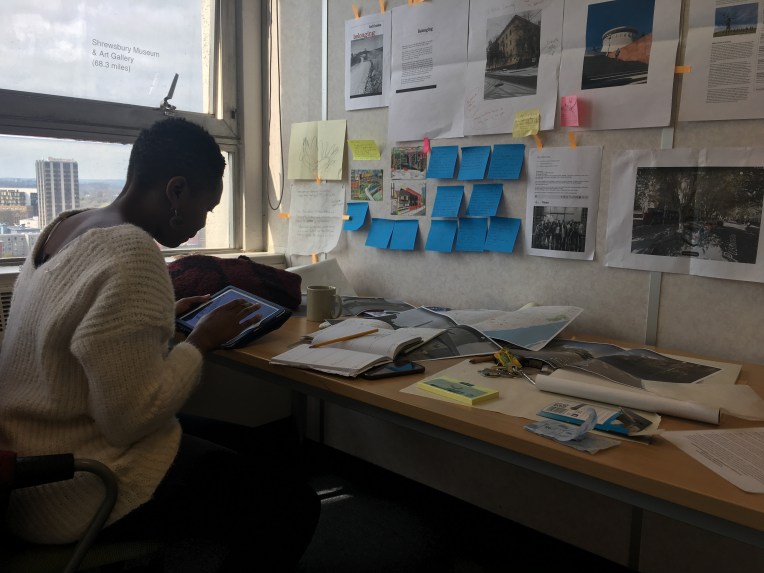
I first learned about Talking Birds when my friend told me about her Nest Residency at Eaton House. I decided to look them up online and was pleased to discover that they aim to make residencies more accessible to people with disabilities and conditions like myself. I graduated from Coventry University in 2018 with an MA in Contemporary Arts Practice and, until my Nest Residency began, hadn’t had access to a space to be able to make work for a whole year – so I knew that this would be a perfect opportunity for me and was so pleased when my application was accepted. My residency began in December 2019 and finished in February 2020, during this time I was able to further explore the effects that Narcolepsy has on my life. In 2012 I was diagnosed with the chronic sleep condition Narcolepsy, this causes me to experience Excessive Daytime Sleepiness and so I can have a sleep attack at any time anywhere. Due to my constant fatigue I often don’t leave the house for weeks at a time and so to have a work space away from home was a great motivation for me to actually get out of bed because I knew I had the chance to actually make work again. During my residency I felt content in the knowledge that I could take naps and not be disturbed, I was safe inside the studio space, I wouldn’t be in anybody’s way, taking naps allowed me to gain just that little bit more energy to then continue to make work once I’d woken up.

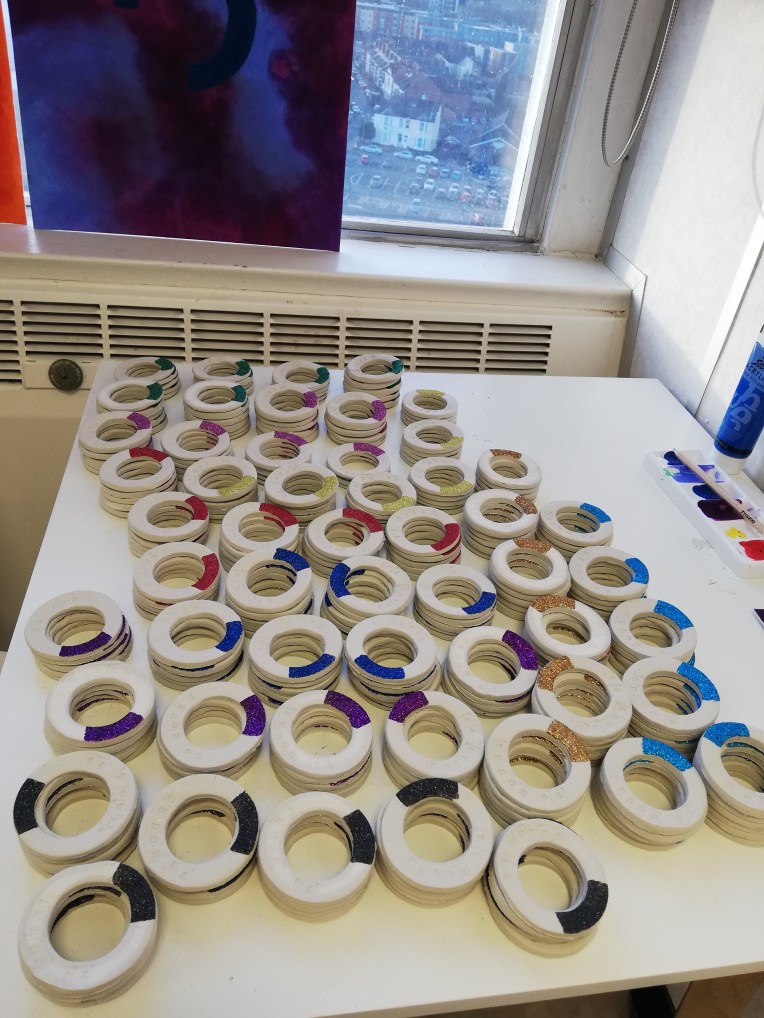
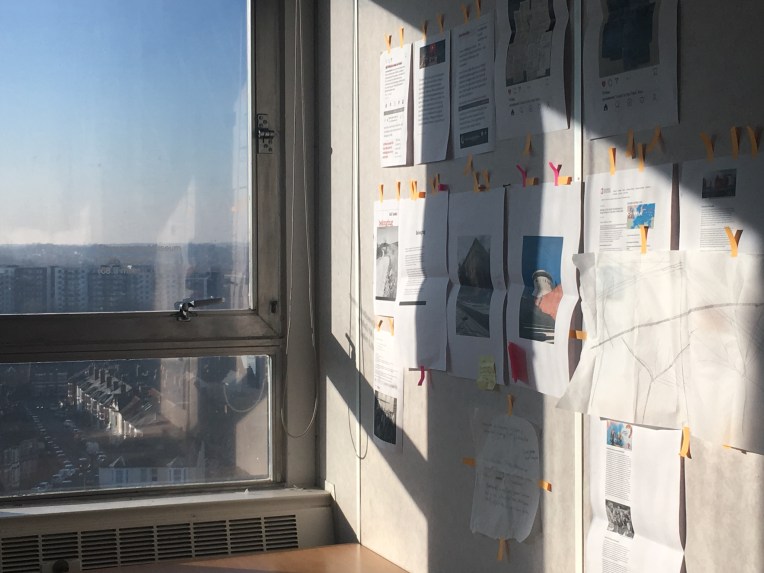
This residency has allowed me to further explore my ideas in relation to time being wasted due to Narcolepsy. For the past 5 years or so I had often used raising awareness for Narcolepsy as the main idea for my work but once I had graduated this all came to a sudden halt. Being in a studio space has allowed me to spread my work out across the floor and experiment with different ideas, having this space gave me the motivation to push myself further with my work thus I created 366 clay circle ‘time tokens’, had I not had the studio space I wouldn’t have been able to do this because creating something like that isn’t too easy on a cramped bedroom floor!

IMG_20200212_163031

To begin I started creating work in my comfort zone of acrylic on canvas, I’ve often used text art in my previous works and so knew that this would be something that I’d be pleased with aesthetically. I worked on canvas boards and the pieces were relatively small, after reflecting on this I decided that I wanted to make work on a larger scale especially since I’d got the space in the studio and so I got some plastic sheeting and bought some clay. The image of a circle was at the forefront of my mind, based on a clock. I began by creating rings from the clay with circle cutters, then cut segments from these circles based on how much time I’d wasted napping, I then used metal letter stamps to press words in to the segments, the words were the things I’d missed out on by napping e.g. family dinners, however, despite these turning out well I knew that I still wasn’t entirely achieving what I wanted. I researched into artists that created work based around time and came across Alyson Provax, her works in ‘Time Wasting Experiment’ really inspired me, she would state how many minutes were wasted and what the time was being wasted on. I could time every single nap I’d taken but because of my condition I don’t always get to choose when I nap and sometimes I don’t even know that I have napped – it’s sometimes hard for me to tell the difference between my dreams and reality because I nap do frequently. Narcolepsy affects me all day every day so I decided that I would make a circle for every day and instead of cutting out segments I would create segments on the circles with glitter. I created 366 (as 2020 is a leap year) circles, using different coloured glitter for each month. Each circle had ’24 HOURS’ printed on to them, each a token of time that we choose how to spend, the circles weren’t fired and so could very easily break, should they break this will only demonstrate how fragile time is.

The Nest Residency was so valuable to me, I was able to explore ideas, set myself bigger challenges and my importantly create work again. I also found it very useful to be at Eaton House and attend the First Thursday Drop-in, this gave me chance to network with other artists and instead of just explaining about my work as I had previously I also got to show people my studio space to that they could see the processes I was going through to create my work.

Reflecting on Cinematica at Arcadia

Rosa Francesca reflects on her recent Nest-supported exhibition at Arcadia Gallery

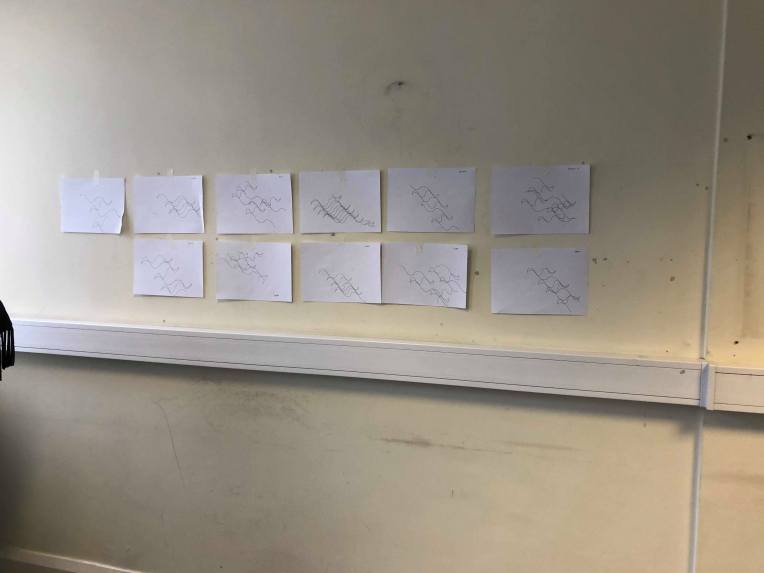
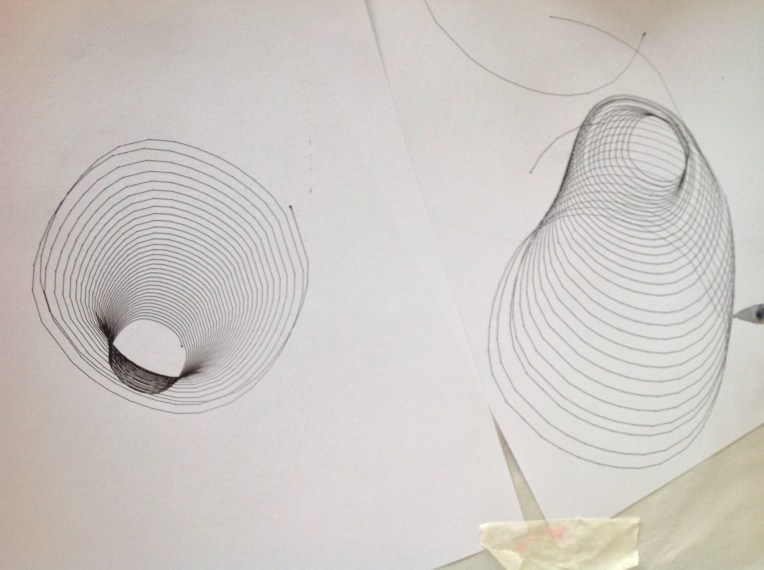
From January 11th-16th I was at Arcadia Gallery in Coventry for a second showing of my project Cinematica, which uses an EEG brain monitor in combination with a pen plotter to create brain-controlled drawings. Members of the public were invited to come in to the gallery and have a go at creating a drawing by trying on the Muse headband and watching the plotter work. Drawings were either kept by the participants, or displayed on the wall.

A13A92AA-9E3A-4EB5-82F5-49C5B8818B59For this second exhibition I changed the design to a sort of geometric flower that moved in a clockwise direction. I found that having a circular design benefitted the project as the pen was far less likely to travel beyond the limits of the plotter and therefore I didn’t have to keep stopping the program to reposition the pen, but also because moving in a repeated clockwise motion meant it was easier to spot variations in brainwaves. I continued to alter the design during the exhibition between visitors, changing the size and shapes slightly. I also found that there was a lot of variation between my brainwaves and brainwaves of participants, so on the third day of the exhibition I began to spend more time on calibration; I would set them up with the brain monitor, look at the programme for a while to see the values coming in from the EEG, so that I could figure out the range of their waves and adjust the programme accordingly.

One of the most interesting findings was when a man brought in his eight-year-old daughter. Although her brainwaves showed on the Muse Monitor app (the app I use to read the EEG waves via bluetooth), no data appeared in the computer programme that the brainwaves are streamed into and therefore I was unable to draw anything. Numbers either displayed as 0 or ‘-inf’. Initially I considered that this was because children’s brains are known to have vastly different EEG results than adults, as their brains are less developed. However, the next day I saw a young child of around three years old who had very clear results in a similar range to some of the adults who had visited. From this I can only guess that the first girl had just not been able to fit the monitor properly, for example if it was not tight enough or not positioned at the right height on her forehead.

B95FBE0F-B0D2-42FD-9915-60FC6963D447For the next outing I would like to improve some of the technical aspects; I need to get used to the routine of calibrating and making sure I explain properly how to wear the brain monitor, as some people had difficulty fitting the headband and therefore there was a weak connection (and in one case, non-existent). I would possibly use better quality paper, and better pens. Sometimes the ink came out too light, partly because of bad quality pens, but also because I needed to adjust motor speed so that the pen was spending long enough in one spot for the ink to reach the page. I also need to work on getting the drawings more centered so that there is more consistency when comparing drawings. It was suggested that I pick shapes such as lines that are easy to compare as well, which is something I intend to work on throughout this year.
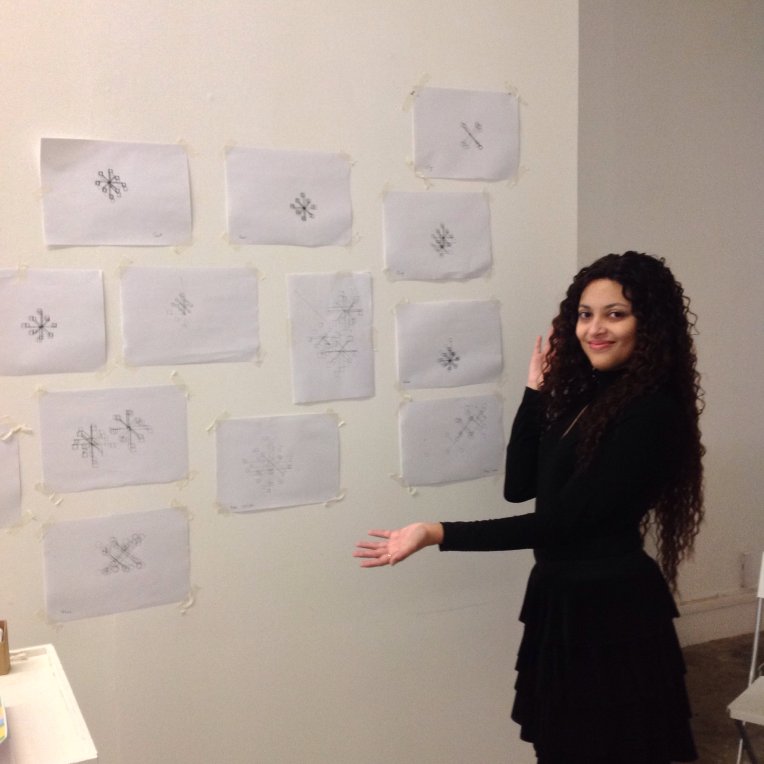
There was an overwhelmingly positive response to the work. The majority of visitors were other artists who had found out about my work through Twitter or Instagram, and a couple of people who also worked in the City Arcade also came in to try it out. Some visitors had specific interests in plotters and fabrication so they were particularly excited by this project. I felt that it was a great opportunity to network with Coventry artists and get to know the scene. I’m excited to continue developing this project as the years goes on!

DF9DF711-DFD4-4E27-B05E-91569DD2D51A

[Photos from Rosa’s Twitter Feed @RosaFrancsArt]

Cinematica: Artist Rosa Francesca reflects on her Nest Residency visualising brain data.

Artist Rosa Francesca reflects on her Nest Residency:

Cinematica is a digital art project using an EEG monitor in conjunction with an XY pen plotter to create visual art. The participant is invited to wear the EEG headset and their brain data will then be sent to the plotter giving it directions in which to draw, producing in the end a ‘mind-controlled’ drawing. This project was developed during a Nest Residency supported by Talking Birds.

I began my residency at the start of June 2019, and I had applied to Talking Birds in particular after hearing about them through the Coventry Biennial open call. I was particularly impressed with their commitment to accessibility, working with disabled artists, and creating environmentally conscious work. I felt that their views aligned with my own, and in particular related to the aims of my work.

3Dspirals

I first had the idea for Cinematica after being diagnosed with Tourette Syndrome at the start of 2018. I had suffered from motor tics and a few vocal tics for most of my life, and waited until adulthood to seek diagnosis. Although it no longer affects me as harshly as it did during my teenage years, I am a member of an online community for adults with Tourette Syndrome and can see the debilitating effects on others less fortunate than myself. One man described how he was no longer able to make art because of his motor tics which rendered his hands to unsteady to hold a pen or a paintbrush. Other members suggested that he tried digital art, but he wanted the ability to create a physical drawing. I decided then and there to create a means of physical art creation without the necessity of fine motor skills.

I had recently purchased an EEG monitor for artistic purposes anyway, and thought it might be good to put it to good use alongside a plotter, which is a robot arm that draws with a pen and paper moving along an XY axis. Through my Nest Residency, I was able to get support to purchase a plotter and to learn to manually code it and figure out how to send data from the brain monitor to the plotter to create real life brain drawings.

hellocov_4

The residency was invaluable in that it provided me with the physical space to contain the machinery, but also gave me a space away from home where I was able to focus all of my attention on this project. Without time constraints and deadlines I was able to work freely without pressure, but the space still allowed me to stay motivated. Janet provided an incredibly useful sounding board, as did other studio holders in Eaton House where my residency was based. It was a wonderful opportunity to meet other local artists and connect with like-minded individuals, and I hope to stay in touch with some of them through the regular Artspace networking events.

hellocov_1

I was able to present a first draft of my project at the Hello Cov exhibition for Artspace studio holders at The Row in Coventry, and the response was overwhelmingly positive. Although at that point the drawings did not look particularly ‘pretty’, it was still fascinating to see how different people’s brains produced different drawings, and allowed me to build a portfolio to compare how the technology worked for different people in different states of mind.

Overall I am incredibly grateful for this residency. I feel that I have achieved more than expected in this project, and can now build on that knowledge even further.

IMG_7963

You can follow Rosa on Instagram @rosafrancesca.art

The importance of Space and Place: from Coventry to Volgograd

Guest Blog by Nest Resident Artist Sylvia Theuri, reflecting on her Nest Residency.

I began this residency with the aim of further developing my artwork, in particular a project which focused on engaging with Coventry’s twin cities. The twin city that I was concentrating on during the residency was Coventry’s first twin city; Volgograd. I wanted to create new work outside of my home environment and discuss ideas with other artists. I was especially interested in having discussions with Talking Birds as they had previously created a project around twin cities with their “Twin Story” project.

The residency gave me space to think, which is so vital in being able to create interesting and insightful artwork. I was also able to spread out in the studio space, rather than be confined to the dining room table, which often happened when I worked from home. It is interesting that my work is all about spaces, yet I often have limited space to actually create the work. 

IMG_6268The residency also gave me the opportunity to talk. I talked with both Janet and Derek about the city of Volgograd, and because they had both been there, they were able to help me to understand the city better. I talked to other artists based at Coventry Artspace, my temporary neighbours. The residency became somewhat of a “third place” for me, somewhere away from my home environment where I could come and feel connected.

At the end of the 9 weeks, I felt like my work had developed, but more importantly I felt that the way in which I thought about my work had developed more. This was because I had focused time to read, and question myself and my work. Looking back on this residency what I am most thankful for is the “space” I was given to come and think about and engage with ideas about space, ironically.

Photo credits: Volgograd Photos by Nastya Tol; Studio photos by TBs; Postcard washing line and works-in-progress by Sylvia Theuri.

Link to Sylvia’s project site

For more about Sylvia and her work, see her website [link to external site].

Welcome to our first Nest Residents!

One day, (funding pending…) The Nest will be a real place. Until then, The Nest is wherever we can find a space to support our Nest Artists’ Residency Programme – and we’re really thrilled to announce that our first two artists have now taken up residence in studios at Eaton House (big thanks to Coventry Artspace for their help with this!).

Andy Sargent started last week and has already practically filled his studio with sketches, paintings and sculptures which are adding to his ‘Hidden Monster’ series exploring “the issues of loneliness, isolation, abandonment, negative reaction, pain, depression, physical instability, poverty, all created by sudden physical disability due to spinal injury.”

IMG_5220

Digital artist Sylvia Theuri started yesterday. She will be using the residency to continue her dialogue with Volgograd (begun through her postcards project) and to make some pieces that respond to the photographs and messages from the individual in Volgograd that received and responded to Sylvia’s Coventry postcard.

IMG_5357

We’re really looking forward to seeing how both artists’ works develop – and to the many interesting creative conversations we hope to have with them (without interrupting them *too* much!)

>> If you are a D/deaf or disabled and/or Midlands-based artist and are interested in applying for a Nest Residency, you can find all the details here.

Could you help us fly? Board Members and Special Advisors wanted [find out more at our TBs social]…

Talking Birds is looking to expand its dynamic Board, to help steer the company’s exciting flight towards Coventry’s tenure as UK City of Culture 2021; to support the development of new premises The Nest; and help take our digital access tool The Difference Engine to the next level.

Hannah_DE_IMG_2049
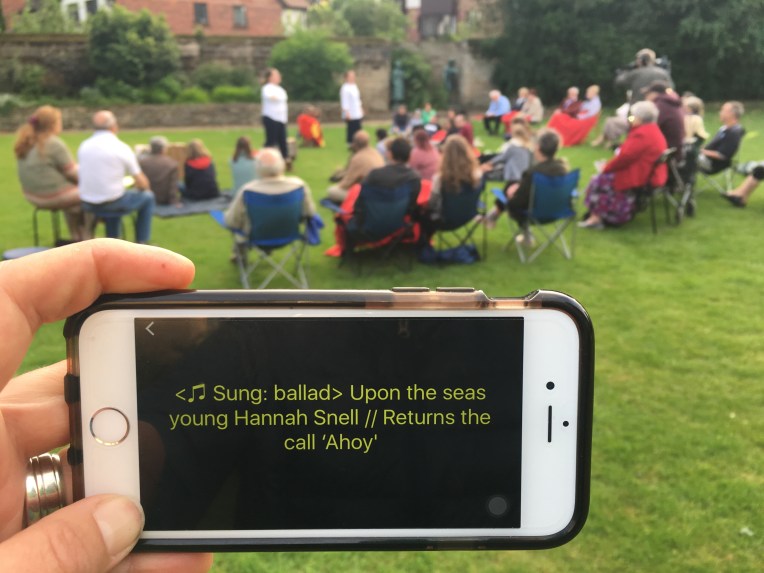
The Difference Engine in action in the field…
We are looking for people who are passionate about the things we are: audiences and accessibility, environmental sustainability, artist development – and Coventry. We are particularly looking for people with expertise in property law and building development, finance, fierce advocates for D/deaf and disabled artists and audiences [particularly in relation to The Nest], and people with experience of business modeling for software/Apps/digital distribution [in relation to The Difference Engine]. We want our board to be as diverse as the city we live and work in.
The role is voluntary and involves 4 meetings PA (usually a weekday 12-2pm or thereabouts; we can Skype you in if that’s easier!) plus an Away Day and individual consultation where appropriate.
We are also looking for Special Advisors who have some of the specific skills above, who may not be able to commit to Board membership but who are willing to offer advice/support on a more informal basis.
IMG_5042
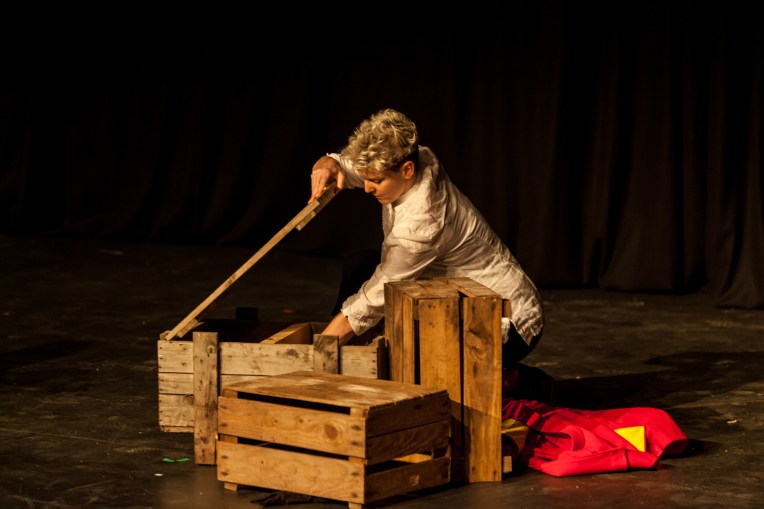
Genevieve Say as Hannah Snell in The Female Warrior
If you would like to find out more, please come to our Meet Talking Birds Social on Thursday 22 November anytime between 12-2pm (short presentation about the company’s work at 12.15 & 1.15) Floor 4, Eaton House, 1 Eaton Road, Coventry CV1 2FJ (vegan/veggie buffet lunch provided)
Please RSVP to access@talkingbirds.co.uk or via Facebook
If you can’t make that date/time but would like to know more, please e-mail or call 07708 262 182 to arrange an informal conversation.
Twitter/Instagram: @birdmail

What can performance bring to the table?

[This post was originally published on histprisonhealth.com]

image.jpegYesterday afternoon, alone in the Shop Front Theatre varnishing parts of the set for Disorder Contained, I listened to the podcast of Hilary Mantel’s second Reith Lecture, ‘The Iron Maiden’. She was navigating a complicated verbal path between the work of Historians and Authors of Historical Fiction, exploring the validity (and comparative value) of two very different approaches to, and renderings of, the past – and exploring more generally how the human mind can view one set of opinions as solid fact and another as slippery, less valid, conjecture.

Hilary Mantel asked “What can historical fiction bring to the table?….It doesn’t say ‘Believe this.’, it says ‘Consider this.’. It can sit alongside the work of Historians, not offering an alternative truth, or even a supplementary truth, but offering insight.”

In this simple answer, she captured the essence of a successful collaboration with the past, characterising the strength of the arts (whether fiction, as in her own work, or theatre, as with Talking Birds) when partnered with the methodical – perhaps forensic is the right word – work of Historians and those engaged in historical research.

There are all kinds of interesting questions that any research project throws out, not least in consideration of the interpretational biases within the source materials, and the layer of interpretation brought to bear on those by the researcher. My understanding is that the Historian must ask the right questions of their sources, use their imagination to draw their material together, find a narrative thread through the complex paper trail and put down the truths uncovered, so that we might better understand the past.

Whether or not it actually says ‘Believe this’, we generally do.

The artist’s process is actually pretty similar: sifting the research materials for the threads and connections that weave a story. The facts that jump out and spark the imagination; that provoke a double take; that demand some thinking about.

It absolutely says ‘Consider this’.

Talking Birds’ work explores the profound and complex relationships between people and place. In the case of Disorder Contained, this latest collaboration with Centres for the History of Medicine in England and Ireland, the people in question are convicts, and their place a whitewashed cell, no bigger than 13ft x 7ft x 9ft. Our sifted version of the research pulls together various disparate events into an unnamed mid-19th century prison, which could be in Britain or Ireland. Though the characters depicted are fictional, the incidents and arguments presented are based on reports and accounts from the time, taken directly from the research done by the teams at UCD and Warwick.

As artists working with this material, we have tried to imagine ourselves in the cells (or felt slippers, or polished boots) of the people confined in (or staffing, or making decisions about) these prisons; and to weave together many of the stories the research has unearthed. No-one can really know how they might cope with being confined alone; where their mind might take them; and if they would meet this horror with fortitude, or as torture. But, as we have made this piece, we have ‘considered this’, and hope to offer glimpses and insights into this flawed reform system: to ask our audiences to also ‘Consider this.’ The combination of fictional context and live performance allows us to go one step further: as our audiences see the characters before them, and listen to the words of the prisoners and commissioners who lived (and suffered) through the Separate System, they cannot help but also consider how these stories might speak to our contemporary attitudes to mental health and prisons.

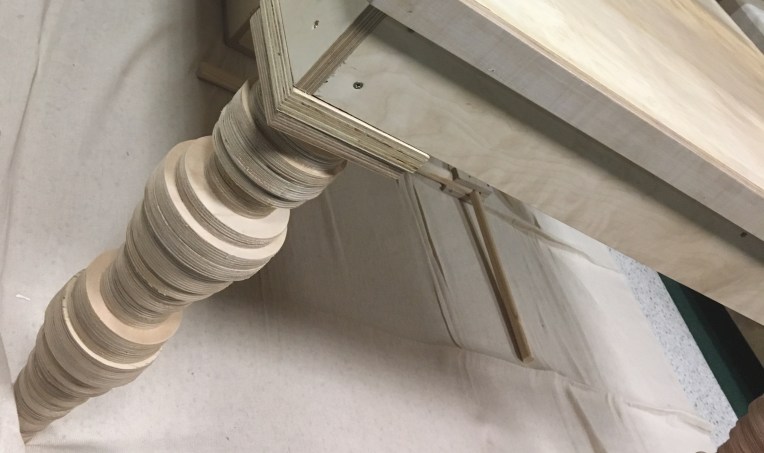
The table leg I was varnishing as I listened to Hilary Mantel seemed somehow a fitting metaphor for this process of making art that asks us to consider history.

With the appearance of a shapely, turned, Victorian table leg supporting a sturdy Victorian table, the proportions are right, but the materials are ‘wrong’. For this shapely table leg is not a piece of solid wood that has been turned in a lathe, it is a stack of machined circles of plywood that impersonates, and stands in for, a Victorian table leg.

The reconstruction of the material may not be completely ‘Believe this’ accurate (nor is it an alternative or supplementary truth), but its very existence helps us to visualise the historical table, offering us an opportunity to examine the table from different angles and in four dimensions, provoking fresh or unexpected views or insights, giving us something to think about.

It asks us to ‘Consider this.’ – to momentarily exist in both the past and the present – and then allows us to return and see, and to understand, our modern tables through slightly changed eyes.

Janet Vaughan, Talking Birds – 23.6.17

If you want to get a measure of a city, look at how it treats its young people…

IMG_9999I googled the title of this post as a quote, because I thought someone clever had previously coined it (or something similar). Google reckons Nelson Mandela and Michelle Obama have both said something along these lines and, I realise now, it also paraphrases Dumbledore on House Elves but, anyway, that’s a fairly major digression from what I actually wanted to write in this post, which was:

If you want to get a measure of a city, look at how it treats its emerging artists…

When Talking Birds was a young, emerging company (over 20 years ago – eek!), we always found it completely brilliant, if continually mystifying, when people gave us a bit of money towards devising a show, or offered us some space in a theatre (or tent or museum or geodesic dome) to put it in front of a paying audience. And then if people (especially people we didn’t know) came to see it, that was absolutely the icing on the cake*. There’s something about being offered a bit of money to make something, and a space to show what you’ve made, that gives you confidence in what you are doing (as well as, obviously, allowing you to get better at doing it). If you aren’t someone who makes things, you might find that hard to believe, but I think it holds true that most of us who make things are ever so slightly surprised and grateful when other people believe in us – because it’s often that belief that allows us to believe in ourselves, which allows us to keep working at it, and to get better.

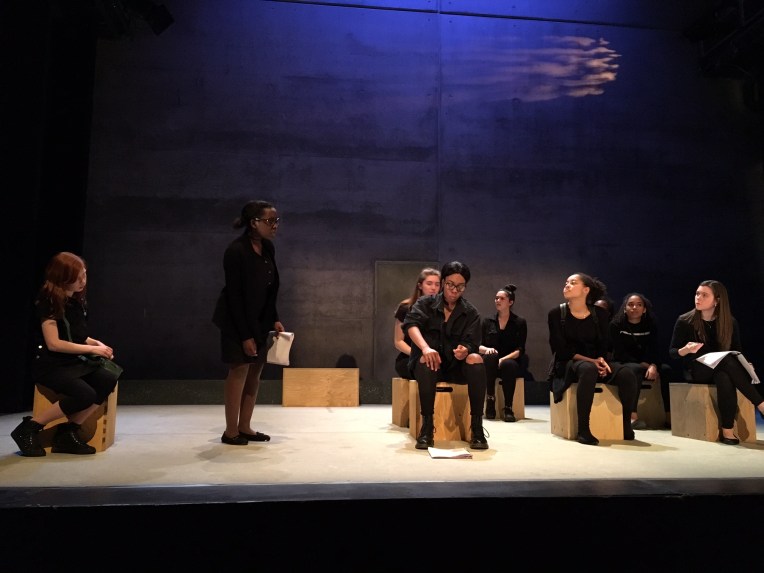
Talking Birds, Theatre Absolute and others are living proof that Coventry has a noble history of treating its young people – its emerging artists – well. There are two really good examples of this coming up next week – and the real purpose of this post is to encourage you to give the young, emerging artists the boost of turning up and watching them perform. If that makes it sound like we’re saying you should patronise and indulge them, then you are either wilfully misunderstanding this post, or (more likely) we’ve just written it really badly. This is absolutely not meant to be about patronising anybody – a friendly, supportive audience will give the performers belief in themselves, yes, but in return for your attendance you’ll get to see some surprising, thought-provoking, committed, skilled, energetic (and energising) young people perform – and perhaps most importantly you’ll experience a fresh perspective on all kinds of things they put before you as you explore their ideas and see the world through their eyes.

Rise by the Belgrade Young Company – a kind of all-girl road movie (see pic above) – is on 13th-18th in B2 at the Belgrade Theatre and Shoot Festival showcases the best of Cov & Warwickshire’s emerging talent with a triple bill on the Friday evening in B2, and an ecelectic day of theatre and music at the Shop Front Theatre and in Shelton Square on Saturday 18th.

We highly recommend them all – treat yourself, and get in at the start of something.

*In the early 90s, Talking Birds was one of a number of young Coventry companies to benefit from the opportunity of a small annual commission from the Arts Alive Festival. These supported commissions encouraged us to learn through doing, forging deep bonds with the city – meaning that we are still making work in Coventry 25 years later and constantly looking for meaningful ways to pay that early investment forward.

Save

Save

Save

Save