The importance of Space and Place: from Coventry to Volgograd

Guest Blog by Nest Resident Artist Sylvia Theuri, reflecting on her Nest Residency.

I began this residency with the aim of further developing my artwork, in particular a project which focused on engaging with Coventry’s twin cities. The twin city that I was concentrating on during the residency was Coventry’s first twin city; Volgograd. I wanted to create new work outside of my home environment and discuss ideas with other artists. I was especially interested in having discussions with Talking Birds as they had previously created a project around twin cities with their “Twin Story” project.

The residency gave me space to think, which is so vital in being able to create interesting and insightful artwork. I was also able to spread out in the studio space, rather than be confined to the dining room table, which often happened when I worked from home. It is interesting that my work is all about spaces, yet I often have limited space to actually create the work. 

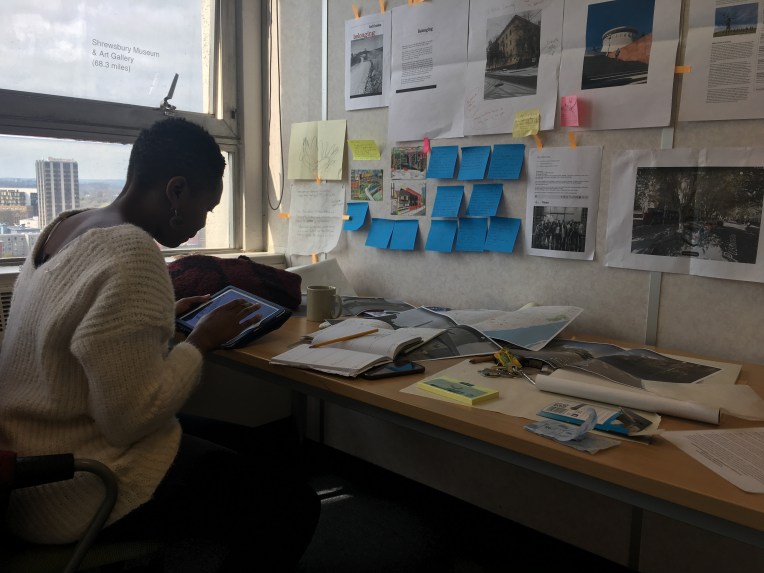
IMG_6268The residency also gave me the opportunity to talk. I talked with both Janet and Derek about the city of Volgograd, and because they had both been there, they were able to help me to understand the city better. I talked to other artists based at Coventry Artspace, my temporary neighbours. The residency became somewhat of a “third place” for me, somewhere away from my home environment where I could come and feel connected.

At the end of the 9 weeks, I felt like my work had developed, but more importantly I felt that the way in which I thought about my work had developed more. This was because I had focused time to read, and question myself and my work. Looking back on this residency what I am most thankful for is the “space” I was given to come and think about and engage with ideas about space, ironically.

Photo credits: Volgograd Photos by Nastya Tol; Studio photos by TBs; Postcard washing line and works-in-progress by Sylvia Theuri.

Link to Sylvia’s project site

For more about Sylvia and her work, see her website [link to external site].

Welcome to our first Nest Residents!

One day, (funding pending…) The Nest will be a real place. Until then, The Nest is wherever we can find a space to support our Nest Artists’ Residency Programme – and we’re really thrilled to announce that our first two artists have now taken up residence in studios at Eaton House (big thanks to Coventry Artspace for their help with this!).

Andy Sargent started last week and has already practically filled his studio with sketches, paintings and sculptures which are adding to his ‘Hidden Monster’ series exploring “the issues of loneliness, isolation, abandonment, negative reaction, pain, depression, physical instability, poverty, all created by sudden physical disability due to spinal injury.”

IMG_5220

Digital artist Sylvia Theuri started yesterday. She will be using the residency to continue her dialogue with Volgograd (begun through her postcards project) and to make some pieces that respond to the photographs and messages from the individual in Volgograd that received and responded to Sylvia’s Coventry postcard.

IMG_5357

We’re really looking forward to seeing how both artists’ works develop – and to the many interesting creative conversations we hope to have with them (without interrupting them *too* much!)

>> If you are a D/deaf or disabled and/or Midlands-based artist and are interested in applying for a Nest Residency, you can find all the details here.

Holding people to account over the choices they make, and helping them make better choices, works!

Today, in a Comment is Free piece in The Guardian, to coincide with the release of the ‘Sustaining Great Art & Culture‘ report, Nicholas Serota Chair of Arts Council England lists some of the headline achievements of ACE’s 10 year partnership with Julie’s Bicycle (a charity that supports the creative community to act on climate change and environmental sustainability.).

Continue reading →

Wednesday Recommendations: Co-ops, artist-friendly cities & change-making football.

Here’s ‘Wednesday Recommendations’ post number 4 – this is some of the stuff Birds have been reading and listening to in the last couple of weeks that we found interesting, and think you might find interesting too:

LISTEN: Reasons to be Cheerful episode 41 – another cracking episode from Ed & Geoff!  This episode explores cooperatives as a resurgent business model of choice, alongside other socially responsible models currently growing in popularity, such as community interest companies, non-profits & social enterprises. The second guest in particular (Joe Guinan from the Democracy Collaborative) describes the very clear advantages (think stability, stronger local economy & job security) of such socially responsible company ownership models to the areas in which they are based vs the de-stabilising effect of the constant change of ownership that happens with big corporations and the way that non-local ownership just siphons profits out of the business and out of the area, or even the country.

Slightly paraphrased, he says: ‘If you have a real stake in the business you work for, you tend not to export your own job overseas and are more aware of the environmental impact of your method of production because you also live there and so you’re unlikely to pollute the water or air your children are going to be drinking/breathing … it’s a more embedded form of ownership’

READ: Art hotel & the ‘artist-friendly city’ is a really interesting blog post from MAIA, who I’d not come across until I head Amahra speak at the a-n Assembly event in Birmingham the other week. One of the projects she’s heading up is working towards creating an Art Hotel in Birmingham. This paragraph rings really true, but also echoes back to a lot of things about co-ops in ‘Reasons to be Cheerful’. “We work with socially-engaged artists, practitioners and citizens with a deep-rooted investment in their environment. Fundamentally, given the broad parameters of which their work interrogates, when you make a city more equitable for artists and makers, everyone benefits. Of course, there is the awareness that in order to do that, it takes a societal shift, to renegotiate our understanding of what being an artist is. For too long, ‘artist’ has held definitions too contained, too narrow and too exclusive.”

READ: I’m not really into the football, but this article from historian David Olusoga totally shifted my perspective – if you’ve also been known to get slightly uncomfortable around a St. George flag, give it a read.

That’s it – as ever, let us know in the comments if you’ve followed any of the recommendations what you thought – and if you have any recommendations for us.

Wednesday Recommendations – stuff to read and listen to.

So it’s official, this is ‘Wednesday Recommendations’ post number 2, which means that <muted fanfare> Wednesday Recommendations has become ‘a thing’. Time will tell whether that is a good thing, or a bad thing, but here goes – this is some of the stuff we’ve been reading and listening to in the last couple of weeks that we found interesting, and think you might find interesting too:

LISTEN: Reasons to be Cheerful podcast episode 37 ‘Rethinking Economic Success’ – Ed & Geoff chat to Kate Raworth, author of ‘Doughnut Economics‘, recorded live in Hay-on-Wye. The basic concept of doughnut economics challenges the assumption that unlimited economic growth and ever increasing GDP is inherently good, but rather explores sustainable ways of increasing prosperity fairly for all the people on the planet. This is a really interesting listen – Kate Raworth describes the principle really simply and it just makes so much sense. There are some good, challenging questions from the audience too. Really thought-provoking and definitely worth a listen.

READ: Dear Ijeawele, or a Feminist Manifesto in Fifteen Suggestions by Chimamanda Ngozi Adichie is a pithily practical companion to her earlier book ‘We Should All Be Feminists’, based on her (highly entertaining) TED Talk of the same name. It’s a short, insightful and thought-provoking book, originally written as a letter to a friend who’d asked for advice on raising her baby girl a feminist. It also contains this lovely paragraph: “Teach her about difference. Make difference ordinary. Make difference normal. Teach her not to attach value to difference. And the reason for this is not to be fair or to be nice but merely to be human and practical. Because difference is the reality of our world. And by teaching her about difference, you are equipping her to survive in a diverse world. She must know and understand that people walk different paths in the world and that as long as these paths do no harm to others, they are valid paths that she must respect.”

LISTEN: The consistently entertaining and slightly irreverent Fortunately Podcast from Jane Garvey and Fi Glover has become required listening at TBHQ. Pick an episode, any episode, and enjoy…

That’s it for now. Let us know whether you followed up on any of our recommendations and, if so, what you thought – and if you’ve got any recommendations for us. Cheers!


F13 – where it came from…

Armed with a massive pile of homemade pizza and a collection of Ikea’s kids’ cups and plates, Talking Birds convened the first meeting of what was to become the Friday 13th (or F13) network in December 2013 (Friday 13th December 2013 to be exact!). At that point, as the notes reveal*, Coventry City Council had a new leader and there was the first mention of City of Culture in the air – presumably because Hull’s win must have just been announced.

Continue reading →

Engaging the Future Changemakers

IMG_6095In April this year, I gave a talk about Talking Birds’ socially engaged mobile project space, The Cart, at the University of Warwick. The Cart is essentially a project about conversation, about making a temporary space for people to get together and have a conversation they would not otherwise have had. As a result of the talk I gave, I subsequently had quite a few conversations I would not otherwise have had! One of these was with Alastair Smith, who convenes the Local Sustainable Development module, which is part of the new B.A.Sc. degree in Global Sustainable Development course at the university and, to cut a long story short, we agreed that I would conduct a walking tour around Coventry for his students, to give them a flavour of the city’s rich social/economic and cultural history.

For me, the drive to do this comes from living on a street full of students and seeing how little they are equipped to engage with this city, because less of the things that make a particular place unique are obvious nowadays. I need to unpack this, as I know it’s a little woolly so here goes…

The way most of us live now is less locally focused and, while global connection brings many benefits, there are also significant downsides. I think one’s sense of place, and consequently of self, is developed by making meaningful connections. Physically, through connecting with the geography, nature and weather of a place, and socially, through connecting with different groups of people – neighbours, work/study fellows, people who partake of the same leisure pursuits as you (in other words, the various communities you are a part of, which are generally geographically or interest based – in my case the arts scene, the school gates etc).

When we can live and work literally anywhere: when the same chain stores, restaurants and takeaways are on every high street and we can get our shopping delivered to our door, maybe we lose the drive to develop a sense of place: insofar as we understand the world, everywhere is basically the same, give or take a few minor variations. In some ways perhaps this doesn’t matter, but I think that actually it does. It *really* does.

I know that I am someone who understands the place where I am by walking it, by looking, by finding out, by listening to its stories – and I’ve observed that, when others perform these actions, they also gain a deeper understanding of the place and of themselves in relation to it. And I think this understanding is a key influencer of behaviour and belonging. When we feel that we belong somewhere (geographically and/or socially), we feel an obligation to take a part in the things that go on there, and to make behavioural choices that support these: on a local level this may mean that we don’t want our street to look a mess and so we make sure we put our bins out on the correct day; or on a global level, we may want to minimise our personal contribution to climate change and cycle instead of using a car.

For students moving to a new city, all these relationships are to be negotiated – and often a particular relationship with the place (I mean the city here, rather than the institution) is not cultivated. I don’t think there is any one reason for this, but I suspect that a perfect storm of factors (social, geographic, economic, emotional) conspire and if there is no stand-out reason to understand the distinctive character of the place, the city, where you study – then the sense of place, the sense of belonging to somewhere wider than the institution, doesn’t develop and there is no real reason why you would want to make that (time, economic, emotional) investment and commit to that place, that city, after graduation. I know that Universities across the UK are waking up to this and examining the civic responsibility of the institution now, but what about the civic responsibility of the arts? And of artists? And of artists who are also residents? What part do we have to play in helping students to develop and understand their connection to the place and where they belong in the wider society?

As many have pointed out before, Coventry – arguably more than anywhere else – doesn’t offer itself up on a plate. You need a little persistence. You need to dig around a bit and find things out. And the city has a graduate retention problem. These two things are probably not unrelated.

It’s this line of thought that led me to offer the walking tour to the students, as something small, but potentially impactful that I could do. A way to impart some of my 25 years worth of interesting gobbets of information – the stuff that got me hooked on this city – to a cohort of young and enthusiastic people coming to study Global Sustainable Development at the University of Warwick. Give them a sense of place and get them hooked on Coventry. My reasoning is that, in choosing that course, they are surely people who want to make a difference, who see themselves as changemakers, who have an interest in social justice – and these are the people Coventry needs to impress and beguile. These are the people we want to remain in the city, to make their lives here.

I wanted to inspire these young people with the stories that inspire me – stories of Coventry’s proud tradition of social justice and innovation, its commitment to youth, its progressive attitude, its innovation, its creativity, its quiet and dogged pursuit of what’s right, its modesty, its possibility…

So I showed them the place the river peeks from beneath the concrete, and the backs of the medieval houses; I told them about the paths of bones across the marsh to support those making the city wall; I told them about Gibson and Tennant’s dash to Cumbria for Westmorland slate and about the phoenix sketched on the back of a envelope; I told them about the city model ultimatum to government; about the City Architects Department being the place all the bright young things wanted to be post-war; about how the ideas inspired by Europe and developed in Coventry spread across the country as people moved on; I told them about pedestrianisation in the city of the car; about a freed slave managing a theatre; about double-doored powder rooms in the ballroom proving handy for losing an unwanted date; about the democracy of classless restaurants in theatres and above swimming pools; about how bankruptcy and commercial pressures can devastate well-designed public spaces and about how important it is to understand why something is as it is before you change it; I told them about a city founded on the belief that everyone deserves beauty, modernity and cleanliness; about a daring and spectacular tightrope walk; about electronic music pioneers; about measures to tackle health and food injustices; about an edible campus, a Marmot city, vegan cafes, arts, culture, mental health, wellbeing; about an Olympic Pool with sunbathing decks and sand-filtered water so clean you can see from one end to the other; about a courtyard of experimental brickwork; a guildhall with a tapestry that inspired a certain Warwickshire playwright; about a tiled mural map with dinosaurs; about twin cities and gifts of timber; about the first civic post-war theatre, and about inventing a way for young people to ask philosophical questions and come to understand the world through acting it for themselves; about a mini stately home on the top of a newspaper building; about criminals buried vertically headfirst; about the hopes for a City of Culture; and I told them lots about the amazing energy and creativity of this city’s people – particularly its independent artists and producers who continually explore this city, and question it, challenging audiences to interrogate, understand and, ultimately perhaps, love it.

I know I opened some eyes and altered some opinions with this walking tour, but only time will tell whether it truly had its desired effect.


  • If you want to get a flavour of the sorts of places I was recommending, try this article.
  • There is also an engagement page for the Local Sustainable Development module, with a bibliography of sources about the city and student work will be posted there.
What can performance bring to the table?

[This post was originally published on histprisonhealth.com]

image.jpegYesterday afternoon, alone in the Shop Front Theatre varnishing parts of the set for Disorder Contained, I listened to the podcast of Hilary Mantel’s second Reith Lecture, ‘The Iron Maiden’. She was navigating a complicated verbal path between the work of Historians and Authors of Historical Fiction, exploring the validity (and comparative value) of two very different approaches to, and renderings of, the past – and exploring more generally how the human mind can view one set of opinions as solid fact and another as slippery, less valid, conjecture.

Hilary Mantel asked “What can historical fiction bring to the table?….It doesn’t say ‘Believe this.’, it says ‘Consider this.’. It can sit alongside the work of Historians, not offering an alternative truth, or even a supplementary truth, but offering insight.”

In this simple answer, she captured the essence of a successful collaboration with the past, characterising the strength of the arts (whether fiction, as in her own work, or theatre, as with Talking Birds) when partnered with the methodical – perhaps forensic is the right word – work of Historians and those engaged in historical research.

There are all kinds of interesting questions that any research project throws out, not least in consideration of the interpretational biases within the source materials, and the layer of interpretation brought to bear on those by the researcher. My understanding is that the Historian must ask the right questions of their sources, use their imagination to draw their material together, find a narrative thread through the complex paper trail and put down the truths uncovered, so that we might better understand the past.

Whether or not it actually says ‘Believe this’, we generally do.

The artist’s process is actually pretty similar: sifting the research materials for the threads and connections that weave a story. The facts that jump out and spark the imagination; that provoke a double take; that demand some thinking about.

It absolutely says ‘Consider this’.

Talking Birds’ work explores the profound and complex relationships between people and place. In the case of Disorder Contained, this latest collaboration with Centres for the History of Medicine in England and Ireland, the people in question are convicts, and their place a whitewashed cell, no bigger than 13ft x 7ft x 9ft. Our sifted version of the research pulls together various disparate events into an unnamed mid-19th century prison, which could be in Britain or Ireland. Though the characters depicted are fictional, the incidents and arguments presented are based on reports and accounts from the time, taken directly from the research done by the teams at UCD and Warwick.

As artists working with this material, we have tried to imagine ourselves in the cells (or felt slippers, or polished boots) of the people confined in (or staffing, or making decisions about) these prisons; and to weave together many of the stories the research has unearthed. No-one can really know how they might cope with being confined alone; where their mind might take them; and if they would meet this horror with fortitude, or as torture. But, as we have made this piece, we have ‘considered this’, and hope to offer glimpses and insights into this flawed reform system: to ask our audiences to also ‘Consider this.’ The combination of fictional context and live performance allows us to go one step further: as our audiences see the characters before them, and listen to the words of the prisoners and commissioners who lived (and suffered) through the Separate System, they cannot help but also consider how these stories might speak to our contemporary attitudes to mental health and prisons.

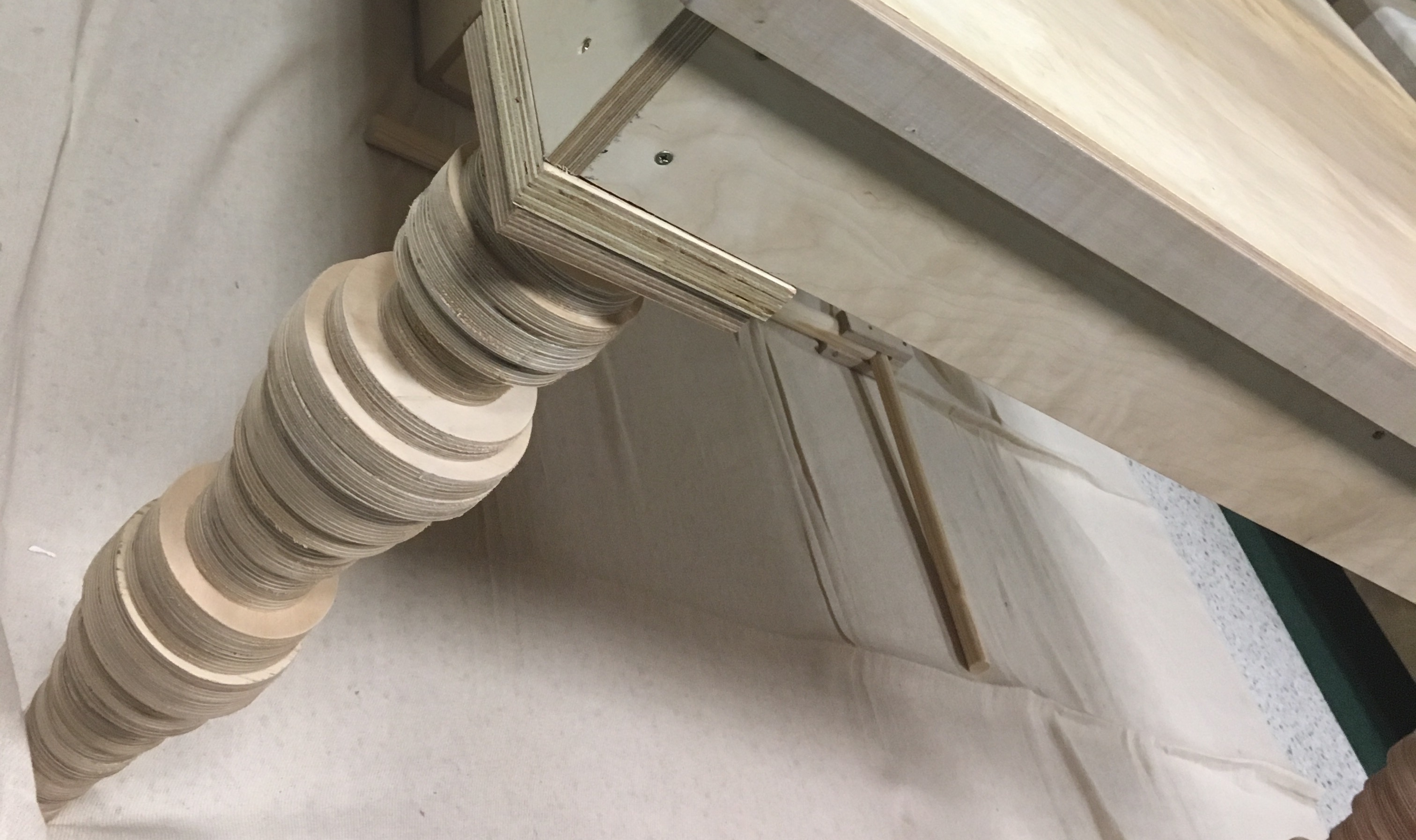
The table leg I was varnishing as I listened to Hilary Mantel seemed somehow a fitting metaphor for this process of making art that asks us to consider history.

With the appearance of a shapely, turned, Victorian table leg supporting a sturdy Victorian table, the proportions are right, but the materials are ‘wrong’. For this shapely table leg is not a piece of solid wood that has been turned in a lathe, it is a stack of machined circles of plywood that impersonates, and stands in for, a Victorian table leg.

The reconstruction of the material may not be completely ‘Believe this’ accurate (nor is it an alternative or supplementary truth), but its very existence helps us to visualise the historical table, offering us an opportunity to examine the table from different angles and in four dimensions, provoking fresh or unexpected views or insights, giving us something to think about.

It asks us to ‘Consider this.’ – to momentarily exist in both the past and the present – and then allows us to return and see, and to understand, our modern tables through slightly changed eyes.

Janet Vaughan, Talking Birds – 23.6.17

We belong to the city, and it belongs to us.

[This post was originally written for the blogs page of the Coventry City of Culture Trust website, supporting Coventry’s bid to be UK City of Culture in 2021]

I’ve been thinking a lot recently about what makes an individual put down roots in a place. I’ve tried to analyse what it was that made me settle here in Coventry – to understand why I am still here, and I’ve asked others what it was that made them decide to call somewhere home.

Continue reading →