Wednesday Recommendations: things to read & listen to.

Things we’ve been reading and listening to this week that you might enjoy too:

READ: No More Plastic by Martin Dorey – a short and very readable collection of achievable quick-win actions every single one of us can take to reduce the plastic in our lives (and therefore in the world), this book is also full of gently provocative prompts to consider lots of bigger ethical, social justice and sustainability issues. One of the great new-to-me examples of positive actions to join in with is Morsbags (a kind of craftivism billed as ‘Sociable Guerilla Bagging’) which involves keeping fabric out of landfill by making it into shopping bags which you gift to strangers, thus helping cut down the number of plastic bags needed. Genius.

LISTEN: There’s only 2 days left to listen to Meeting the Man I Killed, a Seriously podcast from Radio 4. This is a remarkable piece of radio telling the story of a man who killed someone in a road traffic accident that wasn’t his fault. Through meeting people who knew the man that died, the driver tries to get to know the man he killed – in order to come to terms with both the accident and the far-reaching effects it has had on his life and sense of who he is. It’s thoughtful, moving (you will need tissues) and provocative – and says so much about humanity. (40 minute listen)

LISTEN: Another great podcast is Reasons to be Cheerful (by the way, anyone in Hull or Coventry might also be interested in Episode 26 which is about The Power of Culture) and this week I listened to a special bonus episode from a couple of weeks back, called “Reasons to be Pirate“. Here Ed Milliband and Geoff Lloyd are talking to Sam Conniff Allende about his new book Be More Pirate, discussing the positive (and accidentally rather progressive) rule-rewriting done by ‘Golden Age’ pirates organising in opposition to the status quo (slightly surprisingly this involves fair pay, cooperatives, social insurance and equal marriage). The book suggests what we can learn from pirates, and how we can apply some of their methods (but probably not the psychotic ones…) to make the modern world a better place. (37 minute listen)

Well, that’s it. I’d be interested to know if anyone read or listened to any of these (before or after the recommendation!) and, if so, what you made of them – leave a comment…?

JV


F13 – where it came from…

Armed with a massive pile of homemade pizza and a collection of Ikea’s kids’ cups and plates, Talking Birds convened the first meeting of what was to become the Friday 13th (or F13) network in December 2013 (Friday 13th December 2013 to be exact!). At that point, as the notes reveal*, Coventry City Council had a new leader and there was the first mention of City of Culture in the air – presumably because Hull’s win must have just been announced.

Continue reading

Open Cast – Call for Performers

o-c-imageApplications are invited for an open workshop for performers with Talking Birds Theatre Company in Coventry. This is an opportunity to meet and work with the company in a relaxed and sociable group setting over the course of a day (11am-4pm), at the Shopfront Theatre in Coventry. The workshop will be led by Richard Hayhow, friend of Talking Birds and Director of Open Theatre Company.

The aim of the workshop is to identify talented and versatile performers the company can draw on for future projects (see www.talkingbirds.co.uk for examples of our previous work), particularly in the run up to Coventry’s year as UK City of Culture in 2021. We will also be inviting Artistic Directors from other regional companies to join us in the afternoon.

Travel expenses and lunch will be provided, along with any additional support you need to participate fully in the workshop.

Open Cast is aimed at expanding the casting pool for Midlands-based companies and priority will be given to D/deaf, disabled and learning disabled artists, artists from black and minority ethnic backgrounds and those based in the region.

Application is by submitting a video that lasts between 90 and 120 seconds (phone camera is fine) giving us an introduction to you, your work and why you want to come and do the workshop.

In addition to this, we encourage you to include any information that will help us consider your application. You can also attach a resumé/CV if you wish.

Please e-mail birdmail@talkingbirds.co.uk (Subject: Open Cast) with the link to the video or the video attached.

Applicants of any age over 18 welcome. The workshop is aimed at both emerging
and established artists. Full-time students are not eligible to apply.

Please note revised dates:

Date of Workshop: Friday 4th May (Coventry)

Deadline for applications: Sunday 22nd April

We will inform successful applicants by: Wednesday 25th April

Telephone number for any queries: 024 7615 8330 (please leave your name and number clearly) or e-mail access@talkingbirds.co.uk


Royal Mint Minds its Ps and Queues with new 10p coin

The Royal Mint has issued a new 10p coin which celebrates the pursuit of Queuing.

The move was welcomed by The Q Corporation, a Coventry-based organisation formed in 2011 to promote Queuing in all is forms.

A spokesperson for The Q Corp said: “We’re delighted that the Royal Mint has recognised Queuing as one of the UK’s great cultural traditions with this new coin. We’ve no doubt people will be lining up in a courteous and orderly fashion to collect one.”

In the run up to London 2012 Queuing formed part of the UK’s Cultural Olympiad. The spokesperson said: “We narrowly missed getting Elite Queuing included as an Olympic event, as it was deemed by the IOC that UK athletes would have an unfair advantage over the rest of the world.”

However it is believed that post-Brexit there will be an unprecedented increase in Queuing at airports and other UK borders. “Without Brussels prescribing the length and shape of our Queues, it could become a major growth area for the creative economy.” It’s even been suggested that Queuing could be added to UNESCO’s list of Intangible Cultural Heritage assets, alongside Belgium Beer Culture and Poetic Duelling in Cyprus.

The Q Corporation will be helping launch the programme for Coventry UK City of Culture 2021 later this month at the Shop Front Festival on 23-24 March 2018. “In 2021 people will be queuing up for cultural events across Coventry. It’s our intention that the experience of these Queues will be so good that people won’t actually feel the need to go to the events they have been waiting for.”

Follow on twitter: @Q_mob

Call the Q-line: 0800 012 2401

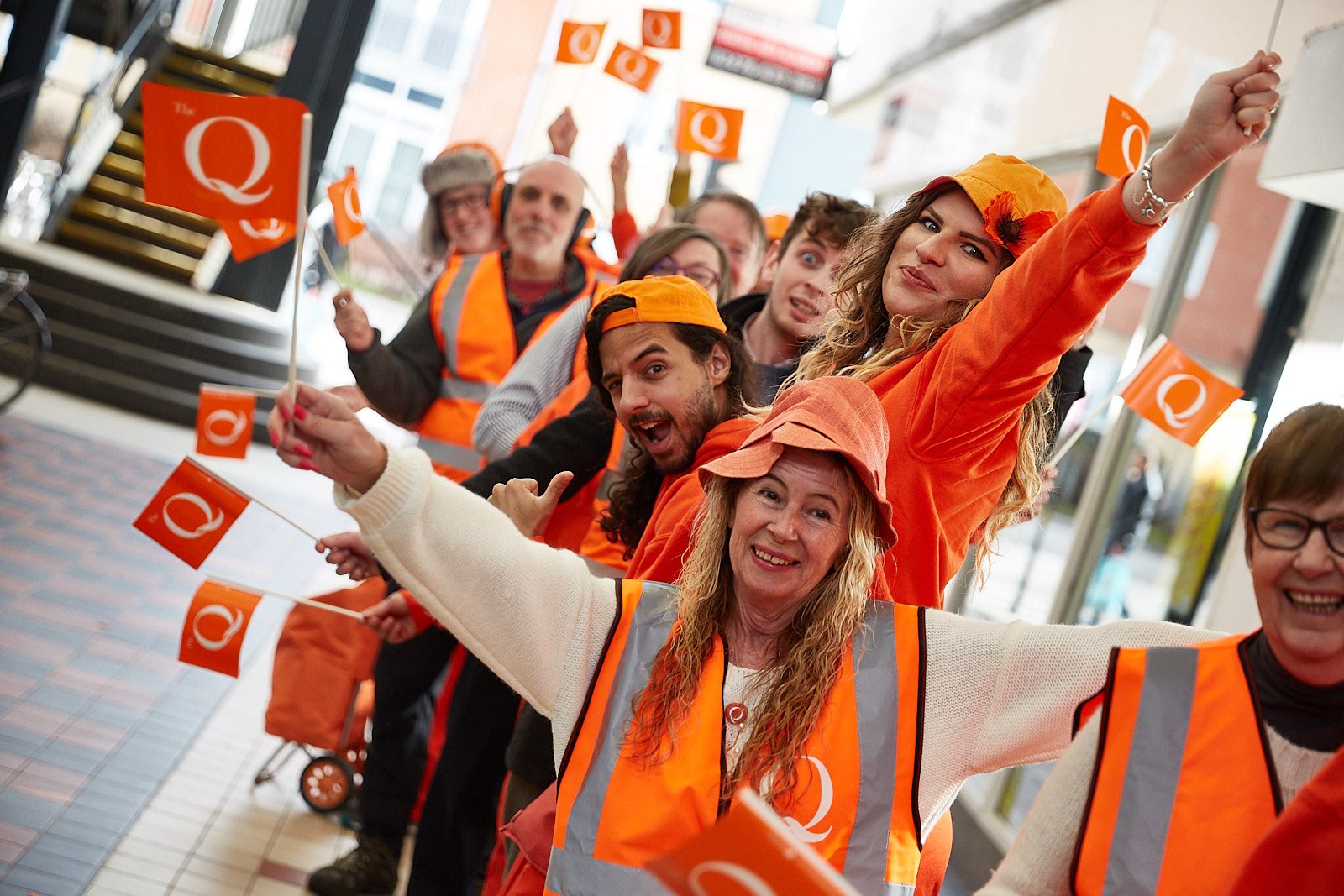
Ornage clad queuers wave flags in shopping arcade
The Q_Mob lining up for the Shop Front Festival (Pic: Andy Moore)

Come Queue With Us!

IMG_6311

Talking Birds needs volunteers to join its street performance The Q on Friday 23rd & Saturday 24th March in Coventry, as part of the Shop Front Festival (the first event in the build up to Coventry UK City of Culture 2021).

The Q is a celebration of the Art of Queuing. In 2011 the Q Corporation was formed in Coventry to campaign for Queuing to be included in the Olympics (therefore ensuring a string of Golds for the UK). Now they return – still dressed in orange – to show why Coventry has the most cultured Queues in the UK, and that it’s high time for our foremost past-time to be recognised as an Artform in its own right.

What do I have to do?

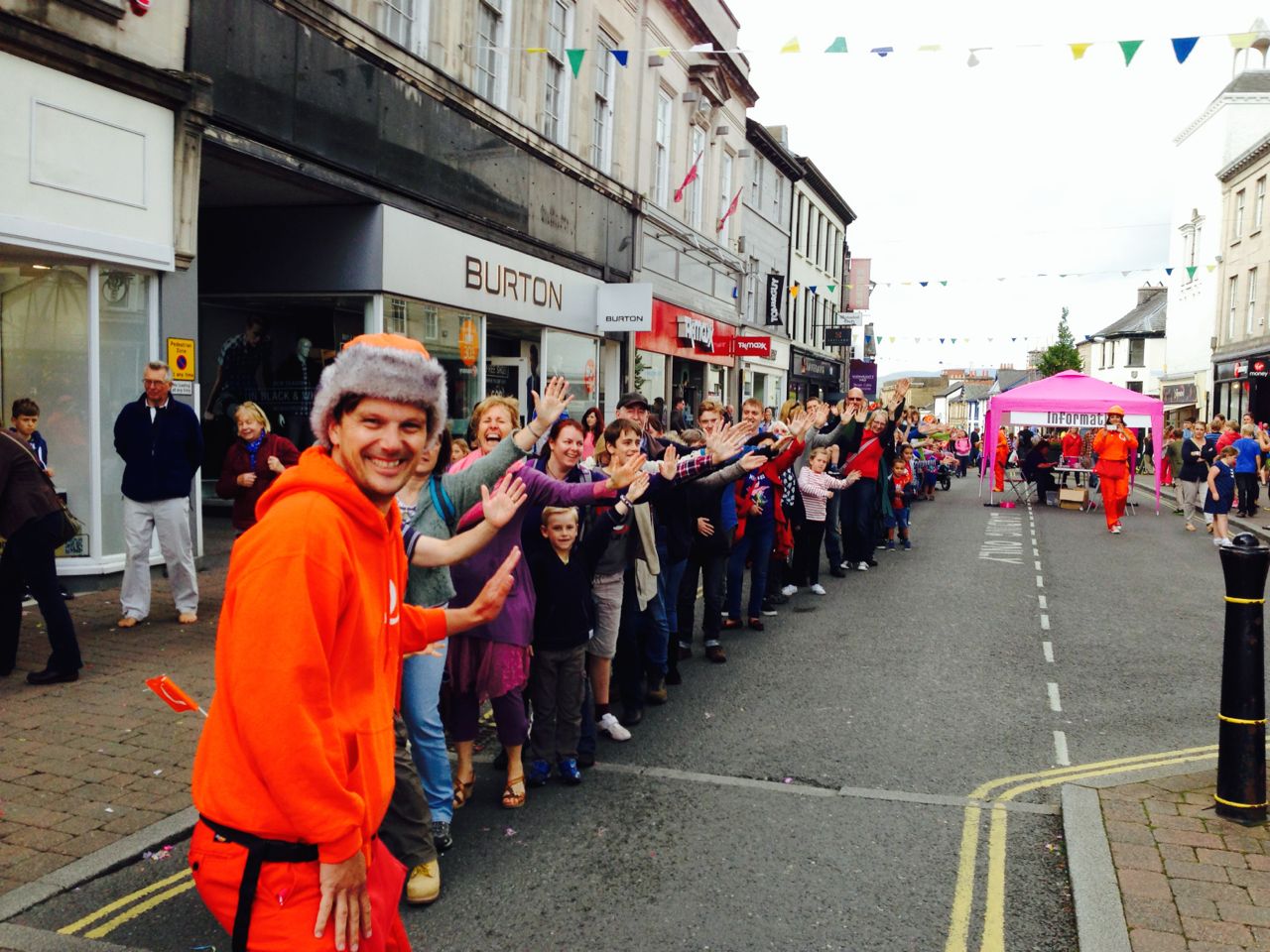
The @Q_Mob is like a Flash-Mob, but slightly more orderly. To join Q_Mob you need to sign up for a 4 hour slot (with ample breaks!) during the Shop Front Festival on Friday 23rd or Saturday 24th March, during which time you will be helping form queues around the City Centre, led by our Q Corp Captains (the elite SAS of queuing).

You will also need to come to a short (1 hour) Q_mob workshop where you can find out more, meet the team and… practice queuing. There are two workshop times to choose from:

Weds 14th March 6.30pm

Friday 16th March 1pm

Both workshops are at Shop Front Theatre 38 City Arcade CV1 3HW (just opposite Argos)

Age requirements: Q_Mob volunteers need to be 18+, younger Q’ers are welcome but need to be accompanied at all times by an also Queuing Parent/Guardian.

There will be FREE CAKE (and other foodstuffs) for volunteers.

How do I sign up / find out more?

Please e-mail us:  theQmobs@gmail.com

Via Facebook

Or call: 0800 012 2401 and leave a message with your name, mobile number and email address (please spell out anything tricky to be sure we can get in touch with you!)

Follow us on Twitter: @Q_mob / @birdmail

I can’t make it to the workshops but I still want to join in. Can I?

Yes! Come along and join The Q in and around Coventry City Centre on Fri 23rd & Sat 24th March.

Engaging the Future Changemakers

IMG_6095In April this year, I gave a talk about Talking Birds’ socially engaged mobile project space, The Cart, at the University of Warwick. The Cart is essentially a project about conversation, about making a temporary space for people to get together and have a conversation they would not otherwise have had. As a result of the talk I gave, I subsequently had quite a few conversations I would not otherwise have had! One of these was with Alastair Smith, who convenes the Local Sustainable Development module, which is part of the new B.A.Sc. degree in Global Sustainable Development course at the university and, to cut a long story short, we agreed that I would conduct a walking tour around Coventry for his students, to give them a flavour of the city’s rich social/economic and cultural history.

For me, the drive to do this comes from living on a street full of students and seeing how little they are equipped to engage with this city, because less of the things that make a particular place unique are obvious nowadays. I need to unpack this, as I know it’s a little woolly so here goes…

The way most of us live now is less locally focused and, while global connection brings many benefits, there are also significant downsides. I think one’s sense of place, and consequently of self, is developed by making meaningful connections. Physically, through connecting with the geography, nature and weather of a place, and socially, through connecting with different groups of people – neighbours, work/study fellows, people who partake of the same leisure pursuits as you (in other words, the various communities you are a part of, which are generally geographically or interest based – in my case the arts scene, the school gates etc).

When we can live and work literally anywhere: when the same chain stores, restaurants and takeaways are on every high street and we can get our shopping delivered to our door, maybe we lose the drive to develop a sense of place: insofar as we understand the world, everywhere is basically the same, give or take a few minor variations. In some ways perhaps this doesn’t matter, but I think that actually it does. It *really* does.

I know that I am someone who understands the place where I am by walking it, by looking, by finding out, by listening to its stories – and I’ve observed that, when others perform these actions, they also gain a deeper understanding of the place and of themselves in relation to it. And I think this understanding is a key influencer of behaviour and belonging. When we feel that we belong somewhere (geographically and/or socially), we feel an obligation to take a part in the things that go on there, and to make behavioural choices that support these: on a local level this may mean that we don’t want our street to look a mess and so we make sure we put our bins out on the correct day; or on a global level, we may want to minimise our personal contribution to climate change and cycle instead of using a car.

For students moving to a new city, all these relationships are to be negotiated – and often a particular relationship with the place (I mean the city here, rather than the institution) is not cultivated. I don’t think there is any one reason for this, but I suspect that a perfect storm of factors (social, geographic, economic, emotional) conspire and if there is no stand-out reason to understand the distinctive character of the place, the city, where you study – then the sense of place, the sense of belonging to somewhere wider than the institution, doesn’t develop and there is no real reason why you would want to make that (time, economic, emotional) investment and commit to that place, that city, after graduation. I know that Universities across the UK are waking up to this and examining the civic responsibility of the institution now, but what about the civic responsibility of the arts? And of artists? And of artists who are also residents? What part do we have to play in helping students to develop and understand their connection to the place and where they belong in the wider society?

As many have pointed out before, Coventry – arguably more than anywhere else – doesn’t offer itself up on a plate. You need a little persistence. You need to dig around a bit and find things out. And the city has a graduate retention problem. These two things are probably not unrelated.

It’s this line of thought that led me to offer the walking tour to the students, as something small, but potentially impactful that I could do. A way to impart some of my 25 years worth of interesting gobbets of information – the stuff that got me hooked on this city – to a cohort of young and enthusiastic people coming to study Global Sustainable Development at the University of Warwick. Give them a sense of place and get them hooked on Coventry. My reasoning is that, in choosing that course, they are surely people who want to make a difference, who see themselves as changemakers, who have an interest in social justice – and these are the people Coventry needs to impress and beguile. These are the people we want to remain in the city, to make their lives here.

I wanted to inspire these young people with the stories that inspire me – stories of Coventry’s proud tradition of social justice and innovation, its commitment to youth, its progressive attitude, its innovation, its creativity, its quiet and dogged pursuit of what’s right, its modesty, its possibility…

So I showed them the place the river peeks from beneath the concrete, and the backs of the medieval houses; I told them about the paths of bones across the marsh to support those making the city wall; I told them about Gibson and Tennant’s dash to Cumbria for Westmorland slate and about the phoenix sketched on the back of a envelope; I told them about the city model ultimatum to government; about the City Architects Department being the place all the bright young things wanted to be post-war; about how the ideas inspired by Europe and developed in Coventry spread across the country as people moved on; I told them about pedestrianisation in the city of the car; about a freed slave managing a theatre; about double-doored powder rooms in the ballroom proving handy for losing an unwanted date; about the democracy of classless restaurants in theatres and above swimming pools; about how bankruptcy and commercial pressures can devastate well-designed public spaces and about how important it is to understand why something is as it is before you change it; I told them about a city founded on the belief that everyone deserves beauty, modernity and cleanliness; about a daring and spectacular tightrope walk; about electronic music pioneers; about measures to tackle health and food injustices; about an edible campus, a Marmot city, vegan cafes, arts, culture, mental health, wellbeing; about an Olympic Pool with sunbathing decks and sand-filtered water so clean you can see from one end to the other; about a courtyard of experimental brickwork; a guildhall with a tapestry that inspired a certain Warwickshire playwright; about a tiled mural map with dinosaurs; about twin cities and gifts of timber; about the first civic post-war theatre, and about inventing a way for young people to ask philosophical questions and come to understand the world through acting it for themselves; about a mini stately home on the top of a newspaper building; about criminals buried vertically headfirst; about the hopes for a City of Culture; and I told them lots about the amazing energy and creativity of this city’s people – particularly its independent artists and producers who continually explore this city, and question it, challenging audiences to interrogate, understand and, ultimately perhaps, love it.

I know I opened some eyes and altered some opinions with this walking tour, but only time will tell whether it truly had its desired effect.


  • If you want to get a flavour of the sorts of places I was recommending, try this article.
  • There is also an engagement page for the Local Sustainable Development module, with a bibliography of sources about the city and student work will be posted there.

Volunteer Singers Needed!

image1We’re looking for volunteer singers to join our Backstage Choir, to perform on Sunday 10th September in ‘Backstage at the Albany Theatre’ as part of Spon Spun Festival and Heritage Open Days in Coventry.
Rehearsal schedule is as follows:
Tues 29th Aug 6-7.30pm (initial get-together/find out about the project)
Sun 3rd Sept 2-4pm
Tues 5th 6-7.30pm
Sat 9th 12.30-2.30pm [*note time change*]
Sun 10th Performance day 9.30 – 5pm

(Singers must be aged 18+ and be able to attend at least 2 rehearsals before the day of the performance).

If you are interested in joining the choir please contact Jodie Dickson on 07342 882 665 or jodie.dickson@albanytheatre.co.uk

Save

What can performance bring to the table?

[This post was originally published on histprisonhealth.com]

image.jpegYesterday afternoon, alone in the Shop Front Theatre varnishing parts of the set for Disorder Contained, I listened to the podcast of Hilary Mantel’s second Reith Lecture, ‘The Iron Maiden’. She was navigating a complicated verbal path between the work of Historians and Authors of Historical Fiction, exploring the validity (and comparative value) of two very different approaches to, and renderings of, the past – and exploring more generally how the human mind can view one set of opinions as solid fact and another as slippery, less valid, conjecture.

Hilary Mantel asked “What can historical fiction bring to the table?….It doesn’t say ‘Believe this.’, it says ‘Consider this.’. It can sit alongside the work of Historians, not offering an alternative truth, or even a supplementary truth, but offering insight.”

In this simple answer, she captured the essence of a successful collaboration with the past, characterising the strength of the arts (whether fiction, as in her own work, or theatre, as with Talking Birds) when partnered with the methodical – perhaps forensic is the right word – work of Historians and those engaged in historical research.

There are all kinds of interesting questions that any research project throws out, not least in consideration of the interpretational biases within the source materials, and the layer of interpretation brought to bear on those by the researcher. My understanding is that the Historian must ask the right questions of their sources, use their imagination to draw their material together, find a narrative thread through the complex paper trail and put down the truths uncovered, so that we might better understand the past.

Whether or not it actually says ‘Believe this’, we generally do.

The artist’s process is actually pretty similar: sifting the research materials for the threads and connections that weave a story. The facts that jump out and spark the imagination; that provoke a double take; that demand some thinking about.

It absolutely says ‘Consider this’.

Talking Birds’ work explores the profound and complex relationships between people and place. In the case of Disorder Contained, this latest collaboration with Centres for the History of Medicine in England and Ireland, the people in question are convicts, and their place a whitewashed cell, no bigger than 13ft x 7ft x 9ft. Our sifted version of the research pulls together various disparate events into an unnamed mid-19th century prison, which could be in Britain or Ireland. Though the characters depicted are fictional, the incidents and arguments presented are based on reports and accounts from the time, taken directly from the research done by the teams at UCD and Warwick.

As artists working with this material, we have tried to imagine ourselves in the cells (or felt slippers, or polished boots) of the people confined in (or staffing, or making decisions about) these prisons; and to weave together many of the stories the research has unearthed. No-one can really know how they might cope with being confined alone; where their mind might take them; and if they would meet this horror with fortitude, or as torture. But, as we have made this piece, we have ‘considered this’, and hope to offer glimpses and insights into this flawed reform system: to ask our audiences to also ‘Consider this.’ The combination of fictional context and live performance allows us to go one step further: as our audiences see the characters before them, and listen to the words of the prisoners and commissioners who lived (and suffered) through the Separate System, they cannot help but also consider how these stories might speak to our contemporary attitudes to mental health and prisons.

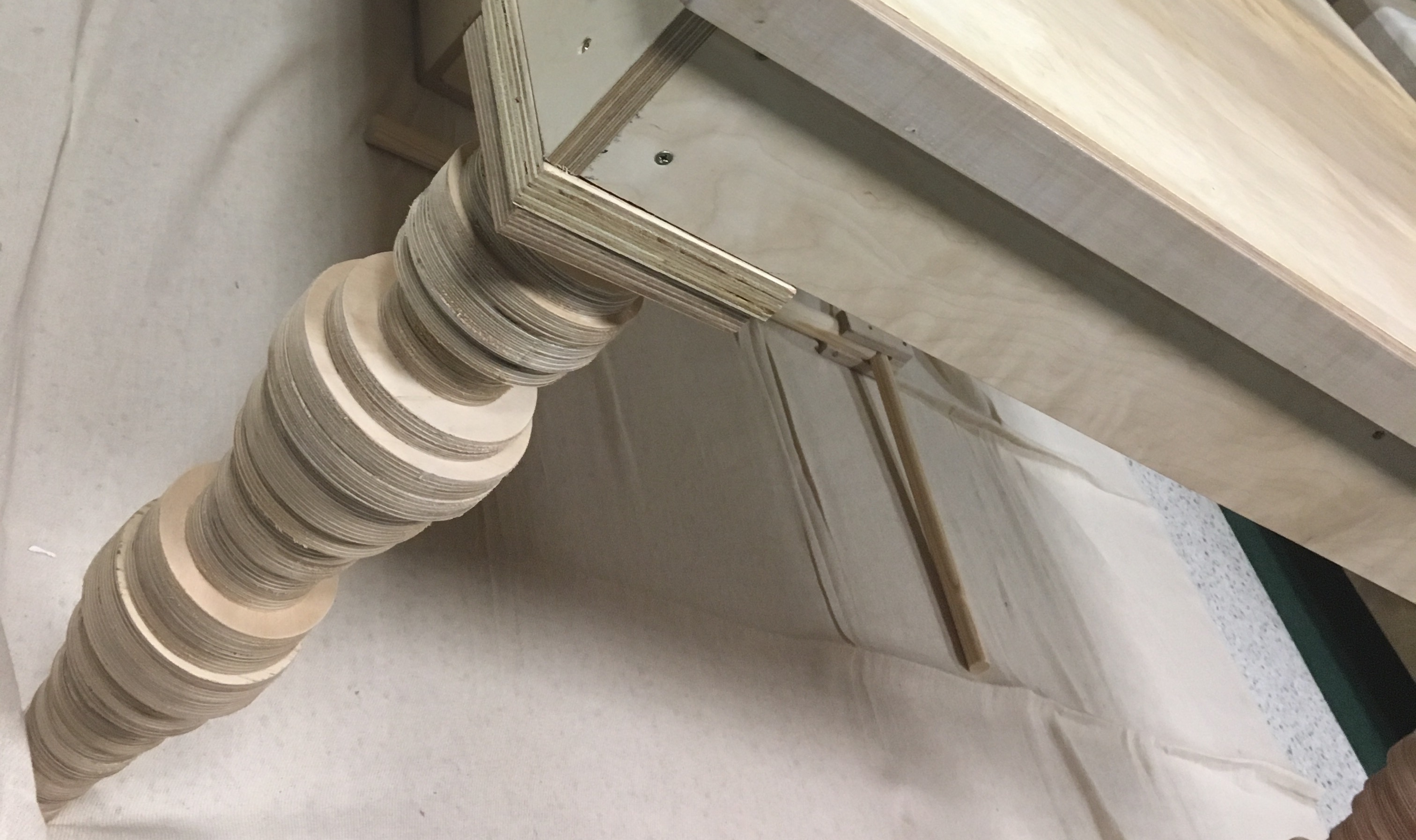
The table leg I was varnishing as I listened to Hilary Mantel seemed somehow a fitting metaphor for this process of making art that asks us to consider history.

With the appearance of a shapely, turned, Victorian table leg supporting a sturdy Victorian table, the proportions are right, but the materials are ‘wrong’. For this shapely table leg is not a piece of solid wood that has been turned in a lathe, it is a stack of machined circles of plywood that impersonates, and stands in for, a Victorian table leg.

The reconstruction of the material may not be completely ‘Believe this’ accurate (nor is it an alternative or supplementary truth), but its very existence helps us to visualise the historical table, offering us an opportunity to examine the table from different angles and in four dimensions, provoking fresh or unexpected views or insights, giving us something to think about.

It asks us to ‘Consider this.’ – to momentarily exist in both the past and the present – and then allows us to return and see, and to understand, our modern tables through slightly changed eyes.

Janet Vaughan, Talking Birds – 23.6.17

We belong to the city, and it belongs to us.

[This post was originally written for the blogs page of the Coventry City of Culture Trust website, supporting Coventry’s bid to be UK City of Culture in 2021]

I’ve been thinking a lot recently about what makes an individual put down roots in a place. I’ve tried to analyse what it was that made me settle here in Coventry – to understand why I am still here, and I’ve asked others what it was that made them decide to call somewhere home.

Continue reading

If you want to get a measure of a city, look at how it treats its young people…

IMG_9999I googled the title of this post as a quote, because I thought someone clever had previously coined it (or something similar). Google reckons Nelson Mandela and Michelle Obama have both said something along these lines and, I realise now, it also paraphrases Dumbledore on House Elves but, anyway, that’s a fairly major digression from what I actually wanted to write in this post, which was:

If you want to get a measure of a city, look at how it treats its emerging artists…

When Talking Birds was a young, emerging company (over 20 years ago – eek!), we always found it completely brilliant, if continually mystifying, when people gave us a bit of money towards devising a show, or offered us some space in a theatre (or tent or museum or geodesic dome) to put it in front of a paying audience. And then if people (especially people we didn’t know) came to see it, that was absolutely the icing on the cake*. There’s something about being offered a bit of money to make something, and a space to show what you’ve made, that gives you confidence in what you are doing (as well as, obviously, allowing you to get better at doing it). If you aren’t someone who makes things, you might find that hard to believe, but I think it holds true that most of us who make things are ever so slightly surprised and grateful when other people believe in us – because it’s often that belief that allows us to believe in ourselves, which allows us to keep working at it, and to get better.

Talking Birds, Theatre Absolute and others are living proof that Coventry has a noble history of treating its young people – its emerging artists – well. There are two really good examples of this coming up next week – and the real purpose of this post is to encourage you to give the young, emerging artists the boost of turning up and watching them perform. If that makes it sound like we’re saying you should patronise and indulge them, then you are either wilfully misunderstanding this post, or (more likely) we’ve just written it really badly. This is absolutely not meant to be about patronising anybody – a friendly, supportive audience will give the performers belief in themselves, yes, but in return for your attendance you’ll get to see some surprising, thought-provoking, committed, skilled, energetic (and energising) young people perform – and perhaps most importantly you’ll experience a fresh perspective on all kinds of things they put before you as you explore their ideas and see the world through their eyes.

Rise by the Belgrade Young Company – a kind of all-girl road movie (see pic above) – is on 13th-18th in B2 at the Belgrade Theatre and Shoot Festival showcases the best of Cov & Warwickshire’s emerging talent with a triple bill on the Friday evening in B2, and an ecelectic day of theatre and music at the Shop Front Theatre and in Shelton Square on Saturday 18th.

We highly recommend them all – treat yourself, and get in at the start of something.

*In the early 90s, Talking Birds was one of a number of young Coventry companies to benefit from the opportunity of a small annual commission from the Arts Alive Festival. These supported commissions encouraged us to learn through doing, forging deep bonds with the city – meaning that we are still making work in Coventry 25 years later and constantly looking for meaningful ways to pay that early investment forward.

Save

Save

Save

Save