Jazz Moreton reflects on her Nest Residency
Having graduated with First Class Honours in Fine Art from the University of Gloucestershire in 2017, I spent years finding my feet and doing little bits of (mainly unpaid) work in the arts. After moving back to Warwickshire, I began to network with artists in Coventry. When somebody mentioned the Nest residency in a meeting, I knew that I, as an artist with multiple disabilities, had to go for it!
My residency was jointly supported by Talking Birds, Coventry Artspace, Coventry Biennial, and Disability Arts Shropshire, and would lead to whatever my outcome might be being exhibited in Coventry Biennial of Contemporary Art 2019.
I proposed that I, as an artist who had never worked with or edited sound, would create a sound-based piece that showcased the abilities that people with disabilities have, in the face of a government, and a wider society, that discriminates against us in many ways (my bugbear since graduation was that people still often assumed that I was stupid due to my neurogenic stammer and dysarthric speech) and, after a nerve-wracking interview with a gatekeeper-esque panel of arts professionals (who, upon getting to know them throughout my residency, turned out to be some of the most delightful people I’ve had the chance to work with), I was thrilled to receive the news that I had been selected.
My piece, which I titled ‘Discursive Ability’ at the point when somebody asked me what it was called for an interim exhibition, was my first proper socially-engaged work. Making it involved me inviting people that I either knew personally or had found through networking to my studio or going to public venues, workplaces, and houses and recording one-to-one conversations about their experiences as people that have disabilities.
 I have lived with multiple disabilities caused by a ‘massive’ stroke when I was thirteen, and I have faced a huge amount of discrimination in most situations. However, it was easy to feel saddened, shocked, appalled by the discrimination- and even abuse- that other people told me, during our recorded conversations, that they had suffered, and do suffer, week in, week out, in Coventry. It is absolutely vital to remember that the issue of Disability Discrimination, inequality, and abuse exists in every locality across the country if not the world, and the sample of Coventry people that I selected were mostly not connected (apart from in the respect that they all knew me). It’s a bit sad that it takes an artist to start to talk about this, rather than world leaders, but there we are.
After recording a long series of fascinating conversations, I had the huge task of editing them onto one soundtrack (which took about ten times longer than holding all the conversations). Thankfully, Derek of Talking Birds is a sound-editing pro (amongst his other talents), and he was able to offer really useful advice, such as switching to a different piece of software (it’s lucky I’m a fast learner)!
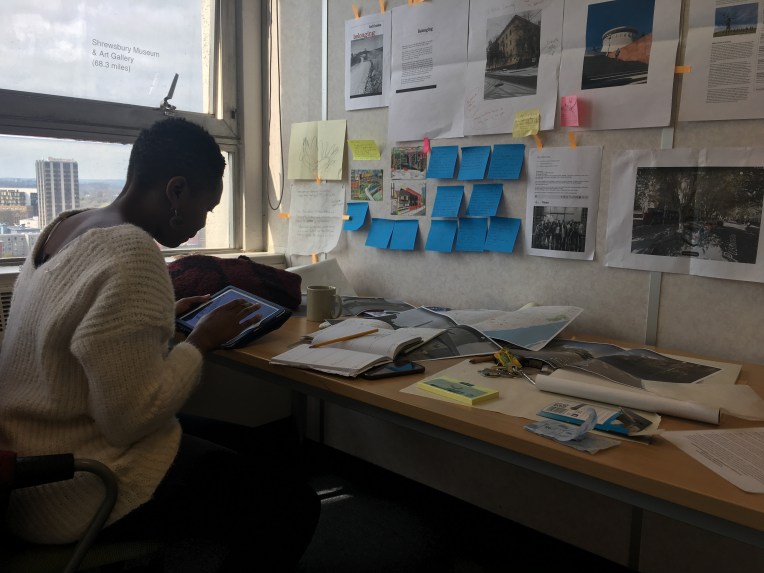
It was fantastic to have a studio space that I could use for up to eight hours a day (based on bus timetables) to edit in. At the time, I was living on a narrowboat and didn’t have facilities (or, in fact, electricity and broadband) to make any sort of digital work, so the Nest enabled me to work in a way that I otherwise would not have had the chance to.
I showed the final version of ‘Discursive Ability’ in Coventry Biennial of Contemporary Art, which was my first major exhibition. Having my audio work displayed in ‘the Row’ has led to other opportunities, and I am currently working on an engagement project for the Midlands Arts Centre, for which I was head-hunted after their curator heard the work that I made in residence during the exhibition.
I’ve also been working really hard on scoping out other opportunities, and I have one or two personal projects at quite a conceptual stage. All I can say is that I will be back!
Jazz Moreton (see Jazz’s AxisWeb profile here!)
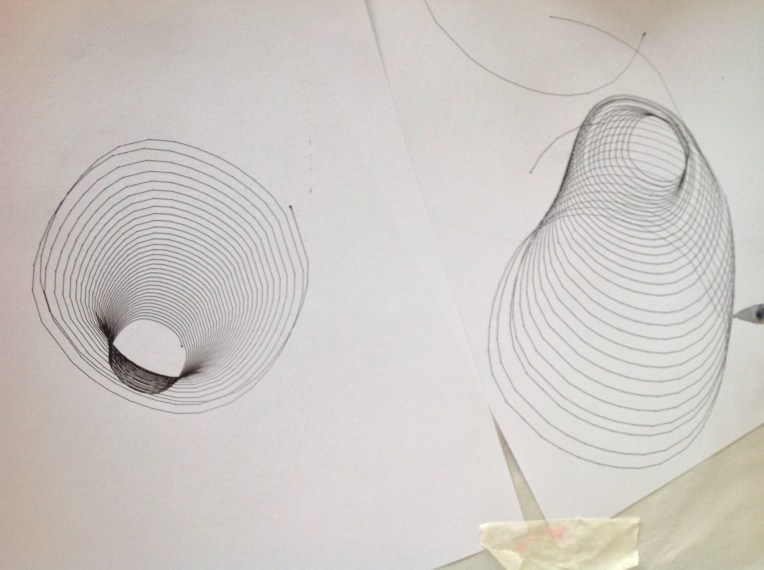
 For this second exhibition I changed the design to a sort of geometric flower that moved in a clockwise direction. I found that having a circular design benefitted the project as the pen was far less likely to travel beyond the limits of the plotter and therefore I didn’t have to keep stopping the program to reposition the pen, but also because moving in a repeated clockwise motion meant it was easier to spot variations in brainwaves. I continued to alter the design during the exhibition between visitors, changing the size and shapes slightly. I also found that there was a lot of variation between my brainwaves and brainwaves of participants, so on the third day of the exhibition I began to spend more time on calibration; I would set them up with the brain monitor, look at the programme for a while to see the values coming in from the EEG, so that I could figure out the range of their waves and adjust the programme accordingly.
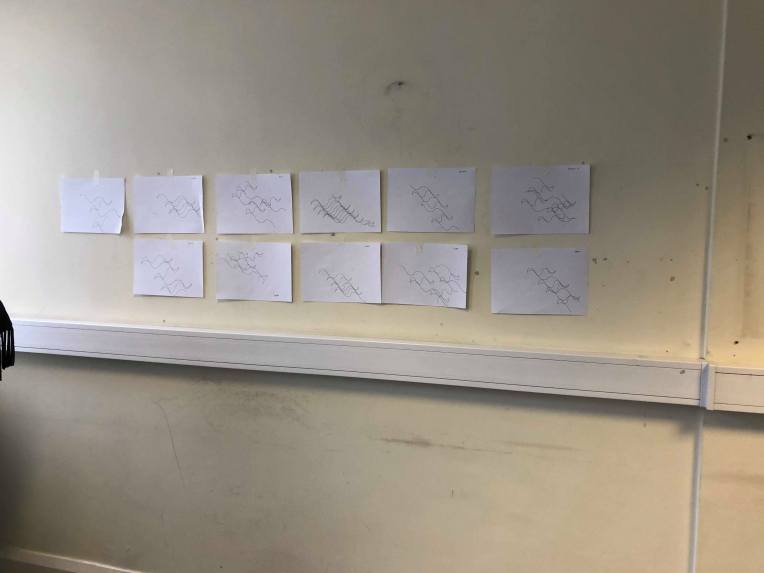
 For the next outing I would like to improve some of the technical aspects; I need to get used to the routine of calibrating and making sure I explain properly how to wear the brain monitor, as some people had difficulty fitting the headband and therefore there was a weak connection (and in one case, non-existent). I would possibly use better quality paper, and better pens. Sometimes the ink came out too light, partly because of bad quality pens, but also because I needed to adjust motor speed so that the pen was spending long enough in one spot for the ink to reach the page. I also need to work on getting the drawings more centered so that there is more consistency when comparing drawings. It was suggested that I pick shapes such as lines that are easy to compare as well, which is something I intend to work on throughout this year.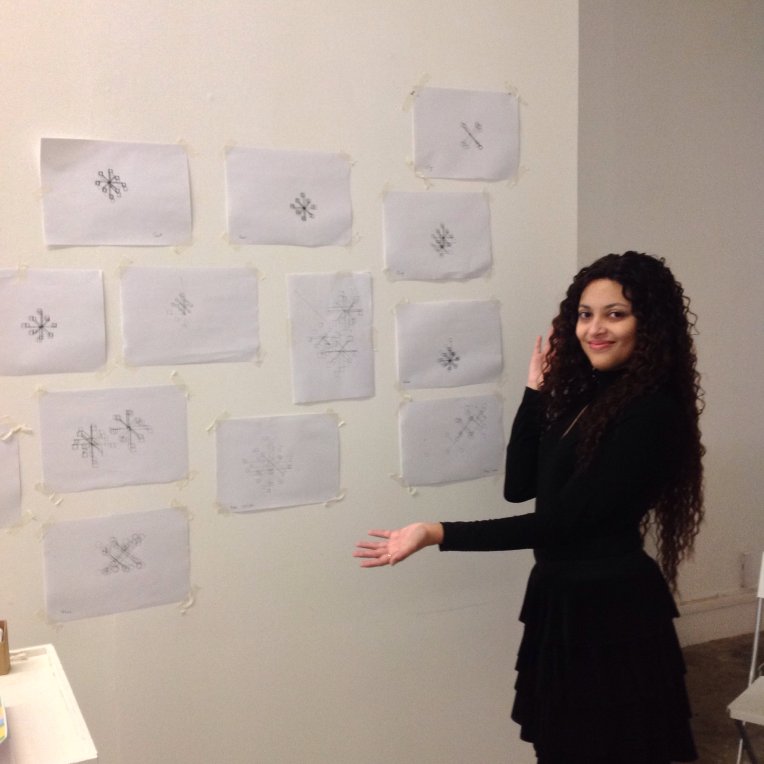








 Words from the Birds