It Takes a City has had a long fuse. It was first sparked over 15 years ago by a story I was told by Paul Duncombe, who was looking after the Belgrade Theatre on the night of the 12th of March 2008, when much of Coventry City Centre was evacuated, due to an unexploded 50kg WW2 German bomb, discovered by workers excavating the site behind the theatre that was to become Belgrade Plaza.
The Nest Residency gave me so much more than I had ever imagined it could. So this is not just about what I did but what I gained. Not just creatively but personally. I had never been given space like this before. It felt greedy. Privileged. It felt overwhelmingly scary. I felt guilt – taking up space when it could have been used for someone else. Especially as I felt like I was maybe tricky.
Jake Barrowcliffe reflects on his Hatching residency
As part of my residency at The Nest, I was required to write a blog post. For some reason, I decided that what I would do instead was write about my experiences as they happened. This has taken the form of a journal of sorts. Now, I will warn you immediately, I have never kept a diary before. I often find my day to day life so utterly boring that the idea of reliving the moment-by-moment banality while writing it down and then by reading it back years later is like a Kafka-esque nightmare to me. However, this details something unusual and out of the ordinary. I do hope, dear reader, that you find some use in what follows or, at least, some entertainment.
One morning in February, Lauren was doing her usual aimless morning scroll through instagram. As she was flicking past all of her cats with hats accounts and insta feminist quotes, she noticed that Talking Birds had made a call out for the Remix Residency at The Nest. She saw a huge variety of props in a picture and was drawn in immediately. There was something about that telephone, that explorers hat! The bucket and spade. It sparked off ideas which started to whirl through her brain, so she messaged Izzy and Ruth.
“I think we may have a shot at this!’
Fast forward to a week later in Gails Balham (a local haunt of ours) Ruth and Lauren discussed ideas that were stimulated from the picture. Coventry’s female and industrial history, the idea of legacy, what Coventry means to us. What would happen if we created a dystopian world filled with time travel, with women at the core? These were just a few topics that we indulged in. We knew we wanted movement at the heart, with small pieces of text to lead the story forwards. Pumped up from all of these tangible ideas, we set to work applying for it. Janet saw something in these mini moments we had created and would you believe it, we were accepted! Now the real work begins…
Before we knew it we arrived in Coventry for our first section of the Residency. It was a lovely sunny day in May. Lauren and Ruth entered the bright blue gates of Sandy Lane Business Park. We began our work in ‘The Space Of Possibilities’ room in The Nest. It was bright and spacious, with so much room for us to create. Within minutes we knew we would feel very comfortable in this space. It felt like our little home for the week.
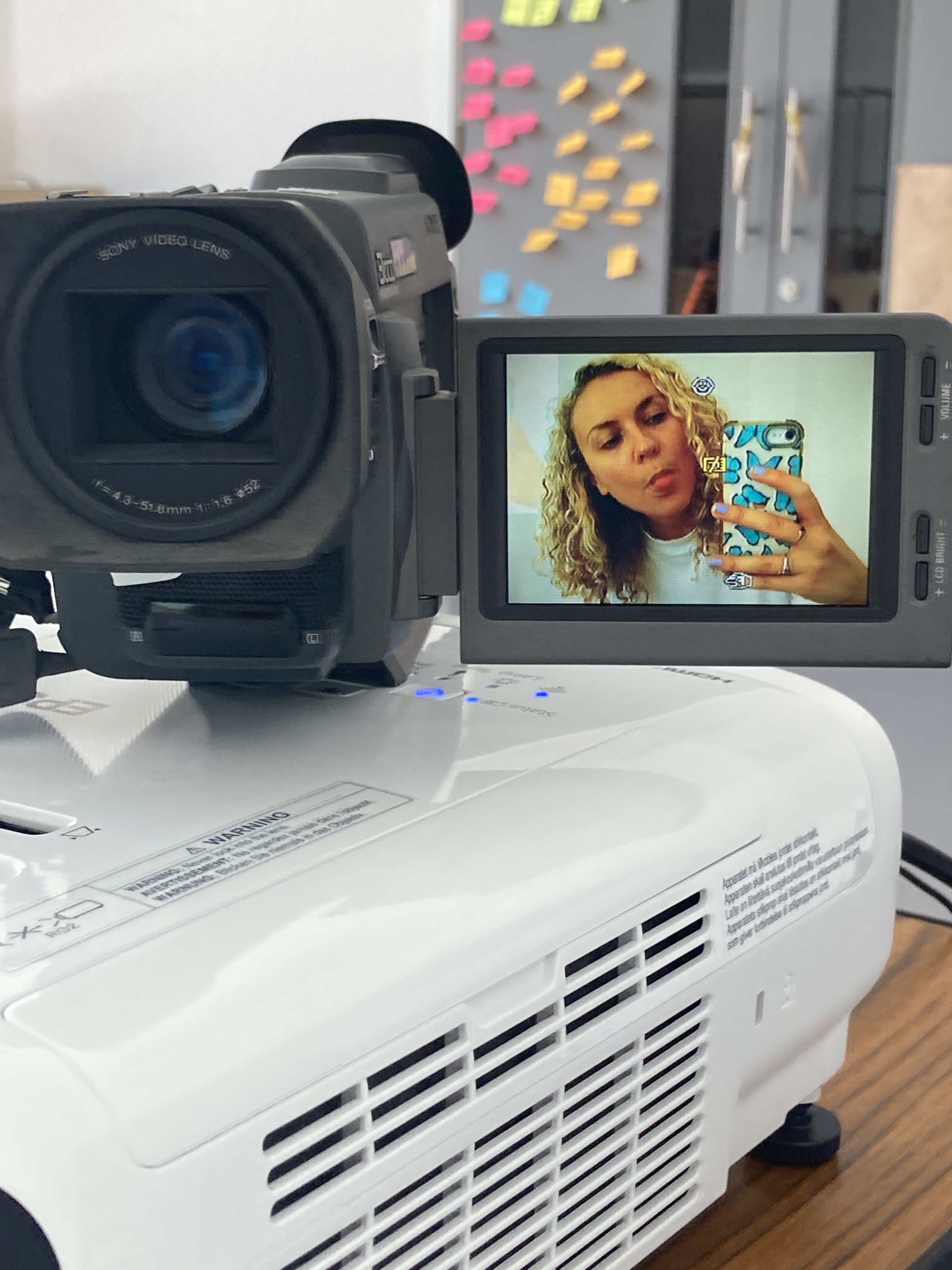
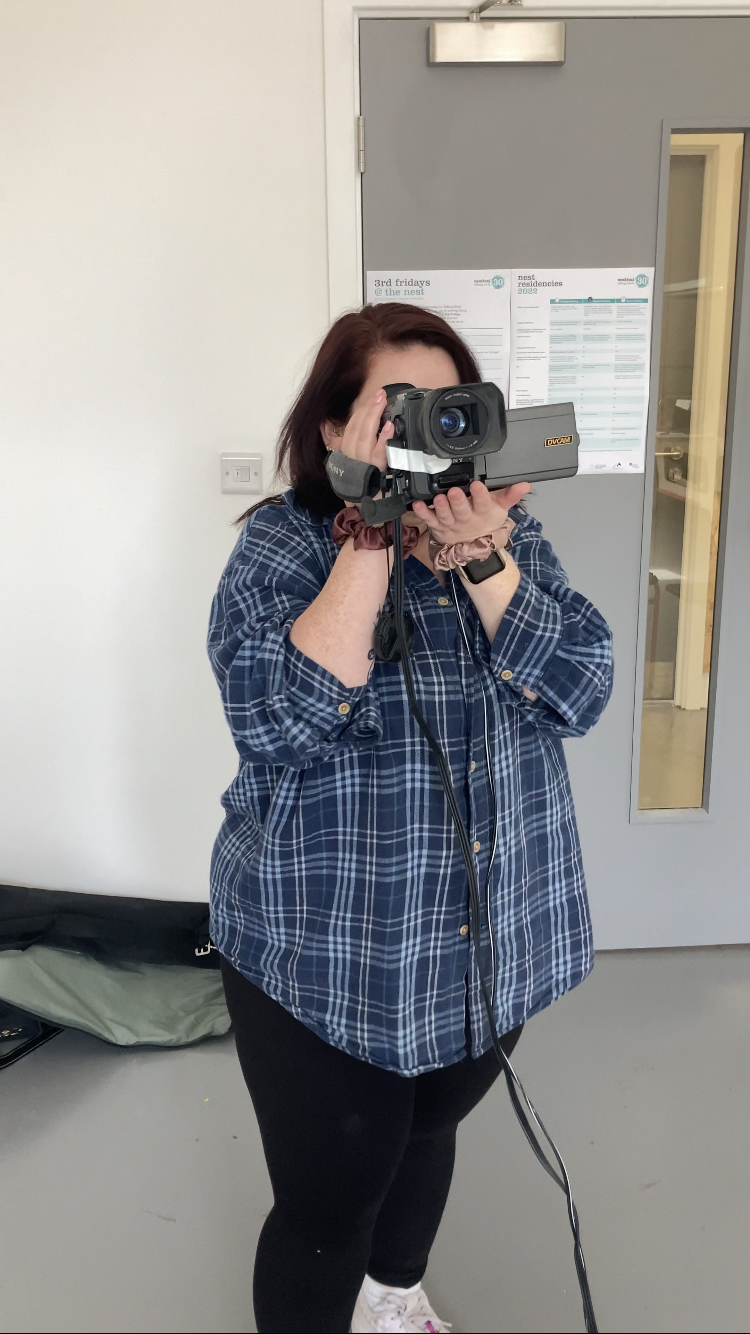
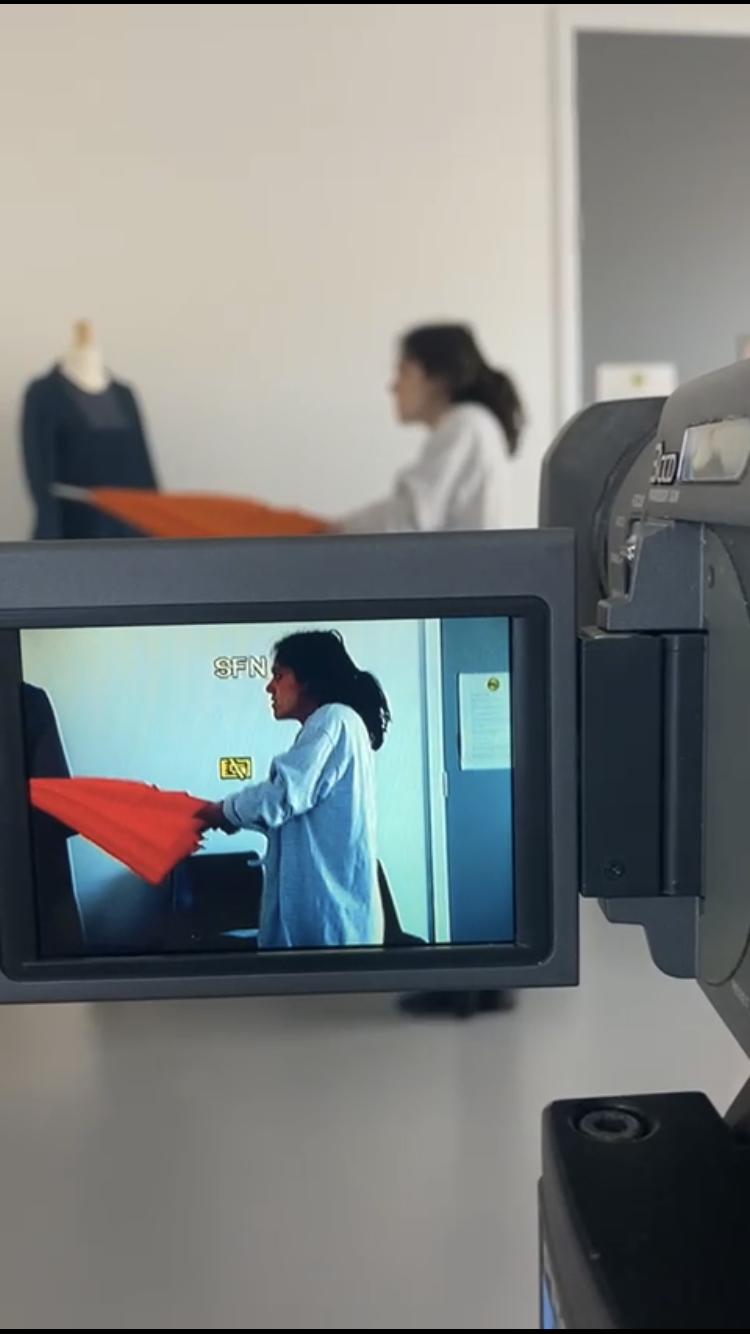
For the first week we just allowed ourselves to play (something which feels so rare in this industry!) The pressure was completely off, so we messed around with tech we’ve wanted to work with for years. Trying out different ways we can use projection, live camera feed and sound. It began to spark so many new ideas for what this project could be. We tested an idea (which came from the projection) about the audience’s perception. What would happen if we projected an image onto the umbrella, but behind it was something completely different? Or a different part of the story being told? We found a bit of magic in this idea, so we ran with it.
Our next stage was to figure out what story we wanted to create. We knew we wanted it to be about Women of Coventry and the stories that seem to be forgotten. We’ve all heard of Lady Godiva, but who else gets to be or should be just as iconic? And you know what, we just couldn’t think. We couldn’t think of any other woman who is allowed to be a figurehead like she is.
So we took to our laptops and began our research. Straight away a name popped up, a woman called Alice Arnold. The first ever female Mayor in England. We couldn’t believe it.
The more we researched her, the more we fell in love with her story. She felt so real to us. Even though she was born in 1880, Alice felt like a modern woman. With real hopes and dreams. Her progressive views and big dreams for gender equality, education and to end poverty just proves that she’s the kind of woman we’d love.
The next woman we researched was a little closer to home and more of a household name. Pauline Black. Visually recognised for her androgenous style, she was a woman we wanted to know more about. Hailed as the Queen of Ska, Pauline became an icon of her music genre. And of course, she is the lead singer of the band The Selecter. Black has also been an actress, with roles in films and television.
Our research came to an end when we found our third female story. Lisa Lashes. Known for being a hell raiser in the rave scene in the 90’s, Lisa was one of the first female DJ’s to break out of Coventry. We loved these women so much already.
We flung post-it notes on the walls of the room, scribbling down our findings and our ever growing questions. The room felt mighty. We were both fueled up with these stories. We played Lisa and Pauline’s music and filled the room with their words and beats. Messing around with movement and tech, we began to create a rough structure for the world we wanted to create.
In our second section of the residency, we introduced two ensemble members to the room. Julia and Sinéad. We wanted their role in this section to enhance our findings and embody some of our ideas further. Extra bodies in the room are always great for storytelling. Oh and for games. Grandma’s footsteps just doesn’t do itself justice with only two players. And we’re super competitive. (Ask Julia and Sinéad).
Over the next few days, we set to work discussing some themes we wanted to work with and some free writing tasks.
‘When I think of Coventry I think of…’ ‘A woman can be…’ ‘Home means to me…’ ‘To f*ck with form you have to…’
These were a few of our free writing starting points. From this, we began to create small pieces of movement involving the props given to us. We all chose two items from the prop box, a section of our writing and 8 movements to create mini pieces. We then watched and gave feedback on moments we’d love to push more. As Ruth is a Movement Director, she then cast her eye over the work we had made. Ruth pushed us for more ensemble moments and different ways Lauren, Julia and Sinéad could connect.
It was such an eye opening exercise. We really felt each other’s warmth in the room, as cliché as that is to say. Hearing different points of view on the city, on what it means to be a woman. It was lush.
Ruth and Lauren then put their heads together at the end of this phase to figure out how we wanted to tell this story. With some time in between, we allowed some dust to settle and to search for the core of it. Tuesday of our final week Ruth and Lauren looked back over bits of writing, videos and also came back to our key themes. And then a line from Sinéad’s free writing drifting into our memory.
“Dreaming alone isn’t enough”
By this point we had learnt so much about these women and we had celebrated their amazing triumphs. But it dawned on us, they’re the first women in their field. They’re singular.
To be honest we feel in history, and the systems that inform it, we often only allow one woman to be held up high and remembered. Like Lady Godiva on the horse “there is space for us all” so why do these women feel isolated? This pushed us to think about the arc of the show. What would happen if the camera and projection only showed one of the performers, not them all. Would it feel more invasive?
We had been playing with video and the camera throughout the process and we wanted to challenge ourselves as a company this week. To move past ‘it looks cool’ or it allows us to play with space. We always knew that the camera felt like it represented much more than just a piece of tech. So we decided to give it a role. We cast it as History.
These were pretty big ideas so we got stuck in practically, pulling together bits of our writing, research and improvisation to make a draft script that we worked on for the next day. Then, Izzy joined us! All of the ideas rattling around Ruth and Lauren’s brain finally had a fresh pair of eyes. Then it was about getting it up on its feet. Sculpting moments through improv, discussion, exercises and best of all collaboration.
On the last day of the residency, we shared our 20 minute piece with some of the Talking Birds team and community. We had a small Q&A at the end and got to hear what resonated, what people felt and thought.
This residency has allowed us to grow as a company. By meeting new people, involving collaborators and working with tech from the seed of an idea. But most of all, giving us the space and support to play. We have continued to learn about our methods as a company and as individual artists. All whilst keeping the core of SpeakUp shining bright at the centre of the work, amplifying untold stories.
We had such an absolute blast, thank you for having us, Talking Birds!
Holly Clark reflects on her 3 day remote Hatching Residency in Winter 2020
I am Holly, I am a theatre maker based in the West Midlands. I took part in a 3 day digital Nest residency. It was to explore a new solo show idea about being dyspraxic and neurodivergent. I knew I wanted to use movement in the piece (as it is known as the ‘clumsy syndrome’) to celebrate the way I move and also to highlight parts of dyspraxia and for it to be autobiographical.
My first talk with Janet about my piece, theatre, and about lockdown was so refreshing. As we know due to the pandemic, this was a rare experience to talk about art and ideas with someone new. I came away with inspiration and ideas and actually put in an Arts Council bid off the back of it. I also tried some ideas and thoughts we had created and discussed.
I then got really stuck. I found making and creating at home really uninspiring and the things I was making didn’t feel right or of any quality. I was getting in my head about it. I was regularly doing automatic writing and trying to imagine what the work could be.
The chats with Janet each time were encouraging and sparked new ideas. She gave me articles on how to reinvent the daily walks and focus on things other than the work in order to relieve the pressure. It worked. I let go and just tried to generate rather than analyse.
I actually got the Arts Council funding for an R&D for the piece. Those three days allowed me to have time and pay to do it. Even though work that was made didn’t go any further it laid the groundwork. The conversations with Janet helped spark ideas of what the piece has begun to be and helped shape it.
It was such a valuable experience to have the mentoring time and support. I encourage you to apply to be part of the programme.
I’m not sure what year it was, maybe 2015 or 2016, could even be earlier than that. I was living in Leicester, working part time at Tesco’s, when I went to a talk about this new software made by Talking Birds Theatre Company, that can give captioning in real time to theatre performances, straight to audience members’ phones; the Difference Engine.
Flash forward five or so years later, and I’m gearing up for my first tour (pandemic pending) of my first theatre show ‘Eugene’ which has the Difference Engine at the heart of it.
When I first found out about the Difference Engine, it was the idea of sending messages to audiences’ phones that grabbed me most: could these messages be secrets that the characters on stage don’t know about? Whilst at the same time captioning what the actors on stage are saying.
The creative possibilities were racing through my head. But the big one was the multiple channels, having different audiences receiving different things that could influence how different audience members see the show – and therefore with everything that happens on the stage being the same, individuals will be seeing the show through a different lens, without realising it. This goes hand in hand with making a piece of theatre for the d/Deaf community.
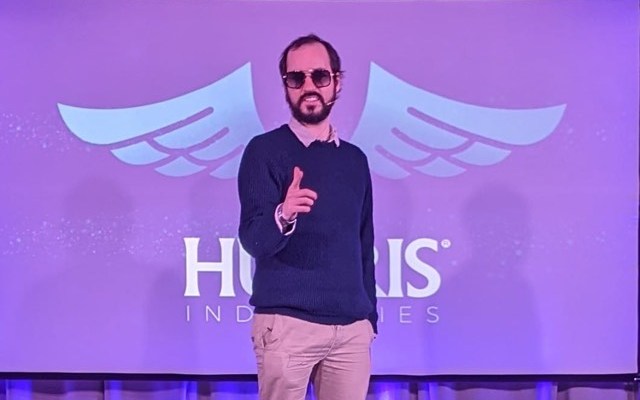
That has been the goal of my show Eugene, to give audiences different ways of seeing the same thing on stage at the same time. Eugene is about a millionaire Steve Jobs-esque figure launching the first super human A.I. It all takes place at a press conference/ product launch. And although Eugene the A.I. appears on a screen at the back of the stage, it also talks to audiences directly throughout. What messages they receive, however, depends on what option they selected on the Difference Engine at the start. The character on stage and the A.I. interact: it’s very much a 2 person show, but with one actor. It’s been difficult, don’t get me wrong, coming up with a script that works on multiple levels, and then inputting that into the Difference Engine. But I think the results (will be) worth it, when for the first time I have a show that’s accessible to d/Deaf audiences, where different audiences have a different experience at the same time: I’m happy to do the hard work, no question.
I think there’s a danger, sometimes, of tacking on accessibility to shows or products, it being thought of as an afterthought, or squeezed in when all the work is done – sometimes it just isn’t. But if I’ve learnt anything from this process, it is that by harnessing the resources that are there for accessibility, like the Difference Engine, something new and innovative can be created that can be enjoyed by many more people. And why wouldn’t you want to do that?
Today is the start of a journey that will culminate on the 7th & 8th of November at Stratford Civic Hall – show time for our new, musical take on the epic tale of Antony & Cleopatra (or Ant & Cleo as we prefer to call them). This episodic blog will keep you posted on our progress – because, as it was you that voted for Antony & Cleopatra – The Musical in The People’s Millions, we’d like you to come with us!
Peter Cann (Director), Nick Walker (writer/librettist) and me (Composer) are at Welcombe Hills School in Stratford, where we observe the school’s daily ritual – an energetic Shake Up ‘n’ Wake Up routine. This freeform bop to a funky soundtrack should surely be adopted around the globe as a caffeine substitute (or at least in lieu of that extra shot). It’s characteristic of this school – and many Special Educational Needs settings – that the approach to just about every aspect of school life is imaginative, playful and progressive.
The first 3 sessions are about getting to know our team – at Welcombe Hills, that’s about 30 pupils aged 9-11 with a variety of special needs – or rather, what’s more important to us, an astonishing amount of imaginative power and creative talent – and working out with them how we are going to tell the story. We have the bare bones of the narrative courtesy of Plutarch (source for Shakespeare’s version), but at this stage everything else is up for grabs.
Peter uses signing/actions to introduce the characters – what’s a good sign for Antony, the Roman Soldier? What’s a good sign for Egypt? Next: where might A & C arrange to meet? ‘Costa Coffee! A big music place ! A lighthouse!’ Then divide into Romans & Egyptians and find different ways of moving for each side. I provide some musical accompaniment – at this stage it’s all about improvising, unlocking and capturing ideas and me and Nick keep notes which will later be sifted and shaped into the script and score.
Every child will have their own way of contributing, some will readily be involved, for others it will be a more a gradual process – we rely on the close involvement of teachers and teaching assistants to help us overcome any communication barriers and start to find connections. One pupil really responds to what I’m playing on the piano and violin and together we come up with a little theme tune based on his name. I record this so I can use it next time.
In the afternoon we head to Bray’s School in Birmingham where we’re again given a warm welcome and see familiar faces of staff and students who were involved in our last opera epic Troy Story. [http://www.talkingbirds.co.uk/pages/troystory.asp]
We have a team of about 30 here too – again with a wide variety of special needs, but more importantly a full spectrum of wicked senses of humour. Here ‘Asda!’ is proposed as a good rendez-vous spot for the heroes. Everyone’s keen to do some singing – we unleash range of musical instruments and melodic and rhythmic ideas come from the floor for the words ‘Cle-o-pa-tra’ and ‘An-to-ny’. Composing can be exciting in solitude, but seldom as exciting as it is in a room of 40 people. Here it’s a team sport, and anyone can take the ball.
From the name-patterns emerge two longer musical phrases, to which Nick puts some words; then we string them together into an embryonic song. What we sing as the culmination of the session is work-in-progress and will evolve further, but the imprint of everyone in this room on the finished piece will be unmistakable. We’re off!
Derek Nisbet, Talking Birds
Be a friend of Ant & Cleo…
Keep updated on our progress by liking this blog. Follow us on Twitter @birdmail and @Orchestra_Swan
Nick (playing the Goose), Sam (playing the little match girl), Craig (playing Hans) and Derek (playing piano – bdumtish!) have been squirreled away this week in rehearsals for our hilarious-and-depressing-in-equal-measure festive extravaganza TREVOR GOOSE AND HIS DARK NIGHT OF LIGHTS! The rest of the band arrive soon, and then all we need (Thursday to Saturday) is you and your friends sat around the cabaret tables in EGO’s atmospheric New York garage style indie venue, supping cocktails and having snacks delivered to your table whilst enjoying a bit of “farcical yet strangely thought-provoking” (CET) festive entertainment – with a Danish-themed raffle thrown in for good measure. If you fancy going the whole hog, you’re welcome to come dressed to fit the monochrome Dr Caligari meets 60’s jazz club theme – click here for some inspiration…









 Words from the Birds