Leanne Moden reflects on her recent Nest Residency
At the end of April 2022, I spent a beautiful, sunny week in Coventry with Talking Birds, as part of their Hatching Residency.
I was really excited to work on a completely new idea – a one-person show based on my recent experiences of chronic illness – and the residency gave me the headspace to finally start the process of thinking about the project, rather than just thinking about thinking about it.
In 2021, I had a sudden and frightening period of ill-health, and the experience really showed me how invisible and chronic illnesses are often treated in the UK. I wanted to explore the highs and lows that come from navigating the world with a chronic condition, with a view to turning this into a piece of autobiographical theatre.
One of the things that struck me most about getting sick was how worried I became about ‘not being useful”. When I was incapacitated by my condition, all I thought about was how much time I was taking off work, and how inconvenient I was being to those around me. That made me think about the current societal narratives around productivity, usefulness, and community, in relation to illness and disability.
During my first couple of days on the residency, I did a lot of thinking, note-taking, and reading, and I wrote pages and pages of stream of consciousness narrative. At the end of each day, I worried that I hadn’t written enough, or used my time as wisely as I could. This was pretty ironic, given I was meant to be writing about productivity and rest! So, by Wednesday, I vowed to just go with the flow, and not get too het up about “being productive”.
As a result, I spent the final few days writing around the themes of the show, as well as plotting the story arc, thinking about how “Deal Or No Deal” might be the perfect metaphor for the Just World Hypothesis, and generally getting super excited about what I was writing.
I also found time to write a draft for a commissioned piece for an unrelated project, and I spent a day working through my current archive of poetry – finding stuff that I’d started but failed to finish, and earmarking it for editing in the summer.
It was almost as if the fear of not being productive was causing me not to be productive. It all felt a bit meta, truth be told! But actually, it was all grist for the mill, and I wouldn’t have found time to consider my own relationship with “feeling useful” if I hadn’t had the time/space afforded by the residency.
It was also really lovely to meet and chat with other creative people during the lunches, and these serendipitous conversations were super inspiring too. I’d like to extend a huge thanks to everyone at Talking Birds for such a lovely, welcoming, and creative experience. I hope it won’t be too long until my next residency!
melissandre varin reflects on their recent Nest Residency
i had my third residency with Talking Birds between the 7th and 18th of March – in-between spaces.
i had access to “Odyssey” studio space at the Nest, received £1000 financial support, and found comfort (once again) in a warm hug, a half-pronounced joke, an overdue catch up and a permission to be – me.
i ended up inhabiting the studio offered to me about 4-5 days across a 2 weeks residency, i never felt like i was feeling the space as i needed to. Was i avoiding the spaces i intended to investigate with this project? i guess that this question will stay in suspension. It is only at the last moment, last day of residency that i started to connect threads, bits and pieces of me in regards to this inavouée (undisclosed) feeling.
Where i needed to be was at linoleum dreams parked on the parking of the Nest.
But – i did not feel ready, in all the complexity of what being ready to re-visit an artwork i sweated in, dreamt in, loved in – could (have) mean(t).
i felt like avoiding, and accepting the fact that i came to this residency depleted for multiple reasons that i will keep silent in typed words but could expand on if you ever see me in the detour of a street, gallery, theatre.
– depleted – it is when i am most vulnerable to external forces. i felt the pressure to produce for the first time in a while at the beginning of the residency. But – returned to myself spiritually guided by (non)living ancestors. i paused on the fact, the need to have such pockets, portals, moments to come depleted, stay depleted – feel its wind of change and its static corners – without pressure to ‘sort it/myself out’. As an artist with mood swings, chronic depression, and care responsibilities – i never paused on the thought that maybe feeling whatever i am feeling, including depleted, did not have to be a feeling, space i needed to unknot but could – be – with/in.
Without performing Black joy, without performing Black queer trauma, without performing but being and trusting the fact that what was (not) happening was ok.
Sym and mel inside linoleum dreams, parked on the parking of the Daimler Power House, kindly supported by Talking Birds
i had pleasure though! Surrounded by beings i love and did not see in a while, taking time to share a cuppa, nurturing friendships learning about how/where Black queer artist friends grew up in in Dakar, Birmingham, Nairobi… working at Odyssey studio with a friend part of B.O.O.K (Building Our Own Knoweldge) working group, inspired by friend and collaborator Samiir Saunders i wrote the first version of my access rider (happy to share with anyone interested) – i got to know about myself and share it to the world.
Ok now that i am starting to list things it actually sounds like it was 2 full wholesome weeks. But i want to highlight the reality that these were interrupted with times when i had to cancel my days as i felt the need to stay still – i must admit that i spent a whole day watching Love Is Blind season 1 and 2 as well (learnt so much!)… . Also learnt a lot navigating the British Arts Show in Wolverhampton as part of a day trip investigating this aching research question: how do we create loving environments? (perspectives from Black queer artworkers who grew up on the African continent and in the EU/UK-based diaspora) –
this residency has been transformative – quite in line with most of Talking Birds’ work. as i am ending this annotation on the residency, i would like to share my love for the being making this organisation – a warm womb i (re)turn to while excited, on a high, depleted, lost ….-
Talking Birds, and its residencies programme is an essential example of what mothering could mean when it comes to the arts sector.
More on this slow-birth-ing creature i am working on or that is working within me in due course.
here is a snippet of a tentacle of this thingy that works and mixes my within for almost a year:
i would like to have conversations with members of my chosen family (mainly (Black) queer artworkers) this time and compile the transcripts of them – both work will inform a multi-language performance and multi-sensory installation i feel the impulse to make. With this project that lives in my heart i have the desire to investigate how senses of aesthetics, of what is art and what is not – are formed and informed by the built environment/ interior design/ furniture/ type of flooring / wall-paper and so on – we grew up in? How can this inform the creation of loving environments in the arts (too)? How can we create loving environments? Dissecting these questions by looking back at our immediate roots and acknowledging the power of ‘things’ in contributing in making us who we are now – i am currently thinking of expanding my understanding of my vibrant materialist approach.
As a dear being sent me on a low a couple of months ago: Octavia E Butler’s assertion in Parable of the Talents, “To survive let the past teach us”
These words will definitely find home on my skin through ink asap.
Let me take you back through time – to the evening of 31st October, 2020. Picture the scene: I’m working night shift, and the news comes through on the radio. The country is, once again, going into lockdown, which means I won’t be able to come into work for the next month or so. This was obviously not a good thing for many reasons, and yet I couldn’t help but be relieved at the idea of having several weeks of time at home to do whatever I wanted. Because an idea I’d been playing with had latched onto my brain, and it wasn’t going to let me go until I got it out.
That idea? An electronic concept album called Once Upon Two Times, which I did end up completing over the November lockdown. However, the idea did not let me go. In fact, if anything, it only grew after I completed the album, gradually getting wildly out of hand. Within a few months, I decided that the story had outgrown the original album, and that the format was actually constricting it – it needed to be something bigger, something different.
So, naturally, I decided that I needed to rewrite the entire thing as a stage musical.
This is no simple feat, as I’m sure you can imagine. I’ve never written a script before, but I do have a lot of determination, and once an idea has latched onto me, I find it very difficult to shake. In addition to that, this project very quickly became something that was important to me – as it grew, I realised that the story wasn’t just about what it seemed on the surface – about Time itself – but also something much more personal. It had become a story that wanted to be told. And even though I was very aware I was in well over my head, I was going to do something about telling it.
The most difficult thing, ironically, was time. Or, rather, finding the time to actually sit down and write. As a creative, I can struggle to settle sometimes, flitting around between projects, unless I have a dedicated time and space to focus my attention entirely on one thing. And so, when a good friend of mine suggested applying for an artist residency with Talking Birds, I was immediately excited. A designated time and space to work on this project? And be able to talk to people who are more experienced in performing arts and get advice? It sounded like just what I needed, the first step towards turning this idea into something tangible and real – and so, when my application was successful, I was absolutely ecstatic.
The residency was definitely a first for me – I’ve never experienced anything quite like it. For so long, I’ve been used to working on creative projects in between the things I’m supposed to be doing – keeping these things I enjoy contained within moments of procrastination or snatched seconds of free time. And so, to have my own dedicated space – and a lovely one, at that – where I was not only allowed to work on this project the whole time, but in fact that was what I was specifically there to do…it was almost overwhelming! I was extremely worried I was going to end up floundering or hitting a brick wall, and ending up wasting the whole two weeks. For my very first day, I came up with a plan to try and stave this off – I was going to map out the entire musical, on the wall, with post-it notes. If I was going to have access to a blank wall that was big enough, then I was going to use it! But it was also something visual and practical, which meant that I could step back and see the bigger picture and spot the gaps that needed to be filled. This ended up being incredibly helpful for letting the project solidify into something tangible – because suddenly this wasn’t just something in my head. It was something I could see and touch. That other people could see and touch.
I was off to a good start – and for the first few days, I spent hours poring over the basic elements of the musical. I took the story apart at a base level, figuring out what it was trying to say. It was like archaeology – this thing already existed, and it was up to me to unearth it. I’d just needed the time to scrape away at it until it became clear, and this residency was finally giving me that time. From there, I was able to build on it. I discovered I could break down the main message of the story into four key themes – Identity, Scars, Stories and Choices – which was a really valuable step to take, because then it made me focus on those themes in pretty much everything I did from that point, weaving it into the songs and the dialogue, and even the characterisation. It gave the story a much more solid grounding and made it feel a lot more structured, as well as really helping me flesh it out. The gaps that I had seen on my post-it wall were starting to be disappear. New ideas were coming easily – the whole thing just kept growing. Now that I had defined its edges, the rest was starting to fill itself in.
But then, about part way through the first week, I hit a snag. I wasn’t sure where to go next. I knew I needed to start on the script, but I didn’t know how to start, or whether I was ready. And there was also this strange pressure that I was putting on myself – a sense that because I was here to work on this project, I needed to be working all the time. Each day, I felt, I needed to produce something. To have evidence of the project moving forward, to prove that I was constantly creating. That I couldn’t just sit and ponder things – even though, on some level, I knew that I needed to allow things to settle in my mind.
Luckily, something came to my aid – one of the lovely things about working at Talking Birds is that everyone is encouraged to have lunch at around about the same time, in a shared communal space. It’s a lovely opportunity to talk about what people are working on and express creative woes. In particular, it was great for me since another artist had begun her residency at the same time as me – another autistic artist who, funnily enough, was also working on a project relating to time. We ended up talking a lot over lunch, and poking our heads into each other’s studio spaces to chat for a little while and get a sense of what the other was doing, even though our art forms were very different. We discovered that we were both feeling that same pressure on ourselves – that we constantly had to be creating, constantly working. That there was a sense of time running out, and that if we weren’t using every second of it, then we were doing something wrong. Together, we came to realise that maybe we needed to think about it differently – that this residency, this time, was for us to use as we needed to, how we liked. And if we needed to pause, to stop, to let things figure themselves out for a little while…then that was completely fine. It was part of the process. And once I’d realised that – once I let myself take my foot off the gas, and didn’t pressure myself in the same way – everything began to flow again.
Chatting with more experienced artists over lunch also helped a lot in figuring out how to approach the thing I was most worried about – the script itself. It was frustrating, because by this point, I knew exactly what the story needed to do, and what needed to happen – I had all the post-it notes to prove it! – and I just needed to get it written down. But I didn’t know where to start. I got to the point where I knew I needed to begin working on it, or I never would. I expressed this over lunch, and got a lot of encouragement to start in a place where I felt more confident – that I didn’t need to do anything in a logical or sensible order, just do something that would get me started, and go from there. I ended up deciding to try writing a key scene in prose first, before converting it into a script. This ended up working really well to get me started, and then as I transferred the scene over, I realised that I was changing things as I worked, making it fit the style of a script better. From there, I was able to continue the rest of the scene writing it straight into a script, and the whole thing began to come into its own. I realised what I needed and how I needed to approach it, which enabled me to go all the way back to the beginning and start from the top. I ended up writing out little notes of all the key points of the story – a tip from the composer next door, who was doing the same to work out his new piece – and started working through them one by one. This really helped focus myself because it allowed me to see where I was going – but, at the same time, it was flexible too, because I could switch the order of the key points around as and when I needed.
The residency was also such a brilliant source of inspiration – I suddenly found myself having to explain this strange and weird project to other people! And it was so fascinating to see other people’s responses to it, especially as other artists, which inspired me in turn. I started asking myself questions I hadn’t thought about before – thinking about how the story might look on a stage, and how you could be creative with that in ways I hadn’t considered. It made me think about how costumes and set could be used to tell the story and show the central themes just as much as the words and the music. I knew that, at this point, I didn’t need to know all the fine details about how this thing might eventually look – all those decisions will be made by directors and designers one day, I hope! But it did affect how I approached writing the scenes, changing how I thought about how the story could be told. And, as a result, it made the work I did all the richer.
By the end of the residency, I had completed the first half of Act One – about a quarter of the entire thing. I consider this a huge achievement, much better than I had dared to hope when starting. I’d been so worried that I would be too scared to actually sit down and write – that I would end up wasting time or staring at the walls. But, after learning that sometimes you need to stare at those walls a little while, I managed to put pen to paper (or, rather, fingertips to keys) and start to bring this story to life. To begin the process of turning it into something that, hopefully, will mean as much to other people as it does to me.
A dedicated studio space is a truly wonderful thing, perilously so … demanding inordinate ounceage of self-discipline, for wont of losing all sense of time, space and ‘other’. Fortunately there is a clock on the wall in Helloland with a fully operational acid battery. Life exudes paradox; compromises, contradictions, imperfections … there’s always room for error, improvement, mistake-making, potential for allowance of some slack. Everything remains where you left it in the dedicated studio space, pretty much just as your yesterdaySelf thought you left it. I’d forgotten this was even possible. The turnover on our dining room table revolves around the minute and second hand.
Like the of confines of A1 cartridge, facing-off the resistant bounce of board and easel, brittle charcoal, graphite, chalk stick and Stop-Clock of the lifedrawing room; anything is possible within certain parameters. Parameters to push against, adhere to, depend upon, agree, disagree, debate, request, contest, accept or change. The potential to perform, under pressure, against the clock, in the moment. Sometimes, nothing worth keeping. Always something to build on – to take forward. A dedicated studio space offers back-to-back moments (a full packet, the whole cake …). How to set one’s own internal parameters when you’re adrift, casting off ‘in the space’ ?
Thankfully, there is always someone elsewhere, ready to pull you out (ready or not) – School Run usually (“time at the bar”).
What an utterly joyous opportunity.
The last time I experienced creative practice within a dedicated studio space was as Fine Art undergraduate sharing messy spaces last millennium, in the early nineteen nineties (before the rise of Edit/Undo). The liberation of free construction in a wide open space had been a distant memory. A Room of One’s Own, indeed, even for the short term, resonates deeply within the psyche; worthy becomes the practice, practitioner and the work.
Now changed with responsibilities, technologies and disabilities involving long term mobility issues, hearing issues and more recently, permanent loss of central vision in what was a dominant eye. Initially truly debilitating for a lifetime photographer and visual artist. Not so for the lifelong experiential learner and stubborn optimist experiencing first-hand the wonders of neuro-plasticity, renegotiating spatial depth and relational proximity.
For the Nest Future Ecologies residency I set out to explore something of the psychology of behaviour … through the medium of interactive art; the potential for change [within ever-pressing Climate Change]. I planned to develop a tug, push-pull mechanism that might demonstrate modes of action; lone, collective and sustained interaction with audio-visual triggers and responses. I wanted all of this to be powered by dynamo, demonstrably off-grid (turns out Coldplay had the same idea, recruiting cyclists to power ostentatious gigs). I had it all mapped out. I knew what I wanted to achieve. I needed to gather a team of skilled engineers and soldering experts. All I had to do was bring them onboard and start experimenting as fast as possible, in this dedicated space. I could work on certain parts myself in the meantime, and start bringing it all together.
Things do indeed take longer than you first think, even though you already know that. I set about ‘cutting back’, editing; the process of removal, decluttering, identifying achievable chunks … reducing on a slow simmer, getting closer to the essence of it. Equally, within a day I started achieving more than even I could have listed on both sides of one envelope. There were also days of unprecedented setbacks, including opening an errant email by mistake and consequently losing access to a decade of emails and having to spend several days on the phone troubleshooting to get back to near ground zero. How many steps, which way?
I decided to slow down. As method in itself. I slowed down.
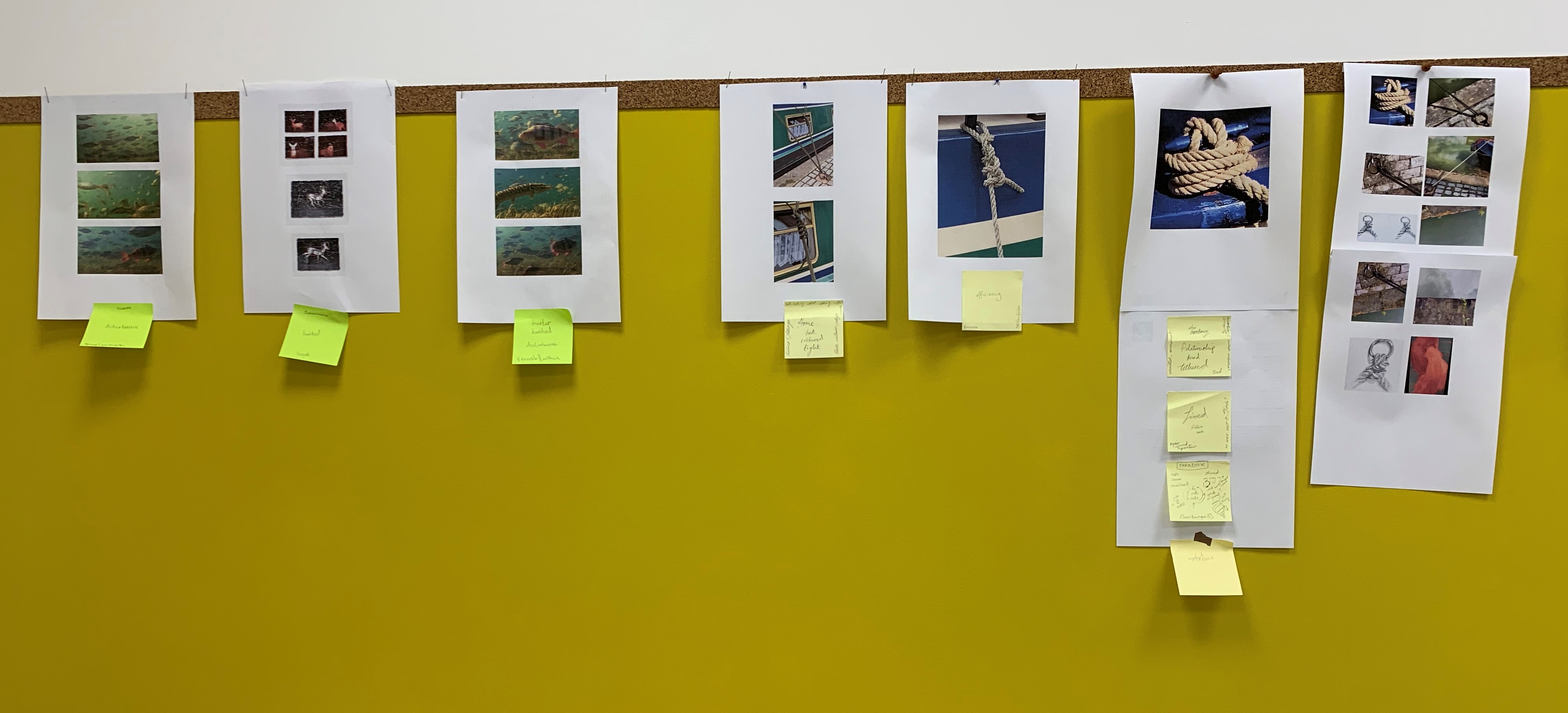
I looked, observing what I had, what was going on … and I listened to the work (I could see it, spread about me, pinned aloft, reshuffled, handwritten notes, building/ collating narratives, pegged to a line, rearranged, reviewed, removed decisively – having lived with it a while, having stood back – a change of perspective, being able to return to it after a break). That is when I started to play (and really enjoy discovering) – when I caught myself chastising myself for not keeping to what I’d set out to do on today’s Studio Diary entry – and realised over the following weeks, that those side-tracks were the deeper explorations of what was stirring within these ideas – they were already present, within – they are the sketches that stuck – the new dawnings of connection-making – that freely flowed when I ‘let go’ – that I presented – that formed significant particles in the unfolding narrative told.
I continue to observe how I operate and look forward to returning to the dedicated space.
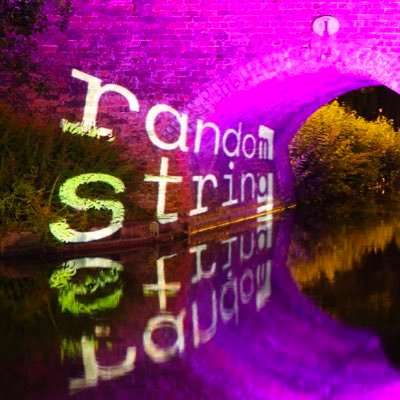
One more thing … I am overwhelmed by the breadth and depth of public engagement with the work in progress that I shared for Random String; 2021. I thought I had printed (sustainably) a surplus of short, open questions;
What do you think might be happening in each of the 3 parts of the video? What do they mean to you?
How does the video make you feel? What feelings or thoughts does it bring to mind?
What do you think should or might happen to get from one part to the next (to move from one phase or state to the next)?
What else could happen?
Every sheet returned, spilling with glorious handwriting; the creative imagination of so many different people who each stayed the full 5 minutes and absorbed the 3 parts – some longer, engaging in the repeat, the loop, the cycle – the spoken and unspoken shared conversation.
The work takes on a life of its own when others see meaning and make their own connections; it begins to make ripples. Moving beyond the self of artist practitioner, if successful, art resonates with others. My task now is to harness what resonates and steer with integrity, more clearly able to actively listen to the work itself, in relation, with others.
A genuine, humble “thank you” to Talking Birds, Ludic Rooms, Arts Council England, the City of Culture Trust and all supporting partnerships in providing generous opportunity for artists in Coventry to develop creative practice in a dedicated studio space with opportunities for conversation, professional development, social connection as well as paid opportunity to exhibit work in progress, without pressure.
Talking Birds’ Nest Residencies are open to any Midlands-based solo or small company of artists (in pretty much any artistic discipline) and will prioritise d/Deaf, disabled and/or neurodivergent artists that apply. – find out more, including how to apply, here.
I came to the Nest residency with an artistic practice that has been through a lot to find its current medium. I feel my art has always been harnessed around a need to decode and observe, flip and reflect back a version of life’s archetypal pains through my own lens in an attempt to reckon with it. However, it wasn’t until I ‘found’ more abstract visual forms that I felt I had the means to express the experiences that I couldn’t translate into a linear narrative.
I was no longer aiming for a recognisable form to anyone but myself. Sensory | Emotional | Abstraction. I was starting to sit with the pain and joys of a late-in-life diagnosis of ASD and slowly unpacking the years of seemingly anomalous perception now rooted in a context that made sense. It was around this time I became acutely aware of how disconnected from nature I had become during my landlocked years in Coventry, and began to make a concerted effort to return to what had been my home from home in my childhood of the great outdoors.
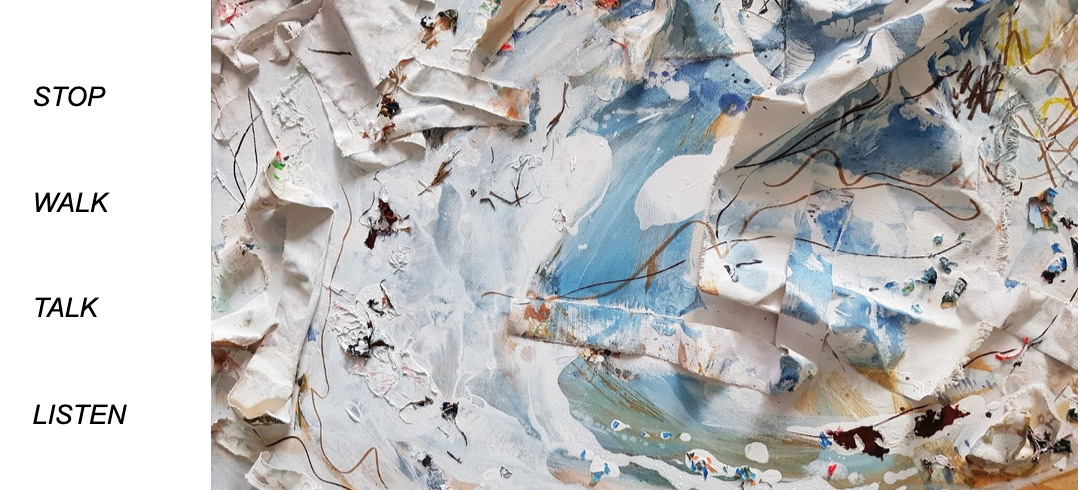
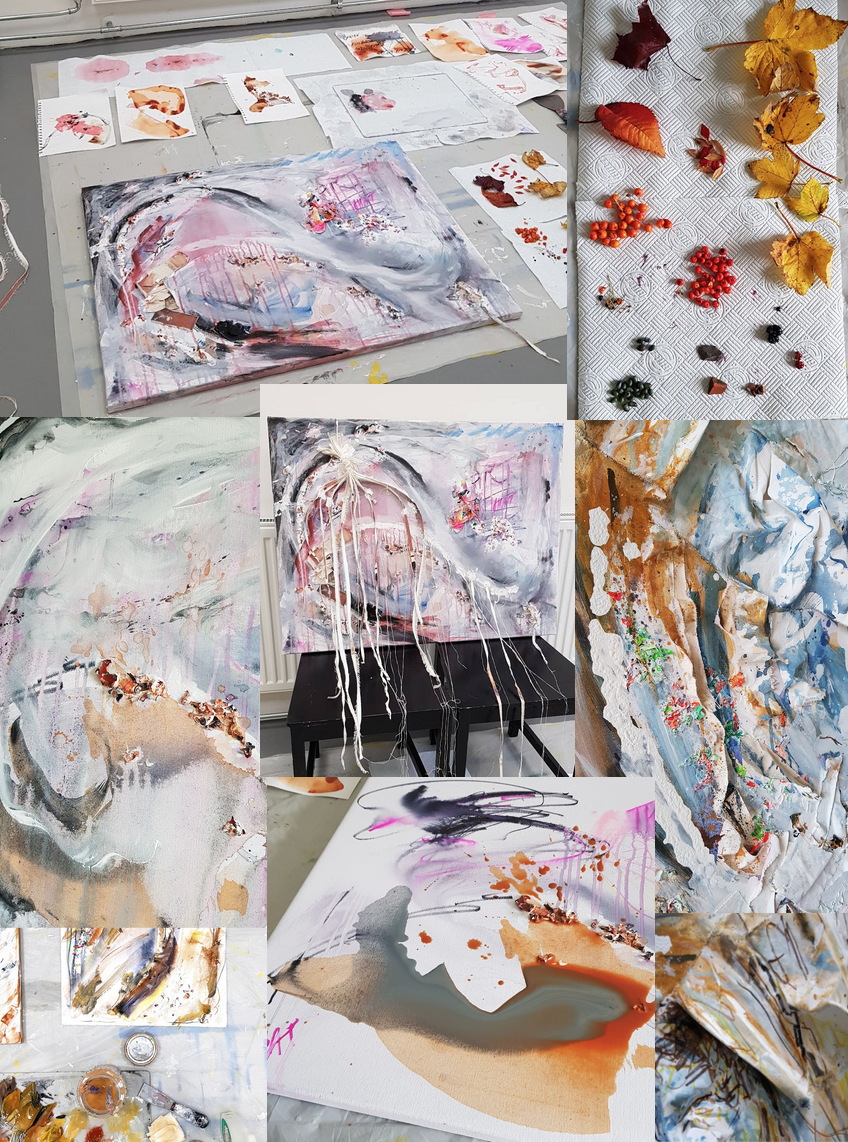
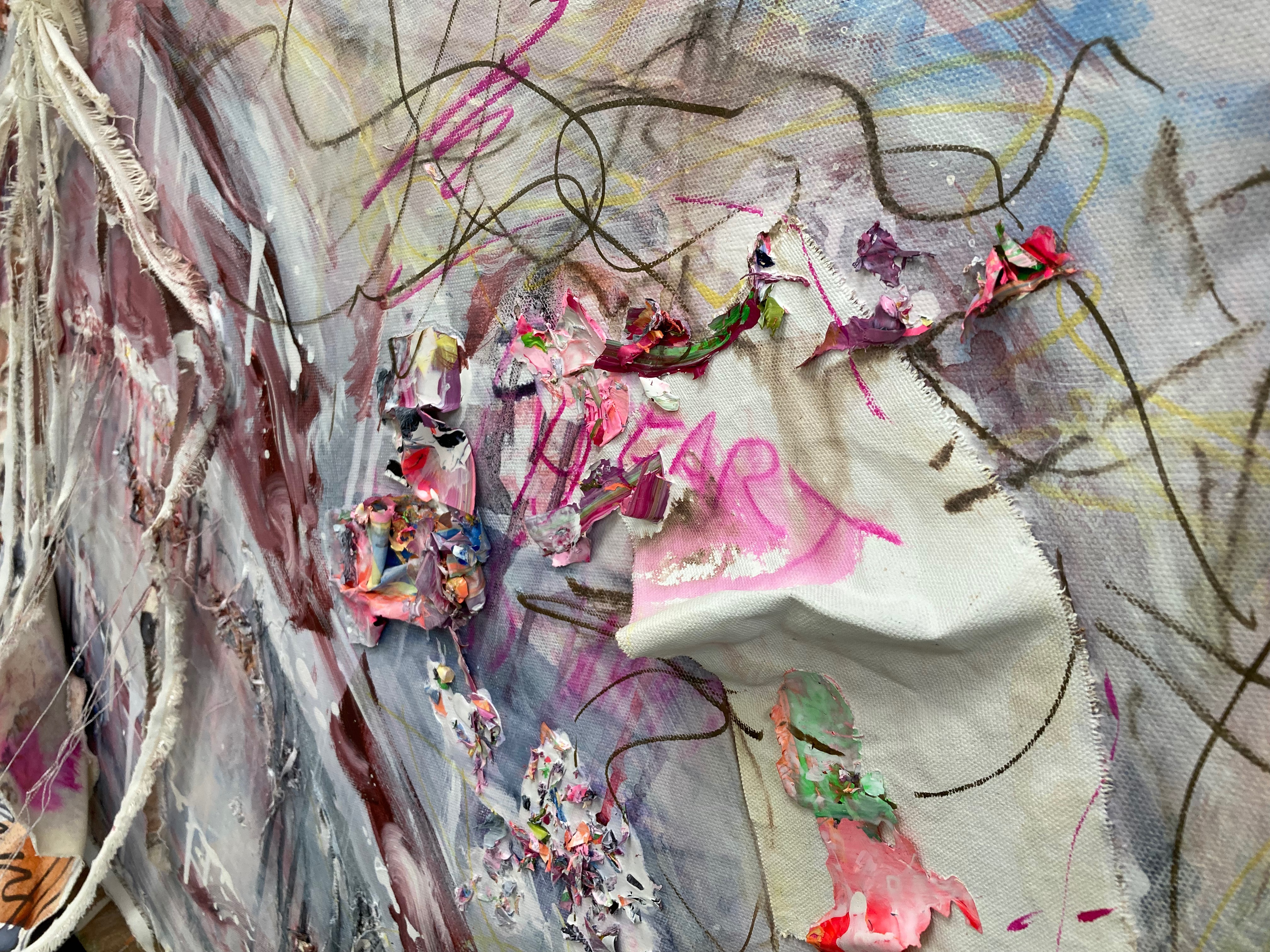
I was finding a lot of peace and therapeutic benefits in nature bathing and beginning to form loose notions of taking natural pigments found during such moments in nature, as sort of talismans, and using them to process some of the emotions I’m trying to put on canvas. Alongside this I was becoming increasingly concerned by the sustainability of my painting process and began to toy with incorporating waste such as canvas offcuts and old paint scrapings from my palette into textures on new works.
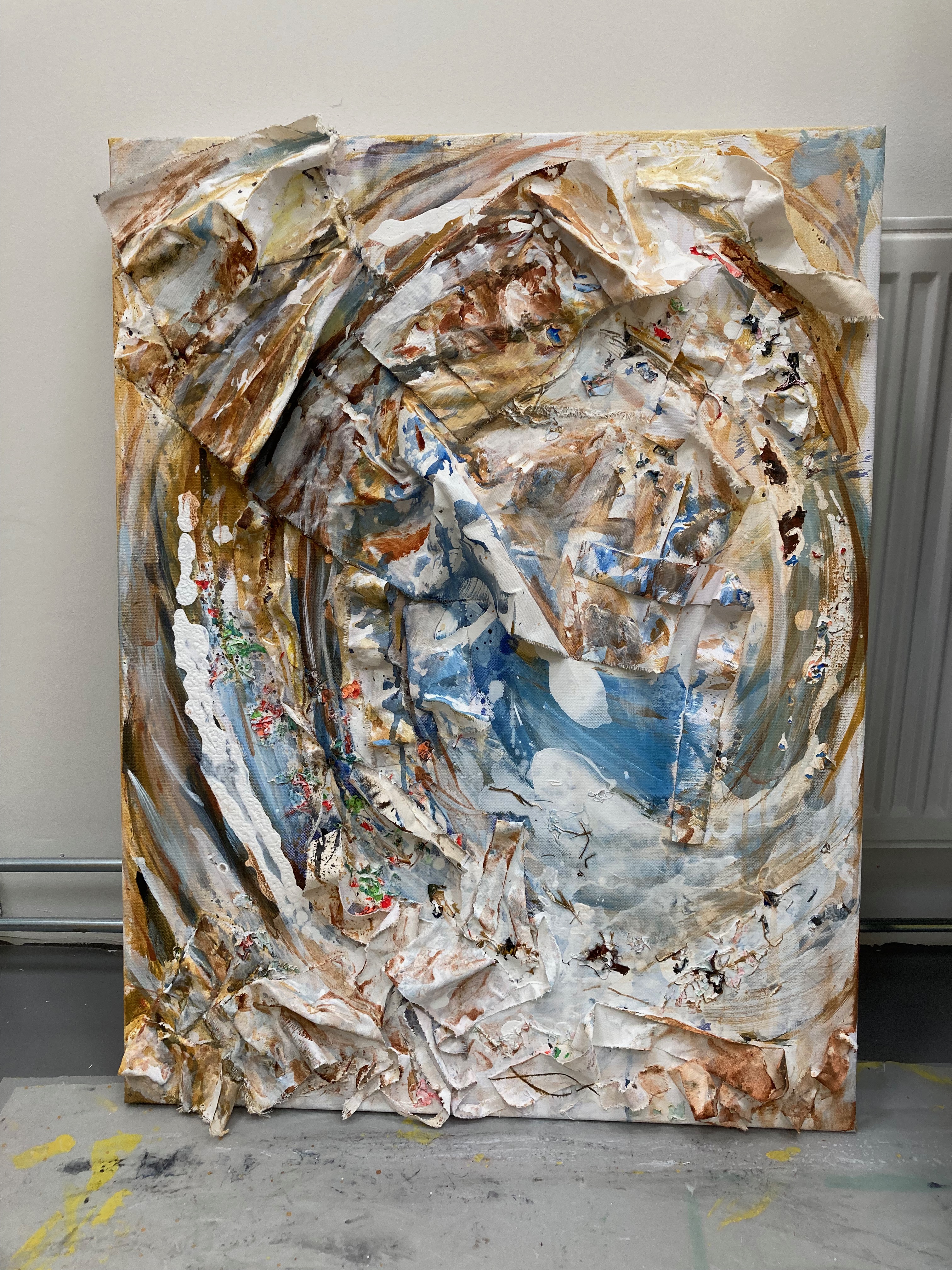
As a result I craved time and space to really play with those ideas free from the usual financial restraints that come with maintaining an artistic practice that is still developing. I applied for a Nest residency proposing to experiment with recycling painting waste into new works and using these textures to really explore mark making and layering. Talking Birds were kind enough to provide me some time, space and conversation.
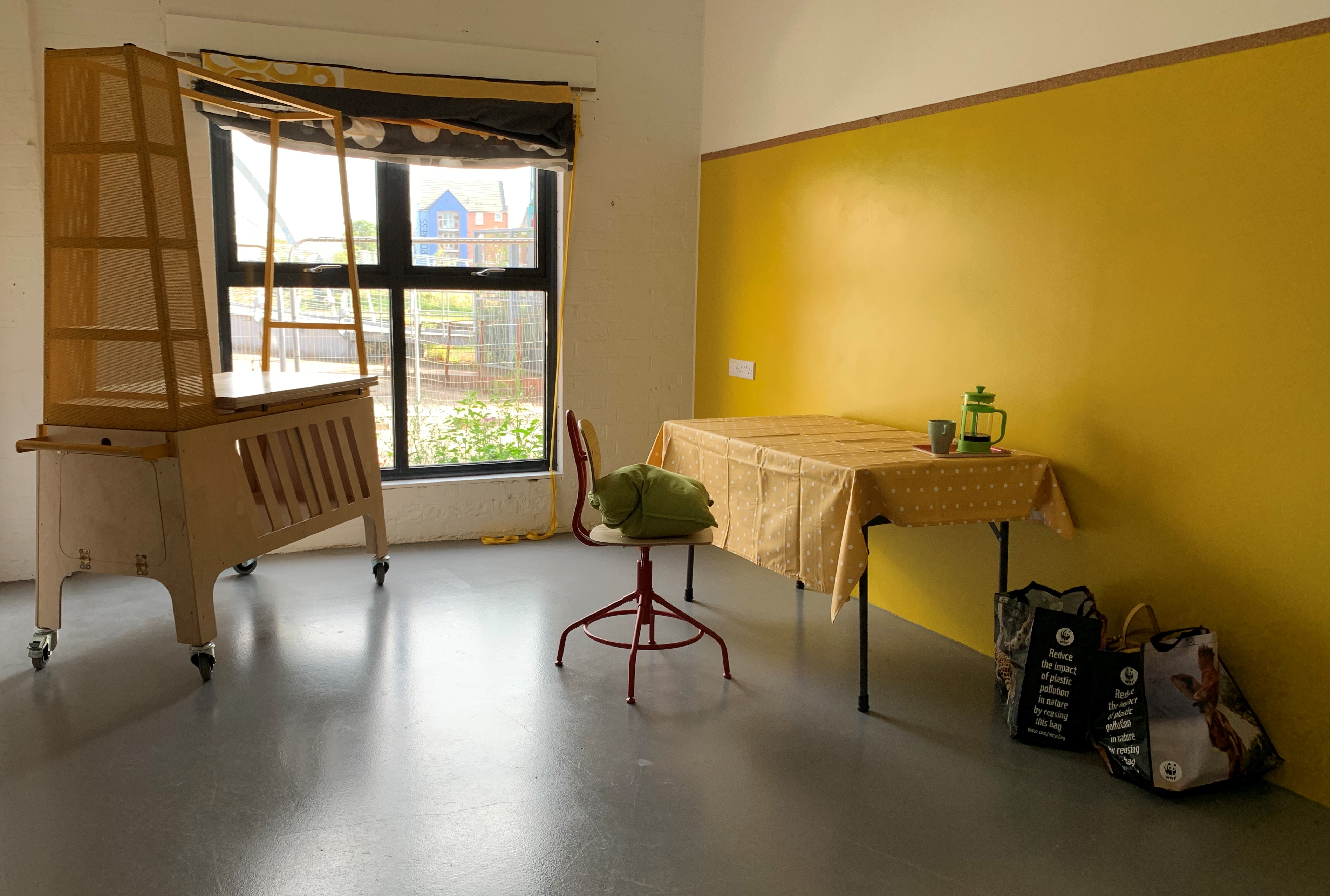
Initially I hit the residency raring, with all the substanceless gusto a naive artist has when entering a new realm. Here I was, with all this time and space to make my own, everything I had dreamed of. I dragged my wares into the studio I’d been provided and marvelled at the rich bright yellow feature wall that would surely act as creative sunshine and nourish my journey from seedling to fully bloomed sunflower.
Time to paint, time to take the 30-odd years of energy that has built up and do something with it. Time to embody the whirlwind of executive functioning that rules my life and bend it to my will.
I could certainly feel the whirlwind. And I was there to paint it. So why couldn’t I tap into it? The wind is an unsettled home from home that I’m all too used to by now, it should be so easy to just open the door. But the door only gave me brief glimpses and hints of the homely scents that wafted through its crack.
So I kept moving. For that is what I’ve always done. Just keep moving. In fact I moved so much during those first few days I don’t think I even realised what I was doing, that I had slipped back into this autopilot, desperately trying to convince myself I was busy, productive, and therefore worthy of this time.
Cognitively I had grasped that this was ‘free time’, mine to use as I wished, but the body remembers. And mine remembered watchful eyes of corporate cultures checking I was on-task. So what to do when the task was to de-task, to move away from blindly running towards an end point and see what I found along the way?
At home, in my spare-room-turned-studio, I had created a little sanctuary in which I could stop, unmask, perfectly cut off from the world and any interaction. The whirlwind and I were a lone duo, conversing back and forth on perfectly squared canvas. With no other bodies to consider in our cosmos all I could do was feel that feeling.
How was I going to do that here? In a new space, that initially seemed so novel to me that it had its own time too. Faster than I’ve experienced. How was I going to work a shared environment back into my practice after having shied away from it for so long? In an attempt to give myself time and space, perhaps I had created a little too much of it.
Two weeks seemed to pass in a singular cycle, one big dawning and sundown. Yet there were pockets of pools in the sandstorm.
I realised I was still aiming for some final image, concept, a palatable and presentable piece.
I was starting to find the patience and tenderness to let myself sit in these pools, striking a balance between thinking about my next move and not thinking too much.
IT WAS OKAY TO STOP.
THE MOST PRODUCTIVE THING I DID WAS ‘NOTHING’.
I actually looked at the work. Not to take photos, not to decide what my next mark would be. To see and hear what happened in the spaces I didn’t try to fill. I allowed myself time to be non-verbal. If a response came I may note it down in mark form, but no pressure.
Sometimes the work was best done in my head, rather than on the canvas.
I’d expected to really spend my time mark making, layering washes and immersed in the painting process like I do when I’m working from home.
I found some cool new ways to make use of canvas offcuts and old dried paint that would otherwise go to waste. I had some great conversations with my peers about inviting others to explore non-verbal and diverse communication in publicly engaged performances. But I found that those activities just facilitated the real lesson, which was in being able to come to my practice from a place of experimentation and play, responding to changes as they occur, organic improvisation, a willingness and readiness to fail, and deal with the sensations should that happen.
Taking my eye away from a final focal point and realigning it to what is in front of me, is when I will see most clearly.
Unfettered Time | 66 x 86 cm | Mixed media, acrylic, watercolour pen, canvas offcuts, waste paint, Coventry earth pigment
I want to develop this time and space further, and perhaps one day invite others to share that time and space with me, creating a ‘conversation’ around finding other ways of being, sitting and sharing our inner experiences together.
We’re hugely excited to be developing Art for the People with the support of Coventry 2021. This is a project that has been a very long time in the gestation – and for a while we didn’t know whether we would be able to convince people to invest and make it happen – because it doesn’t really take the shape of a traditional art project.
Nest Residency No 1 by Andy Sargent – Contemporary visual artist.
As I write this, I am looking back on four weeks of a residency organised by the wonderful Talking Birds which ended on the 22nd March 2019, that took place at Eaton House in Coventry. The studio space was provided by Coventry Artspace, up on floor 11, which is I think, the highest place I have ever created work!
I wanted to use this opportunity to further my ideas on a series of works called “Hidden monster”, which deals with the subject of sudden (and permanent) injury, the impact it has on one’s life, how one deals with having to adjust to it, other peoples perceptions of it, and so on. It deals with the isolation, pain, depression, vulnerability, and struggle that comes with disability. I use the motif of the “Hidden monster”, and through this character I can describe the issues I have faced, and still do, as I have first hand personal experience.
This residency allowed me to expand my ideas, and as I don’t have a personal purpose built studio space, I jumped at the chance to take up this opportunity. Even though I struggle daily with mobility issues, I made sure that I could get into the residency as much as possible, to get full use of the studio space provided. From day one, I started creating lots of charcoal drawings, mapping out and moulding images that could be used for three dimensional and two dimensional works. These ideas then filtered into paintings on either board or canvas, small sculptures, and also two large banners or wall hangings. All these works dealt with a multitude of subjects to do with this over-arching subject of being “the monster”. Some of the work dealt with “who is the monster?”. I had been called a monster after my injury, however I see ignorance and hatred towards the disabled as far more monstrous, than someone who has found him/herself on what has been described to me in the past as “the scrapheap of society”. I cannot, nor could I, speak for all disabled people, however these works represent a collection of outpourings on a subject often swept under the proverbial carpet!
During this residency, Talking Birds were busy contacting various people and organisations they saw as being interested in seeing this work and meeting me. I got to discuss the work, the issues depicted in it and life as an artist with physical limitations. Many ideas were discussed, ways and places to show the work, reactions to seeing this work, how the work could be presented in other forms etc. Certainly, from being an artist who lives on the outskirts of Nuneaton, away from the cultural centres in this country, the residency with Talking Birds provided me with a way to raise my profile, and be noticed by more people, getting the message out that my work exists. One aspect of becoming permanently injured in my case, is that you lose your career/job, and earning money becomes a major issue. So not only does physically getting out to meet people pose a huge problem, but you often can’t afford to go anywhere after you’ve paid your essential bills! So a major part of this residency was meeting other very creative people, and feeling, albeit temporarily, part of an artistic community.
So, on reflection, this Nest Residency has been a fabulous four weeks in which to get work created, meet great folks, plan further ideas and opportunities. I would certainly recommend to any other artists who consider themselves disabled to apply for a Nest Residency. You never know what it may lead to!
(A huge thank you to Phillipa Cross, Janet Vaughan and Derek Nisbet from Taking Birds, and Mindy Chillery at Coventry Artspace for making this residency happen. Also many thanks to all the artists, arts organisations, and arts professionals who came to see my work during my residency)
Andy Sargent.
[Photo gallery pics by Talking Birds, Photos in the text by Andy Sargent]
Talking Birds needs volunteers to join its street performance The Q on Friday 23rd & Saturday 24th March in Coventry, as part of the Shop Front Festival (the first event in the build up to Coventry UK City of Culture 2021).
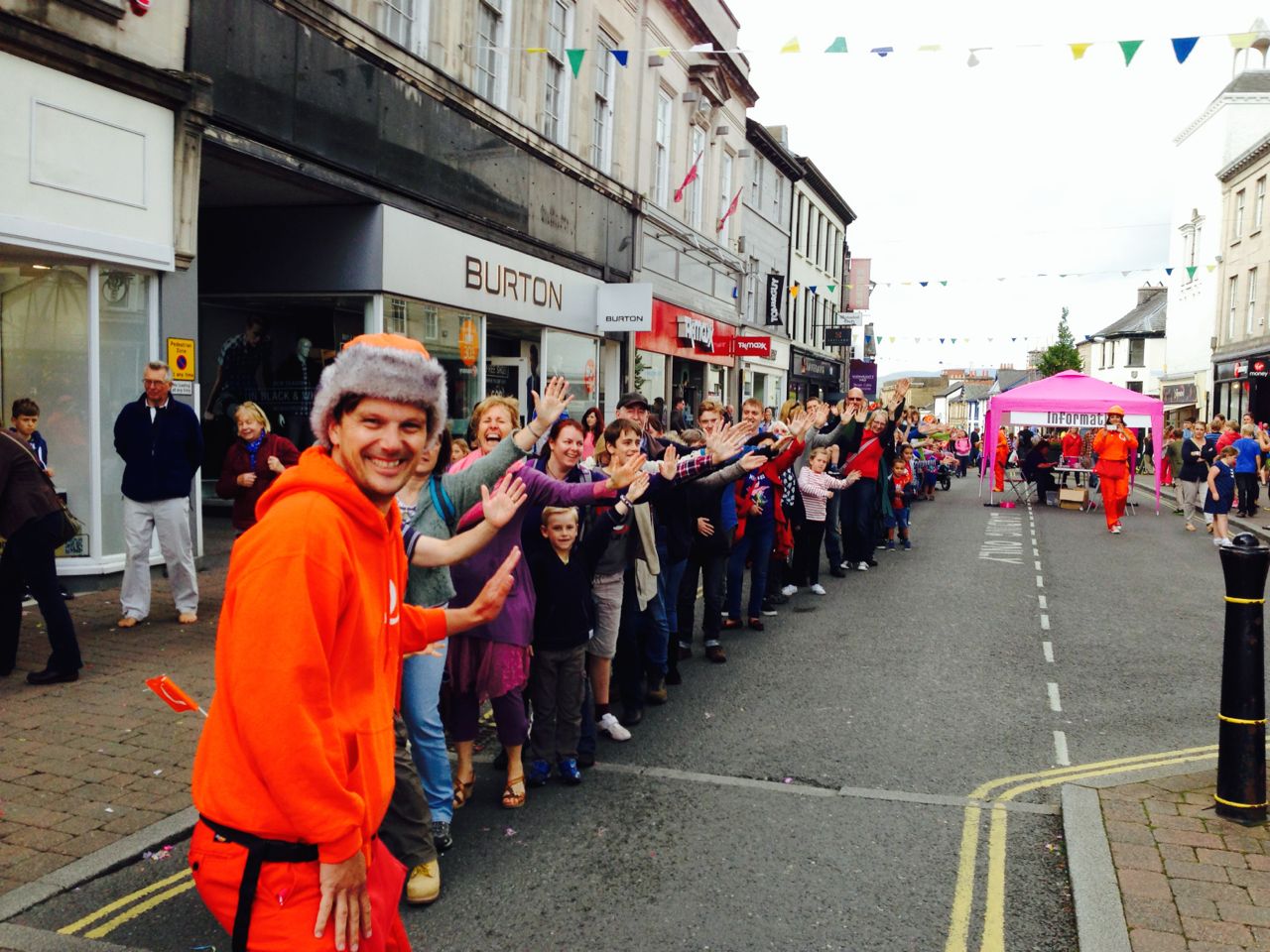
The Q is a celebration of the Art of Queuing. In 2011 the Q Corporation was formed in Coventry to campaign for Queuing to be included in the Olympics (therefore ensuring a string of Golds for the UK). Now they return – still dressed in orange – to show why Coventry has the most cultured Queues in the UK, and that it’s high time for our foremost past-time to be recognised as an Artform in its own right.
What do I have to do?
The @Q_Mob is like a Flash-Mob, but slightly more orderly. To join Q_Mob you need to sign up for a 4 hour slot (with ample breaks!) during the Shop Front Festival on Friday 23rd or Saturday 24th March, during which time you will be helping form queues around the City Centre, led by our Q Corp Captains (the elite SAS of queuing).
You will also need to come to a short (1 hour) Q_mob workshop where you can find out more, meet the team and… practice queuing. There are two workshop times to choose from:
Weds 14th March 6.30pm
Friday 16th March 1pm
Both workshops are at Shop Front Theatre 38 City Arcade CV1 3HW (just opposite Argos)
Age requirements: Q_Mob volunteers need to be 18+, younger Q’ers are welcome but need to be accompanied at all times by an also Queuing Parent/Guardian.
There will be FREE CAKE (and other foodstuffs) for volunteers.
Or call: 0800 012 2401 and leave a message with your name, mobile number and email address (please spell out anything tricky to be sure we can get in touch with you!)
Maybe in a week or two it’ll have sunk in, but at the moment the announcement that Coventry will be the next City of Culture still has the dream-like status of something slightly unbelievable that you have been told several times, but somehow need to verify for yourself…
[THREAD #1] Apologies in advance to non-Coventrian followers, but today is going to involve a large volume of tweeting in support of @coventry2021 #ukcityofculture2021 #thisiscoventry #2021blue /1
Guest post: Vanessa Oakes reflects on her stint on The Cart in the #ThisisCoventry tent (which was curated to launch Coventry’s bid to be UK City of Culture 2021) at Godiva Festival last Sunday.
a space… a cart… a place to sit and think… to listen… focus on our past, present and imagined futures… rest, recharge our phones, shut out the festival NOISE and… meditate on a life made up of memorable moments.
heads down.
needles in… stitch by stitch… cultural moments cross the ring road… pale blue, blue, white threads, births, love affairs and friendships thread through cloth, as conversations flow an observation surfaces sideways:
how artists and arts organisations talk about interacting with the community rather than thinking about themselves as part of the community.*
testing our powers of concentration… conversation… commitment… action stitching our way along roads, across precincts, towards homes… we lament: it’s only two thirty…
heads down.
children play, climb and hide… nest and then… disappear/lost… and finally, thankfully, found… we return again to the cloth… thread a needle… pin a note, add a thought, learn a stitch… listen… and… hesitate… a place to rest a pint? is he serious? no… thought not… a hasty retreat.
a cart… a place to… sit… perhaps just sit… rest our feet… process our words… and think, then… once again…
heads down.
we listen… and imagining a future landscape of our stories told on these streets… we stitch.

























 Words from the Birds