Kim Hackleman reflects on her Nest Residency
“Language is a life raft.”
Amanda Gorman
The Nest is a home base and shared workspace for Talking Birds, a company of artists based in Coventry, England, known for their “gently provocative projects which explore, and seek to illuminate, the profound and complex relationships between people and place”(1). This week I completed a two-week, funded residency inside The Nest, in the wonderful studio called ‘Helloland’.
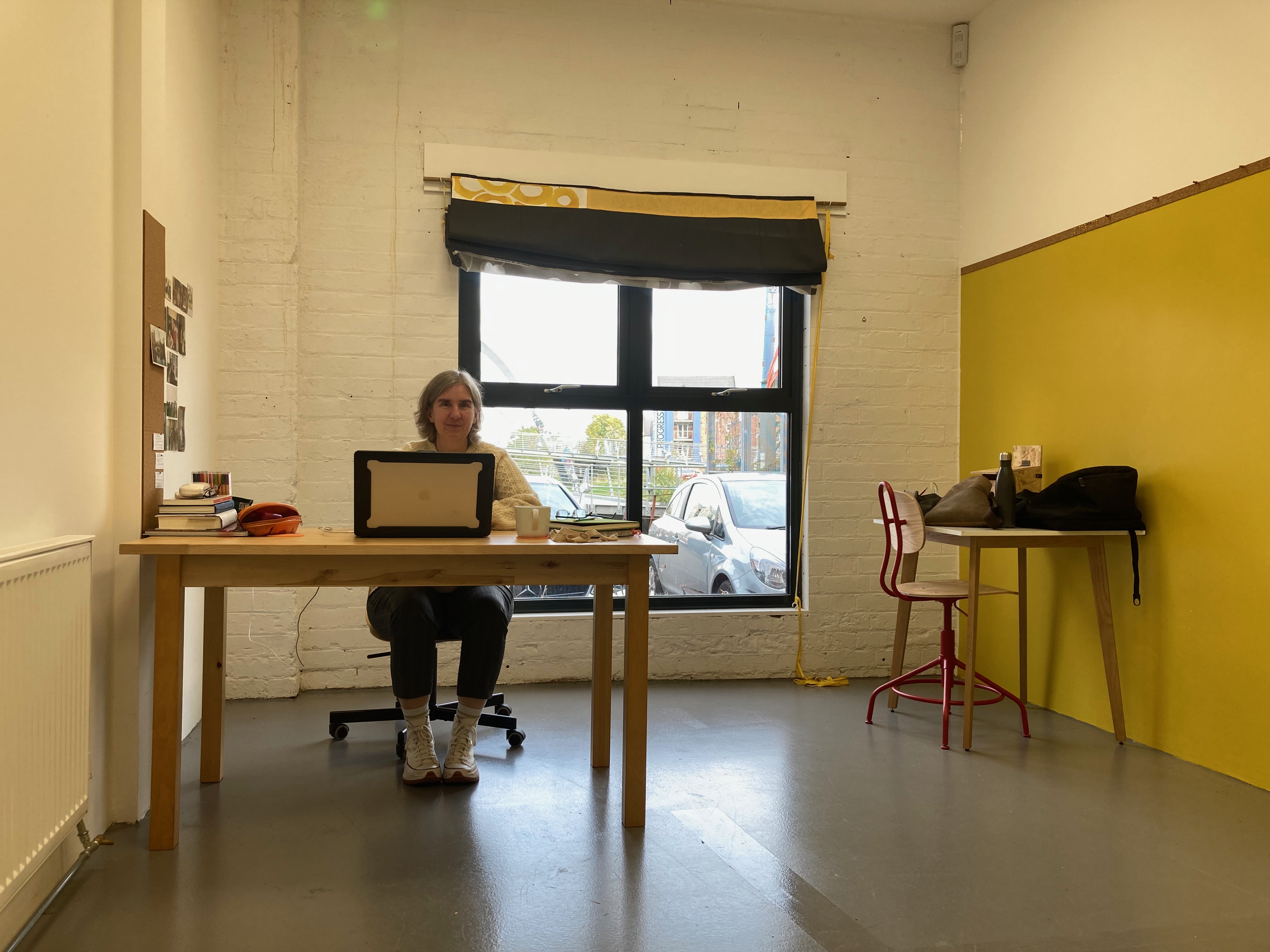
With this precious time I wanted to write daily, explore poetic forms, and return to the dramatic form, which is familiar to me as a life-long theatre maker. I also wanted to use the two weeks to explore practices, which might have a life once the residency came to an end. Writing practices yes, but also ways of living which were more conscious. In reading the Nest Handbook, two sentences in particular caught my eye:
“We advocate for greener/active travel wherever possible, and we encourage you to walk, cycle or use public transport to travel to and from The Nest where you can.”
“When bringing food into the building, please consider avoiding meat if you can.”
So, that first day I set off walking joyfully whilst listening to a podcast after packing my lunch with care for the planet. Janet Vaughan, Designer and Co-Artistic Director of Talking Birds, greeted me when I arrived and handed me the key to ‘Helloland’.

When I walked into the studio, the first thing I saw was an image through the window of a bird flying across the canal, which triggered three thoughts:
“I feel a sense of freedom, like it must feel to be a bird flying through the air, by having this funded time and space to focus on my writing.”
“That image reminds me of the Gateway Arch in St. Louis and I doubt there are many people who when they see it are instantaneously moved mentally to a place over 4,000 miles away.”
“How ironic the first thing I see is a bird, I wonder if it can talk.”

Then I set my belongings down and started to write. I had already decided that I would keep to a schedule each day of arriving at 9am, writing until the shared lunch break from 12:30 – 1:30 and then writing again until 5pm.
Each room in The Nest is named after a Talking Birds project and lunch takes place in the appropriately named ‘We Share This Space’. The shared lunch break allowed for time to pause, refuel, stretch my legs, and explore the consciously designed space that is The Nest. It also was a time of meeting and communing with other creatives who came into The Nest.
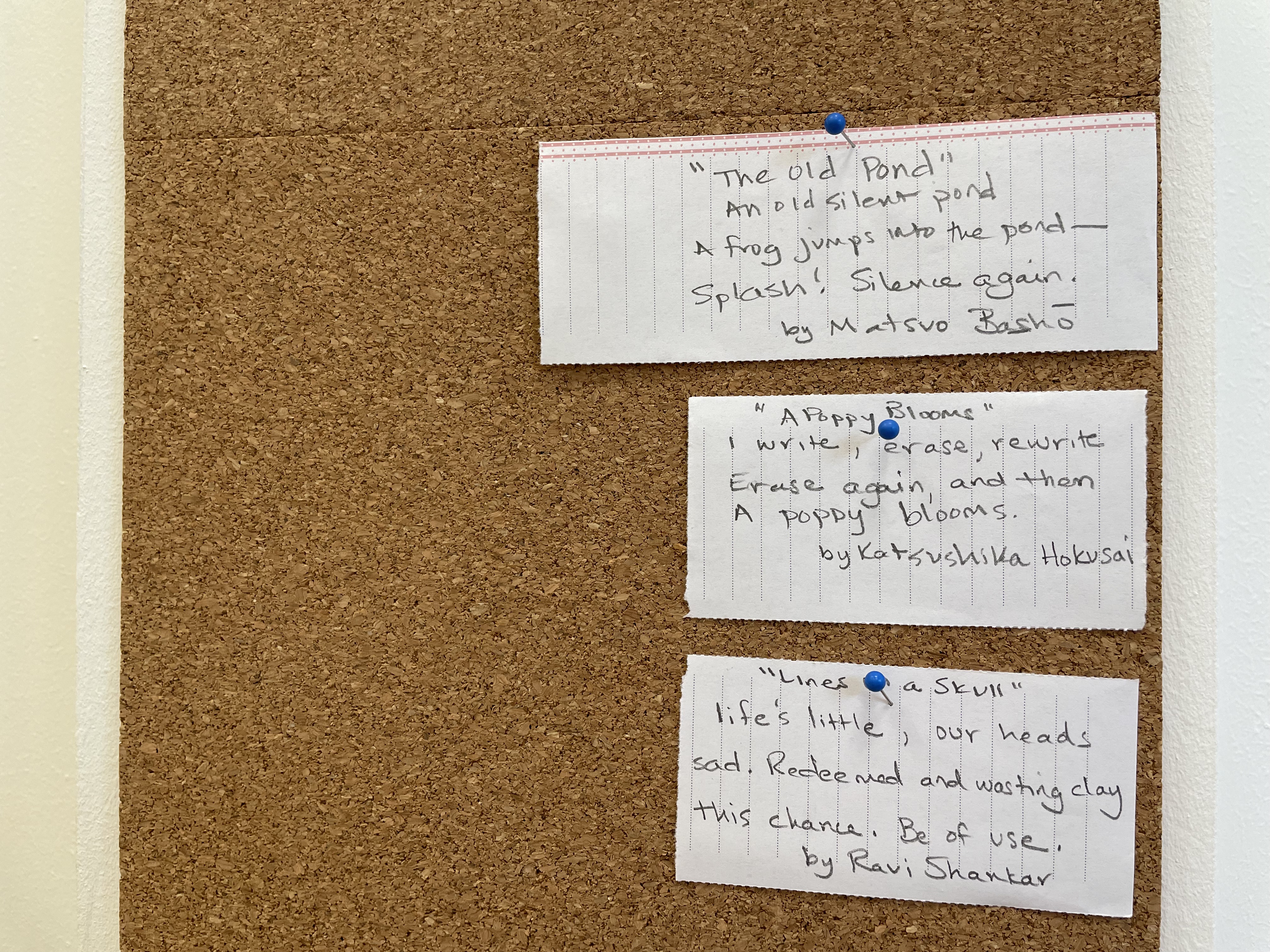
While in ‘Helloland’, much of my writing was given over to the exploration of words in different poetic forms. I continued writing in Free Verse and carried on my practice of writing haiku daily which I have been doing for some time – in August 2017 I received a phone call that my mother was terminally ill with cancer, the next morning I wrote ‘A Triptych of Haiku for Mom’, which began this daily practice. I kept inspiration in the room: books (such as Mary Oliver’s ‘Devotions’, Amanda Gorman’s ‘Call Us What We Carry’, and everything I have that Casey Bailey has written), photographs of family throughout the generations, and prime examples of some of the forms I would be working with, such as these haiku:
I revisited the Ghazal, which was introduced to me be the poet Bohdan Piasecki while working on Our Wilder Family as part of City Voices (a programme devised and created by Theatre Absolute and Coventry UK City of Culture. And I researched and wrote in a few forms which I had never used before: Acrostic (as my residency was due to begin on the day of the Queen’s funeral, Simon Armitage’s poem was fresh on my mind) and Villanelle (with fond thoughts of Killing Eve in my head).
I also wrote my first sestina.
The sestina is a complex, thirty-nine-line poem that uses six-line stanzas, each using the same six words at the end of its lines in different orders, followed by an envoi. The order of repetition follows a spiral:
ABCDEF
FAEBDC
CFDABE
ECBFAD
DEACFB
BDFECA
(envoi) ECA or ACE
The envoi must also include the remaining three end-words, BDF, in the course of the three lines so that all six recurring words appear in the final three lines.
They tend to be written in iambic pentameter (and without rhyme), which I followed. Later sestinas sometimes allow homophones for the repeat words, and you will see at one point I do this.
I have loved the work of Talking Birds for years, having experienced it soon after moving to Coventry from New York City in 2001. My first sestina is dedicated 30 Years of Talking Birds, to their own work and the generosity of spirit they show in supporting so many other creatives:
HELLOLAND
1.
A mustard coloured wall stands to my left.
White walls are found on the three other sides.
Grey door ahead with a small clear window,
Two desks, one to hold things and one to write,
Three different kinds of chairs sit in the room.
My newly arrived objects are foreign.
2.
I am aware that I too am foreign.
I was unaware though when I first left.
I was ignorant of the lack of room,
And too, the pressing in from all four sides.
To understand feelings I have to write.
This becomes a door, no, open window.
3.
The timing is right for a new window.
To understand again what feels foreign.
To untangle the past, make something right.
To integrate and accept what is left.
I want to incorporate all the sides,
But I feel I am running out of room.
4.
So I say hello and sit in this room.
The handmade blind drawn over the window.
Looking straight ahead and not to the sides,
Centred now as something which is foreign,
And pouring out everything that is left,
Until a poppy blooms, I write, rewrite.
5
Recalling back and asking why I write,
I see my young self in another room,
Long before I was asked to come, then left,
I had climbed in through the small high window,
Drawn in by maps of lands that were foreign,
Everything melted away on all sides.
6
If each day I forget and take their side.
If daily I forget and fail to write.
I begin to feel that I am foreign.
I begin to feel that I have no room.
I frantically look for a new window.
I cannot breathe and feel my soul has left.
7.
All their sides fall away and mine is left.
I write myself a world with a window,
My foreign body belongs in this room.
 Words from the Birds
Beautiful and so generous … Thank you for sharing sestina techniques, Kim.