Joanna Litten reflects on her recent Hatching Residency at The Nest.
‘Get that application in!’ My friend Natalie told me. I told her I didn’t have time, discounting myself.
I’m not scared of rejection. I am afraid to fail.
But she was right. What’s the harm in putting myself out there?
Weeks later, breastfeeding in the dark, laying awkwardly on my side; I opened my junk to see I’d been offered a space.
I yelped, my baby chomped, I shushed, he suckled, I bit my finger to muffle my scream and called my partner. He was just getting our eldest to sleep, and we both whisper-screamed on the phone.
But after such a long time in the early years of parenthood, could I really do this? Take two whole weeks out and write?
Days picking up small objects from the floor, wiping bums, sorting snacks, running around the park, holding endless space and love for my beautiful babies, being present (stay present), always present and promising myself that no matter how tired I am, tonight would be the night I finish that project; write that song or that story.
Not to mention I have been recovering from not one but two traumatic births. After my first baby, I had a breakdown so severe that I couldn’t drive. I went from someone who would hop in the car and drive three hours and back to perform a gig without thinking, to someone who couldn’t even drive down the road. It made my world even smaller; took away my ability to work in the same way and left me building parts of myself back up block by block.
Who would I find when I entered this space?
Then I arrived at Talking Birds.
I met the gorgeous TB team. Three incredible humans, Janet, Derek and Mel, who made me feel instantly at ease. They showed me to Solid Blue, the room I would occupy for my residency and I was alone whilst the sun was up.
The Nest offers the opportunity to create without expectation. They offer this to neurodivergent and disabled artists because they understand how expectation and deadlines impact our ability to actually create. They encourage play, space and percolation.
Solid Blue was perfect; warm, bright, cosy, quiet. I curled up in the corner with a book, sipping filter coffee, or laid on the futon on the floor and allowed my mind to clear. I stretched; I sat hunched deep in concentration. I was surprised how much of my creative writing skill set had been laying dormant waiting for me to have time to access it.
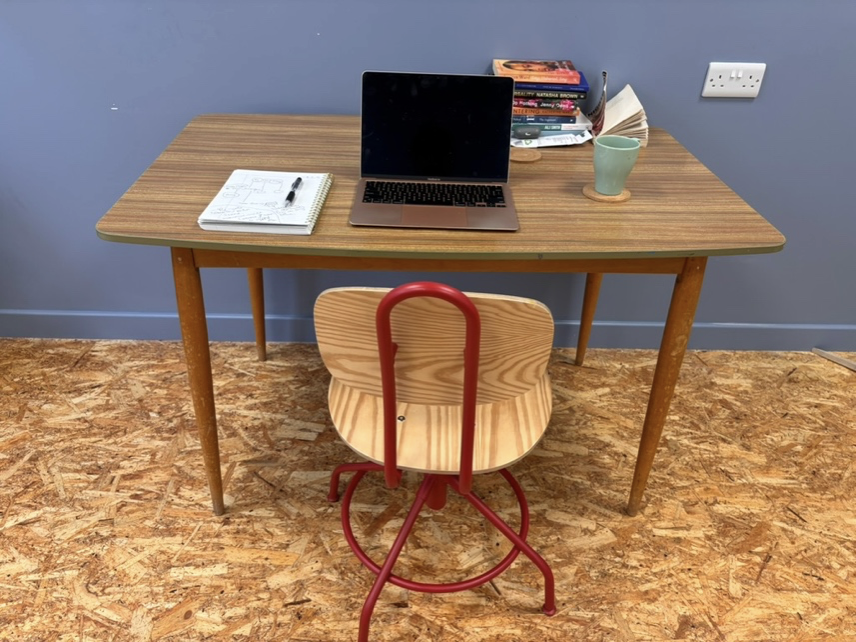
I came here with the intention of planning out an experimental novelette, a rotating psychogeographical piece centred around the lives of four women; characters that I had profiled and written sections for in the newborn days, when I was stuck to the settee, nap trapped and done with watching MAFS and eating flapjacks.
I’ve never taken on anything extended before; I generally prefer short stories, poetry and flash fictions. I find it hard to organise large amounts of writing, and also to keep myself interested long enough to complete it. But the intention here was to make a novel in the style of flash; a novel accessible to people who feel like me. The people who love to read but find it daunting, who want a story in easy to understand, digestible chunks. I want both to create a world, but also the feeling of movement.
For the first week, I wrote furiously. It was an outpouring, who are these characters? What are their stories and why are they here? What are their motives?
Each day I felt myself getting clearer, stronger, more curious—pulling at threads to see which ones would give, and where they could lead. At the end of each day, I would write questions for myself the next morning.
What does everyone look like ?
How do you slip in metaphor/simile without it reading like you are learning how to do it in primary school?
What is this story actually about?
How can you make it dance?
Is this a book or something else?
I wanted to create a hybrid of tenses and perspectives that represented the characters inner workings. How can I achieve that without it looking messy?
On day six, the story took quite a twist, and I became mildly obsessed with ‘the Mandela Effect’. How we as humans can speak of almost the same belief or issue with such divisive intensity.
Day seven I became particularly taken with the idea of ‘Good and Bad’; ‘Darkness and light.’ How the dynamic shifts depending on circumstance and connection. People’s thresholds for behaviour; their expectation of the world around them.
By the time I reached my final day, practically I had written 20,000 words, fleshed out six character profiles, produced the skeleton of a novel and read two books. Emotionally, it was so much more than this. I had the most amazing, inspiring conversations and was almost moved to tears by fellow residency artist Julie Joannides work.
And on a personal level, this has been life changing.
I thought by the end of the residency I would feel more like ‘myself’. But instead, I felt clearer about who I have become. That the creative person I visualise myself to be is a part of me, but that in order to make something new, I have to rise to meet myself where I am instead of where I was or feel I should be.
To move forward instead of glancing backwards.
To love myself despite the things I wish I could change.
To love myself because of all the things I can’t change.
To be grateful for all of the opportunities passed and all of the ones to come, and to all of the people, like Janet, Derek and Mel, who make it possible.
I am so pathetically grateful for this opportunity.
My cup is full.
Books that have inspired me:
Anne De Marcken – It lasts forever and then it’s gone. This book is so insanely beautiful and weird. It nods to grief, forgetting, trying to remember and hold on to the past, identity, and the theme of choosing your own path or accepting fate.
Rachel Yoder – NightBitch. Nothing I have ever read has captured my own personal experience of the push and pull of motherhood and creativity. It made me nervous because I am exploring similar themes and metaphors, but then I realised— men don’t worry about this shit. It made me think a lot about how I’ve read time and again that ‘The motherhood genre is overflowing,’ but no one is saying this about the crime fiction or space sections, and without motherhood, there would be no murderers or astronauts so, I think there is space!
Maggie Nelson – The Argonauts. The same friend who told me about this residency leant me her copy when I was pregnant and honestly, it is one of the smartest and most beautiful books I have ever read. Fractious observations, essays, ideas. It is perfect.
Natasha Brown – Assembly and Universality– top tier writer with incredible characters and observations of human nature.
Ali Smith – Everything she has ever written, particularly There But For The. I watched an interview with her and she says she also starts writing without a framework to see where her characters take her.
Parini Shroff – The Bandit Queens. Amazing feminist drama, she treads the line of funny and sad so seamlessly.
Claire Kilroy – Soldier Sailor. This book absolutely destroyed me. It is a devastating portrayal of PPD and loneliness in motherhood.

