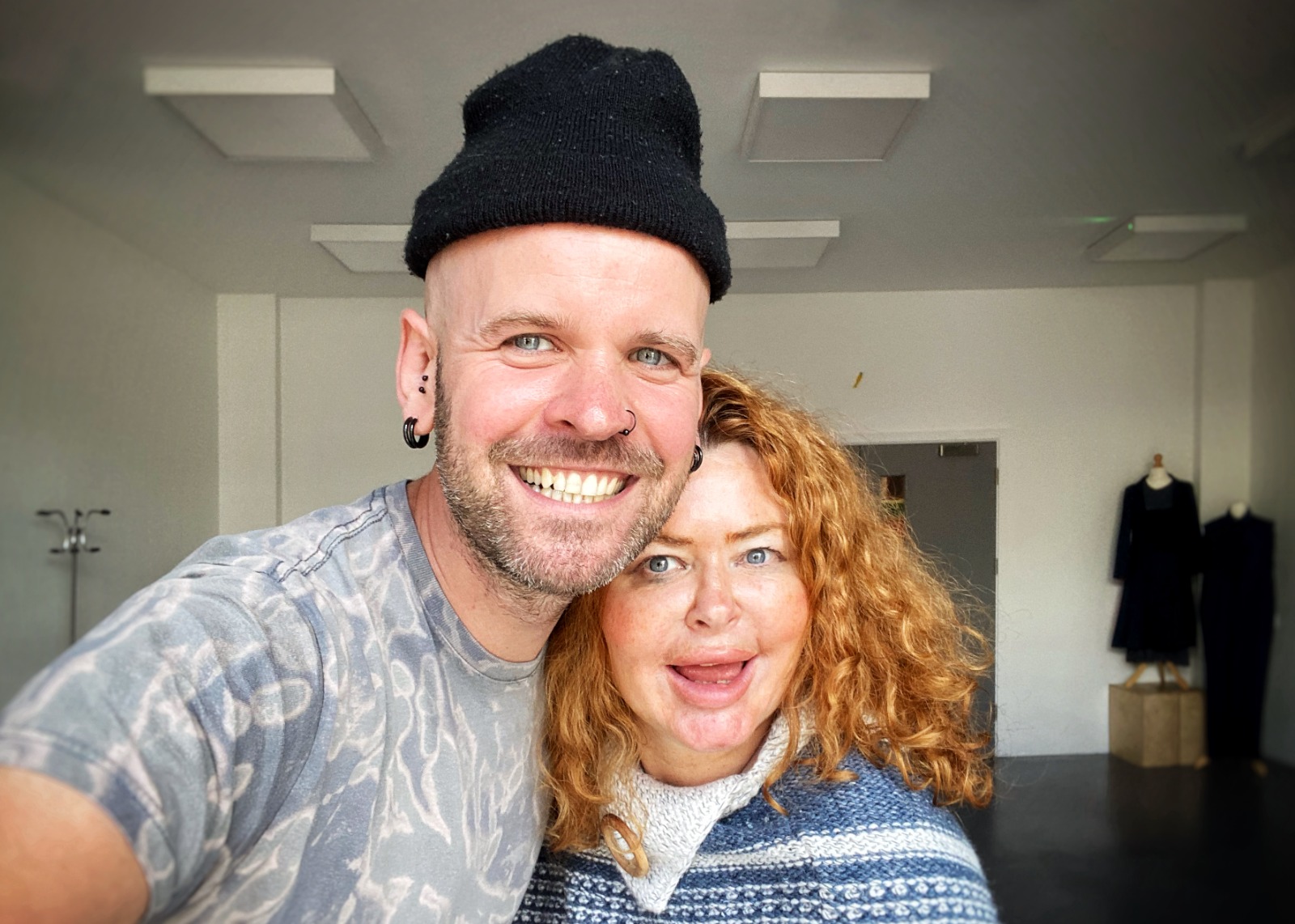
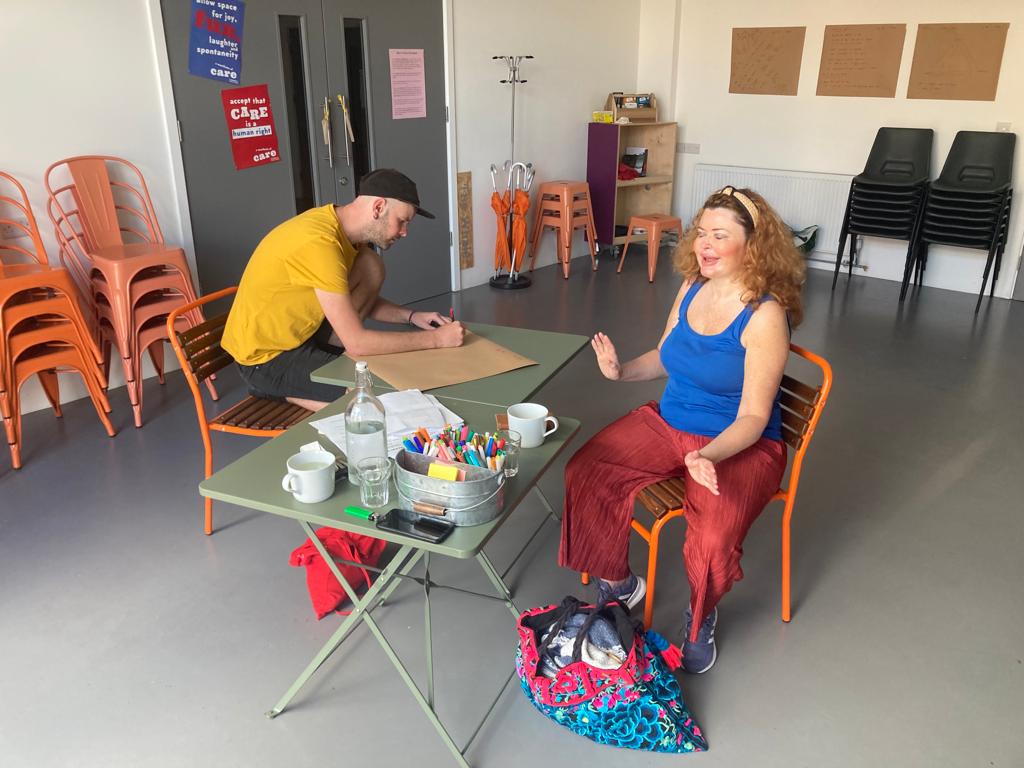
The nest is a wonderful, comfortable place to create ideas and develop theatre. It is environmentally friendly too, nothing is thrown away but recycled. I am a theatre maker and performer who is aiming to intergrate BSL into my devised theatre production by forming a new character. Name of the production is DDDivas, which is exploring gender, female impersonation and my lived experience of being a neurodivergeant woman with long term health conditions. Me and Pierce Starre, a solo performance artist whom is also neurodivergeant, were both placed in the Space of Possibilities, a bright airy space where the sun can shine through the glass entrance and windows. We were very close to the kitchen too which is always a plus.
It was a wonderful space to explore and develop a character (as in the role of Ben, the stage manager). I wish to make my devised piece of theatre accessible so that any disabled member of an audience can attend any evening rather than attending a designated evening where BSL interpretation is available and another evening where captions, and then audio description is available. Relaxed performances need to be available during a full length of a tour too.
Me and Pierce came up with some wonderful ideas regarding the inclusion of BSL within the production, which is going to be developed further in future. I did have a meltdown midweek as was very tired, which effected my blood sugar levels too. Scribing was wonderful from Charlie as well as videos provided, but I realised that me and Pierce had slightly different needs, so it may have been really helpful for me to have further support regards my disabilities, as I do require additional breaks which I take when needed. I sometimes forget to take them due to effects of my dyspraxia so often need reminding to take a break, often due to stressful situations I will carry on working.
A lot was learned during the week which has changed my perspective positively, I feel I can take ideas forward which will be great to share with rest of team and those within the arts that can offer assistance. I am developing other ideas too related to aspects of theatre and story telling, but I am placing focus on DDDivas currently, as due to covid and being on the shielding list, I had to hold back on this project for some time. All the staff and artists at Talking Birds were very interesting and supportive, and it was great to meet them in such a warm friendly space.
It’s so lovely that Talking Birds is placed near the canal, a pleasant, quiet walk which is useful for head clearing on the way to the space and back. So kind of Philippa and Charlie to give me a card before I left, saying thank you for using the space and spending time at Talking Birds. Me and Pierce were very appreciative and grateful. And like it says on the front of the card, I have met more of my flock. Thank you so much Talking Birds.
One morning in February, Lauren was doing her usual aimless morning scroll through instagram. As she was flicking past all of her cats with hats accounts and insta feminist quotes, she noticed that Talking Birds had made a call out for the Remix Residency at The Nest. She saw a huge variety of props in a picture and was drawn in immediately. There was something about that telephone, that explorers hat! The bucket and spade. It sparked off ideas which started to whirl through her brain, so she messaged Izzy and Ruth.
“I think we may have a shot at this!’
Fast forward to a week later in Gails Balham (a local haunt of ours) Ruth and Lauren discussed ideas that were stimulated from the picture. Coventry’s female and industrial history, the idea of legacy, what Coventry means to us. What would happen if we created a dystopian world filled with time travel, with women at the core? These were just a few topics that we indulged in. We knew we wanted movement at the heart, with small pieces of text to lead the story forwards. Pumped up from all of these tangible ideas, we set to work applying for it. Janet saw something in these mini moments we had created and would you believe it, we were accepted! Now the real work begins…
Before we knew it we arrived in Coventry for our first section of the Residency. It was a lovely sunny day in May. Lauren and Ruth entered the bright blue gates of Sandy Lane Business Park. We began our work in ‘The Space Of Possibilities’ room in The Nest. It was bright and spacious, with so much room for us to create. Within minutes we knew we would feel very comfortable in this space. It felt like our little home for the week.
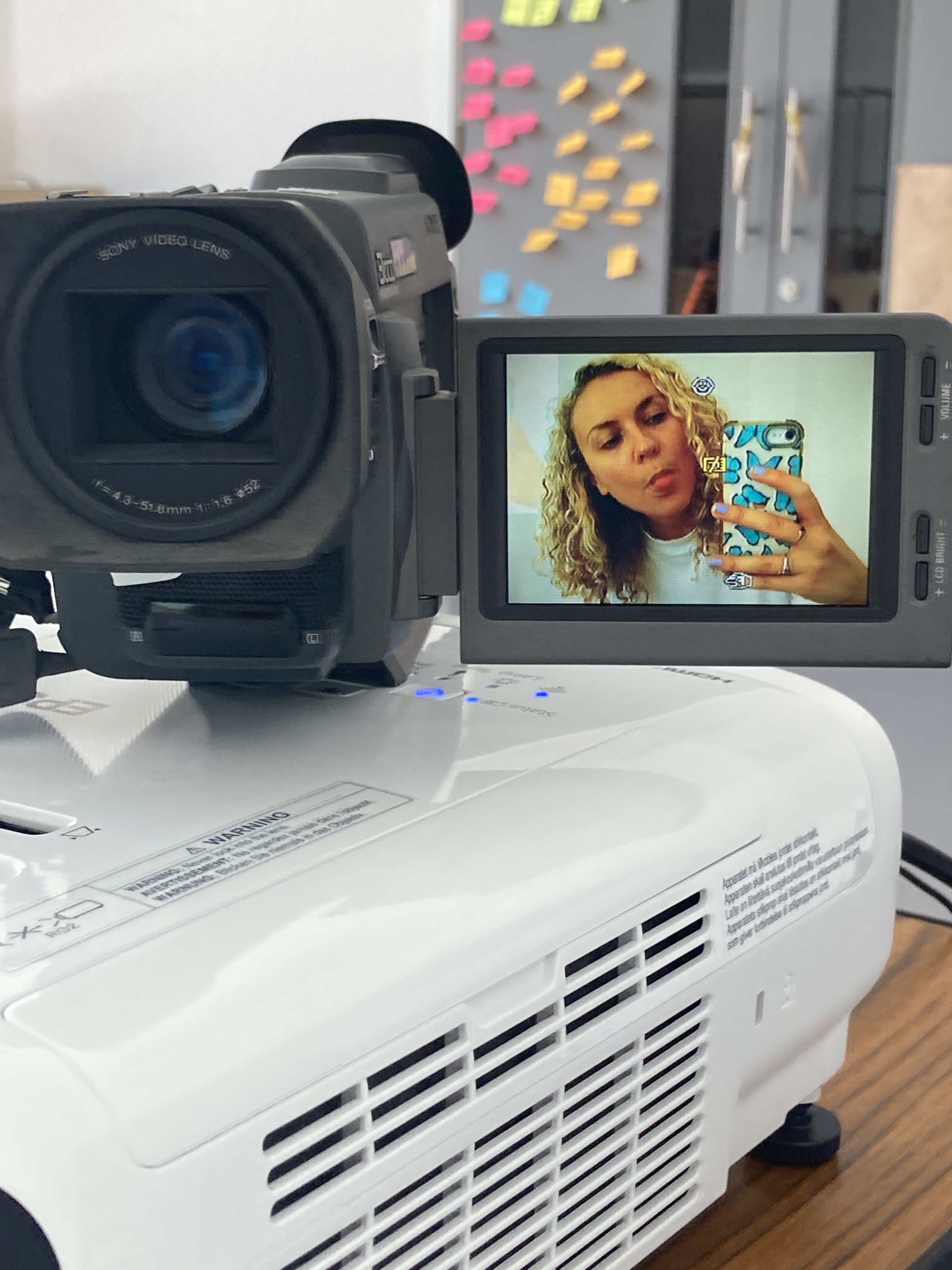
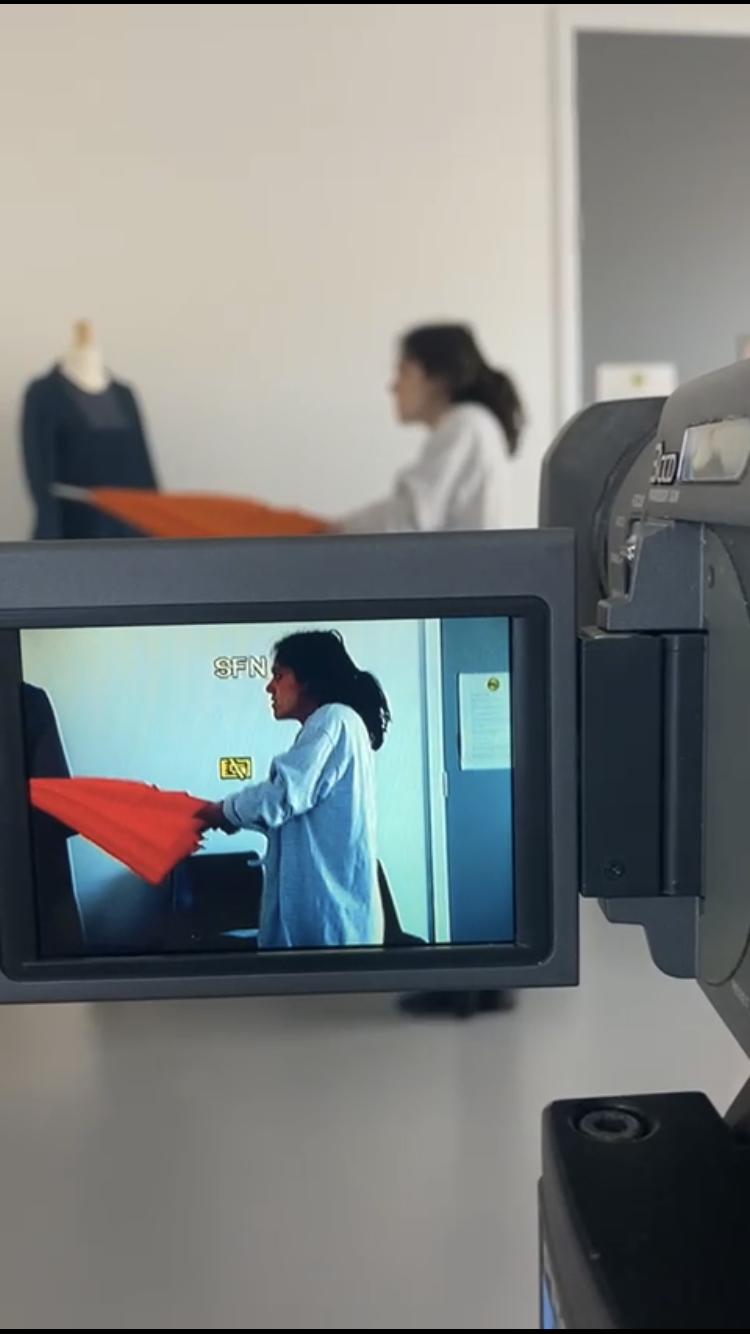
For the first week we just allowed ourselves to play (something which feels so rare in this industry!) The pressure was completely off, so we messed around with tech we’ve wanted to work with for years. Trying out different ways we can use projection, live camera feed and sound. It began to spark so many new ideas for what this project could be. We tested an idea (which came from the projection) about the audience’s perception. What would happen if we projected an image onto the umbrella, but behind it was something completely different? Or a different part of the story being told? We found a bit of magic in this idea, so we ran with it.
Our next stage was to figure out what story we wanted to create. We knew we wanted it to be about Women of Coventry and the stories that seem to be forgotten. We’ve all heard of Lady Godiva, but who else gets to be or should be just as iconic? And you know what, we just couldn’t think. We couldn’t think of any other woman who is allowed to be a figurehead like she is.
So we took to our laptops and began our research. Straight away a name popped up, a woman called Alice Arnold. The first ever female Mayor in England. We couldn’t believe it.
The more we researched her, the more we fell in love with her story. She felt so real to us. Even though she was born in 1880, Alice felt like a modern woman. With real hopes and dreams. Her progressive views and big dreams for gender equality, education and to end poverty just proves that she’s the kind of woman we’d love.
The next woman we researched was a little closer to home and more of a household name. Pauline Black. Visually recognised for her androgenous style, she was a woman we wanted to know more about. Hailed as the Queen of Ska, Pauline became an icon of her music genre. And of course, she is the lead singer of the band The Selecter. Black has also been an actress, with roles in films and television.
Our research came to an end when we found our third female story. Lisa Lashes. Known for being a hell raiser in the rave scene in the 90’s, Lisa was one of the first female DJ’s to break out of Coventry. We loved these women so much already.
We flung post-it notes on the walls of the room, scribbling down our findings and our ever growing questions. The room felt mighty. We were both fueled up with these stories. We played Lisa and Pauline’s music and filled the room with their words and beats. Messing around with movement and tech, we began to create a rough structure for the world we wanted to create.
In our second section of the residency, we introduced two ensemble members to the room. Julia and Sinéad. We wanted their role in this section to enhance our findings and embody some of our ideas further. Extra bodies in the room are always great for storytelling. Oh and for games. Grandma’s footsteps just doesn’t do itself justice with only two players. And we’re super competitive. (Ask Julia and Sinéad).
Over the next few days, we set to work discussing some themes we wanted to work with and some free writing tasks.
‘When I think of Coventry I think of…’ ‘A woman can be…’ ‘Home means to me…’ ‘To f*ck with form you have to…’
These were a few of our free writing starting points. From this, we began to create small pieces of movement involving the props given to us. We all chose two items from the prop box, a section of our writing and 8 movements to create mini pieces. We then watched and gave feedback on moments we’d love to push more. As Ruth is a Movement Director, she then cast her eye over the work we had made. Ruth pushed us for more ensemble moments and different ways Lauren, Julia and Sinéad could connect.
It was such an eye opening exercise. We really felt each other’s warmth in the room, as cliché as that is to say. Hearing different points of view on the city, on what it means to be a woman. It was lush.
Ruth and Lauren then put their heads together at the end of this phase to figure out how we wanted to tell this story. With some time in between, we allowed some dust to settle and to search for the core of it. Tuesday of our final week Ruth and Lauren looked back over bits of writing, videos and also came back to our key themes. And then a line from Sinéad’s free writing drifting into our memory.
“Dreaming alone isn’t enough”
By this point we had learnt so much about these women and we had celebrated their amazing triumphs. But it dawned on us, they’re the first women in their field. They’re singular.
To be honest we feel in history, and the systems that inform it, we often only allow one woman to be held up high and remembered. Like Lady Godiva on the horse “there is space for us all” so why do these women feel isolated? This pushed us to think about the arc of the show. What would happen if the camera and projection only showed one of the performers, not them all. Would it feel more invasive?
We had been playing with video and the camera throughout the process and we wanted to challenge ourselves as a company this week. To move past ‘it looks cool’ or it allows us to play with space. We always knew that the camera felt like it represented much more than just a piece of tech. So we decided to give it a role. We cast it as History.
These were pretty big ideas so we got stuck in practically, pulling together bits of our writing, research and improvisation to make a draft script that we worked on for the next day. Then, Izzy joined us! All of the ideas rattling around Ruth and Lauren’s brain finally had a fresh pair of eyes. Then it was about getting it up on its feet. Sculpting moments through improv, discussion, exercises and best of all collaboration.
On the last day of the residency, we shared our 20 minute piece with some of the Talking Birds team and community. We had a small Q&A at the end and got to hear what resonated, what people felt and thought.
This residency has allowed us to grow as a company. By meeting new people, involving collaborators and working with tech from the seed of an idea. But most of all, giving us the space and support to play. We have continued to learn about our methods as a company and as individual artists. All whilst keeping the core of SpeakUp shining bright at the centre of the work, amplifying untold stories.
We had such an absolute blast, thank you for having us, Talking Birds!
Co-Artistic Director Janet reflects on the 5G Explorer programme (2/2).
When Coventry University approached Talking Birds about taking part in the 5G Explorer project, we decided to open the opportunity out to some of our ‘freelance family’ to take part with us. We knew that both Steph Ridings (who has worked with us in both a writing and producing capacity) and film maker Rachel Bunce had been developing projects that might benefit from the use of this kind of technology and so the three of us worked together as ‘Team TBs’ for the duration of the project.
Co-Artistic Director Janet reflects on the 5G Explorer programme.
In 2005, I gave one of the ‘Hothaus Papers’ talks at Vivid. My talk was entitled ‘Are theatre-makers natural net artists?’ and explored some of the crossover techniques that Talking Birds and others were adapting from our experimental theatre practice to the – then relatively new – practice of making natively digital artworks that existed purely on the internet, arguing (spoiler alert) that it was a pretty good fit.
Sinéad Brady reflects on her recent Nest Residency
When I saw Talking Birds’ call out for Nest residents as studio space had recently become available, it felt like the perfect time to grab the books I’d wanted to read for a while, but not had the time or space, gather my old notes on the topic I wanted to explore and delve deeper into the texts I’d recently written. I was ready to jump back into an idea I’d been thinking about for a while, and I was excited about getting to work around other creative people.
My residency took place in Helloland, a super comfortable and compact studio space with a calming view of the canal.
It was a dream come true to have space to spread out and hang my research, thoughts and questions on the wall. I brought with me old research and ideas for plays I hadn’t been able to return to for a while and I spread out them out on the tables and walls. Suddenly they were tangible and seemed possible again.
For a few years I’ve been interested in exploring how healthy I can be as an individual in an unhealthy world. How much is my health and self-care my own responsibility? This interest has only grown since the start of the pandemic, as we’ve been called to practice, and reflect on the meaning of, collective care and since even more responsibility has fallen on us as individuals to make decisions regarding our health.
After several stimulating chats with the Talking Birds team and a really helpful, constructive call with Caroline Galvis, a Berlin based theatre maker and fellow co-founder of international Rule of Three Collective, where I talked through my ideas and the reasons why I wanted to explore the topic, I was getting closer to narrowing down my research to one urgent question: How much can we care for ourselves in an uncaring world?
When I applied to the Nest Residency, I had an idea of the scripts I wanted to develop, and potentially combine, but I ended up not only working on those scripts, but also digging out a poem I wrote in lockdown about how difficult I find processing the news. I started bringing things together I didn’t expect to, like combining this poem with movement exploring self-care.
After a week of delving into scripts, I felt it would be beneficial l to invite another theatre maker into the space as an outside eye on my ideas and my writing. Angela Mhlanga, a Coventry based actor, writer and director kindly came into the Nest and read my scripts out loud with me. It was invaluable to hear Angela read the plays out loud and the chats we had about them afterwards really helped me develop each idea – thank you Angela!
By the end of the week, I was able to start thinking about what mediums would work for each script and how they could all work together in a multimedia installation with live performance, audio and film.
The Nest Residency gave me the chance to revisit an idea without feeling like I was restarting. It gave me the space to realise how far I’d come with my research and script writing. By the end of my residency, I also felt so proud of how far I’ve come as an artist through such a politically and financially difficult time. I’m extremely grateful to Talking Birds for this opportunity and for all the interesting and supportive chats we had during my Nest Residency.
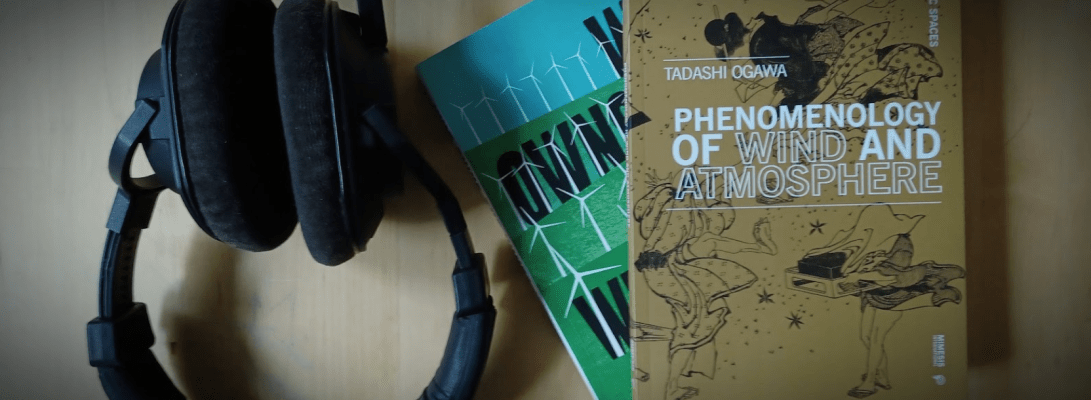
I applied for a NEST residency to revisit my personal archive of sound recordings, distributed across a number of drives in my studio. I was interested in collating and catalogue recordings which connected to the subject of the wind: some of these would be recordings made incidentally during the production of moving-image projects, others captured with the specific intention of recording the ambiental sounds of wind. In reality, this time spent cataloguing and editing during the residency formed part of a wider process of listening, reading and thinking about the connections between the medium of sound, and that of the wind.
The NEST residencies offer artists time and space to research and experiment without the pressure of producing an outcome. My last five years have been mainly dedicated to two experimental film projects produced collaboratively with composer Abul Mogard, Kimberlin (2019) and Phoenix City 2021 (2021). For me the residency was, first and foremost, an opportunity to step away from ‘projects’, and to instead return to thinking widely about the medium and nature of sound – my primary medium before transitioning to the field of artists’ moving-image. So, whilst researching future work around the subject of the wind, this residency was also an opportunity to think deeply about the medium which has driven my creative thinking in the visual arts.
Thinking through some analogies…
The wind is usually considered problematic for sound recordists, who look for ways to avoid its buffeting since it doesn’t play nicely with the delicate diaphragm of the microphone. The aggressive rumble of wind on the diaphragm tends to break with the transparency of the recording, and distracts from its intended subject. And yet to the naked ear, the sound of the wind can be beautiful, meditative, and even musical. Of course, the wind becomes sonorous only as it comes into contact with the surfaces of the earth, shaped by the contours of the landscape. The soughing of the wind give voice to the world, and bring its contours into relief, much like the rain in this famous passage from John Hull’s Touching the Rock: An Experience of Blindness:
“Rain has a way of bringing out the contours of everything; it throws a coloured blanket over previously invisible things; instead of an intermittent and thus fragmented world, the steadily falling rain creates continuity of acoustic experience… I feel as if the world, which is veiled until I touch it, has suddenly disclosed itself to me.”
Sound, like the wind, is shaped by the contours of the landscape, flowing through and around, colliding and reflecting off its relatively immovable surfaces. Land, vegetation and buildings shape airflow, and inside our buildings the walls and furniture likewise sculpt our experience of sound, and with it our perception of space.
Sound is also tactile in a way which directly corresponds to the materiality of the wind: the thudding bass of the sound system pounds the chest and the gut, and is felt through the sensitive soles of the feet. In the world external to us, the forms we perceive as sound (once interpreted through our nervous systems) are, like the wind, movements of air molecules provoked by changes of pressure. I have a particular memory, an epiphany with some parallels to that described in John Hull’s passage on the rain, in which I recall my attention being brought to the susurration of the wind through a group of trees in front of me, in an apparent ‘bringing to life’ of the world around me. Seconds later I felt the same air which I had just observed animating leaves of the trees a few yards away, now brushing against my cheek – a moment of synaesthesia through which a particular understanding of the physical world came into focus. An entire set of relations momentarily became ‘visible’ for me through this ‘medium-in-between’, which connects us to the world.
Thinking through this analogy, it is an unexpected outcome of this residency to find myself returned to one of my first sound works: my degree show piece Gunshot Corridor (1999). Installed in a 30-metre long corridor in the sculpture department at Kingston University, this early work has proved foundational to my understanding of sound as medium. It was an ephemeral work in which the negative space of the corridor was animated by the intermittent sound of gunshots, which rifled down the passageway, fleetingly breaking the inert quiet of the space. The movement of air of the gunshot, and that produced by the movement of the physical cones of the loudspeaker enter into an analogous relation, as the acoustic pressure wave is briefly made ‘visible’ in the negative space of the corridor. I pursued the expression of this set of relations through a number of installation works at the time, including a series of site-specific pieces which employed the sound of pigeon wings as metaphor for the movement of sound.
Bullet Shock Wave (1970), Harold E. Edgerton, courtesy Smithsonian American Art Museum
The respiration of the world
Amongst the sound recordings in my personal archive which I returned to during my NEST residency, I ended up spending a lot of time listening to recordings from a particular project The Creature in Between (2016). The Creature in Between was a pilot project initiated by Claudia Fontes, an experimental colaboratorio taking place in a Wichí community in the north of Argentina (with sculptor Elba Bairron, photographer Guadalupe Miles and hacker Mateo Carabajal). The project was conceived as an intermedia and intercultural exploration of what it means to be a person living in the world with other creatures, in which “artists, hackers, potters, writers and musicians will come together to collaborate in creative processes, finding novel ways of translating their perceptions across cultures, generations, languages and species”.
During the 10-day residence I worked closely with Mawó Mendoza, a member of the Wichí community who took me daily to sites in the savannah where he would attempt to share with me his deep understanding of the acoustic language of his natural environment – and where we would produce a series of over 25 collaborative field recordings. These recordings culminated – at least it felt like a culmination, I’m not sure this was merely my perception or whether Mawó had intended it this way – in two recordings of the sounding of a sacred object, which I now know to known in the English language as a bull-roarer, but which Mawó described to me as “the caller of the winds”. This delicately carved wooden object, shaped like a slightly twisted leaf attached to a long string, was traditionally used by the Wichí shaman to “call the four winds into conference” in times of drought. In Mawó’s understanding of the world, without the wind we cannot breathe and the plants shrivel (and of course, this is entirely true: it is the wind that moves clouds and brings moisture across great distances).
When I listen to these recordings now, they seem to synthesise a set of relations which trace a line from the analogy of sound to wind (the object which Mawó called “the caller of the winds”, known in the wichí language as Lhayialh, is effectively a sounding instrument which displaces air as it is swung in a circular motion), to interactions between Mawó and the birds around us via this instrument. Listening across other of our recordings, I hear other moments in which birds of varied species appear to be reacting – somehow animated but I can’t speculate as to what is really going on – to the changing intensities of the wind, in the exact same ways that they appear to react to Mawó’s bull-roarer.
Sounding clay vessels produced collaboratively during The Creature in Between (2016). The making of the vessels was undertaken at a communal table once the direction and speed of the wind was considered favourable for this act of creation. Image by Guadalupe Miles, courtesy of The Appreciation Society.
In Wichí tradition and thinking, the wind is understood as synonymous with breath – and I think it is principally this lesson from the Creature in Between which led me to be sat at the NEST revisiting these recordings, ideas and memories. The Wichí people and other of the ‘pueblos originarios’ (‘original communities’) do not deal with trivia, their folk tales tend to deal with the essential knowledge which is central not only to their own survival, but moreover to the harmony of the entire natural order.
Lhayiahl (2016), by Duncan Whitley and Mawó Mendoza. Audio track selected for The Slow Bird, curated by Claudia Fontes for Affective Affinities the 33rd São Paulo Biennial 2018.
I don’t yet feel able to draw together everything which I began to unpack during the two-week residency into a neat form (and I am a long way from these strands becoming reconfigured into the form of an artwork), but what the residency has enabled for me is to identify a number of threads from which I could plan out future research.. The residency went beyond a realisable process of identifying and collating recordings in my personal archive, to a far messier process of throwing onto the table a set of sounds, memories and concepts which have haunted me since my first visit to Argentina in 2016 (and perhaps since I first began to study contemporary art in the late 1990’s). The next phase of this work will be to take these strands of this residency research into a practice-based exploration through sound, perhaps piece by piece through further small residencies or commissions.
Today marks 2 years since the death of George Floyd. And today the More Than A Moment working group has put out this statement asking organisations that have signed up to the Pledge to publish our action plans so that we can (rightly) be held accountable.
Daz and Martha from calico reflect on their recent Nest Residency.
We recently completed our first ever residency with Talking Birds. On our Hatching Residency, the Talking Birds team granted us time, space, advice and support, to try out a completely new idea. We had a week to play and explore, to create without any time pressure or expectation to produce. It was joyful, transformative, scary, and at times, a complete nightmare.
This was the most time we have had to explore an idea in, well, forever. We are so used to time-sensitive making, to cramming rehearsal time into commission opportunities and giving ourselves impossibly small amounts of time to create entire shows. And we are good at it, we have found a rhythm to working to the tick of the clock, built up stamina for the create-perform-create-perform way of working.
We expected to keep up our pace; that we’d finish our week at the Nest with a whole new show, maybe two, with reams of polished content and new ideas to deep dive into. But, in reality, when Talking Birds told us to take our time, and expected nothing from us, we stopped in our tracks. The clock stopped ticking.
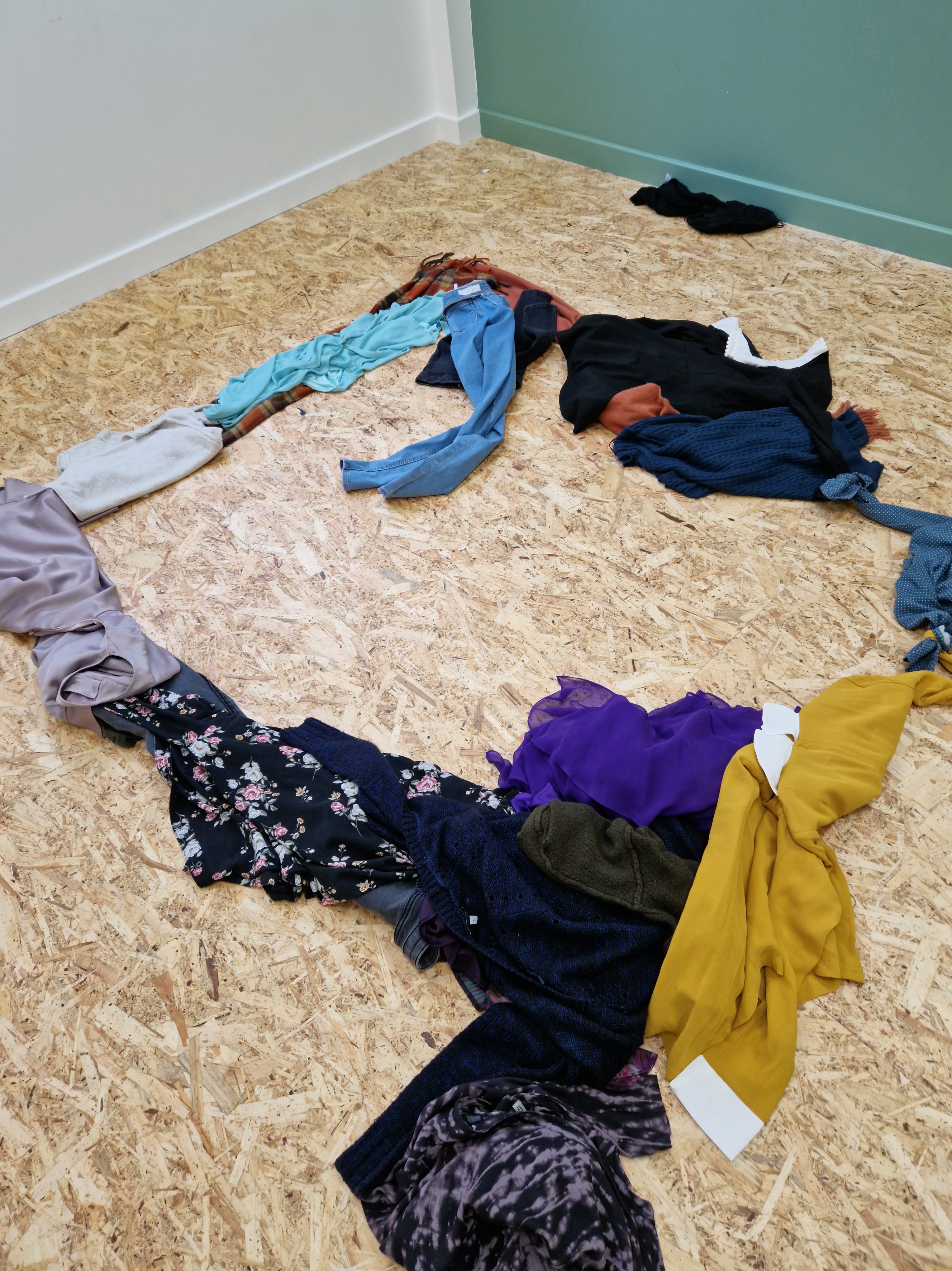
Sometimes, we were our own time-keepers, keeping our pace and continually pushing from idea to idea, medium to medium, trying out as many things as we possibly could in one day. We had this space, these people, this time, and we had to use every second of it creatively. We danced, we jumped, we played with shadows, with clothes, we drew, we wrote, we explored video, improvised, choreographed, imagined. On these days, the possibilities felt endless, that we could generate so much, interrogate our idea so deeply, all in one day.
On other days, we had no idea what to do. There was too much time. We couldn’t keep up the pace. So we slowed down. We took more breaks, and longer breaks, basking in the sun by the canal. We abandoned The Nest and treated ourselves to a long lunch out. At first, we felt guilty for running out of steam, for killing time. But then we had new ideas, we reflected on what we had made and saw our ideas from new perspectives. We also reflect on the way we work, and on the landscape and reality that has made us feel like taking your time is time-wasting. But at the Nest, there is quite literally no waste. Everything is composted, recycled and reused, and this, like any good thing, takes time.
Our Nest residency gave us the time to learn how to slow down. The reality of the fast-paced, product-focussed environment that we are now re-entering means that the clock will, inevitably, start ticking again. But we are so grateful for the Talking Birds, sharing their space, their ways of working, and their time, with us.
Leanne Moden reflects on her recent Nest Residency
At the end of April 2022, I spent a beautiful, sunny week in Coventry with Talking Birds, as part of their Hatching Residency.
I was really excited to work on a completely new idea – a one-person show based on my recent experiences of chronic illness – and the residency gave me the headspace to finally start the process of thinking about the project, rather than just thinking about thinking about it.
In 2021, I had a sudden and frightening period of ill-health, and the experience really showed me how invisible and chronic illnesses are often treated in the UK. I wanted to explore the highs and lows that come from navigating the world with a chronic condition, with a view to turning this into a piece of autobiographical theatre.
One of the things that struck me most about getting sick was how worried I became about ‘not being useful”. When I was incapacitated by my condition, all I thought about was how much time I was taking off work, and how inconvenient I was being to those around me. That made me think about the current societal narratives around productivity, usefulness, and community, in relation to illness and disability.
During my first couple of days on the residency, I did a lot of thinking, note-taking, and reading, and I wrote pages and pages of stream of consciousness narrative. At the end of each day, I worried that I hadn’t written enough, or used my time as wisely as I could. This was pretty ironic, given I was meant to be writing about productivity and rest! So, by Wednesday, I vowed to just go with the flow, and not get too het up about “being productive”.
As a result, I spent the final few days writing around the themes of the show, as well as plotting the story arc, thinking about how “Deal Or No Deal” might be the perfect metaphor for the Just World Hypothesis, and generally getting super excited about what I was writing.
I also found time to write a draft for a commissioned piece for an unrelated project, and I spent a day working through my current archive of poetry – finding stuff that I’d started but failed to finish, and earmarking it for editing in the summer.
It was almost as if the fear of not being productive was causing me not to be productive. It all felt a bit meta, truth be told! But actually, it was all grist for the mill, and I wouldn’t have found time to consider my own relationship with “feeling useful” if I hadn’t had the time/space afforded by the residency.
It was also really lovely to meet and chat with other creative people during the lunches, and these serendipitous conversations were super inspiring too. I’d like to extend a huge thanks to everyone at Talking Birds for such a lovely, welcoming, and creative experience. I hope it won’t be too long until my next residency!
I have just completed a two week Nestival residency with the amazing Talking Birds organisation. The residency ran across two separate weeks in March 2022 (due to falling ill in-between the scheduled 10 day period) and took place inside The Nest; Talking Birds’ beautiful base adjacent to the Daimler Powerhouse on Coventry Canal.
The residency allowed me to take a break from work and gave me the space and the freedom to look at my project work with fresh eyes and excitement. I worked my way through my archive to start the lengthy process of curating my work into a photography book. Due to the nature of being freelance and constantly needing to look for work and move forwards towards the next job, whilst I always ensure I am shooting personal work and passion projects, I often struggle to find the time to develop and explore ideas in depth and work on the post production side. This residency gave me the freedom to delve into my hard drives and rediscover old work that has been untouched and unseen for weeks/months/years.
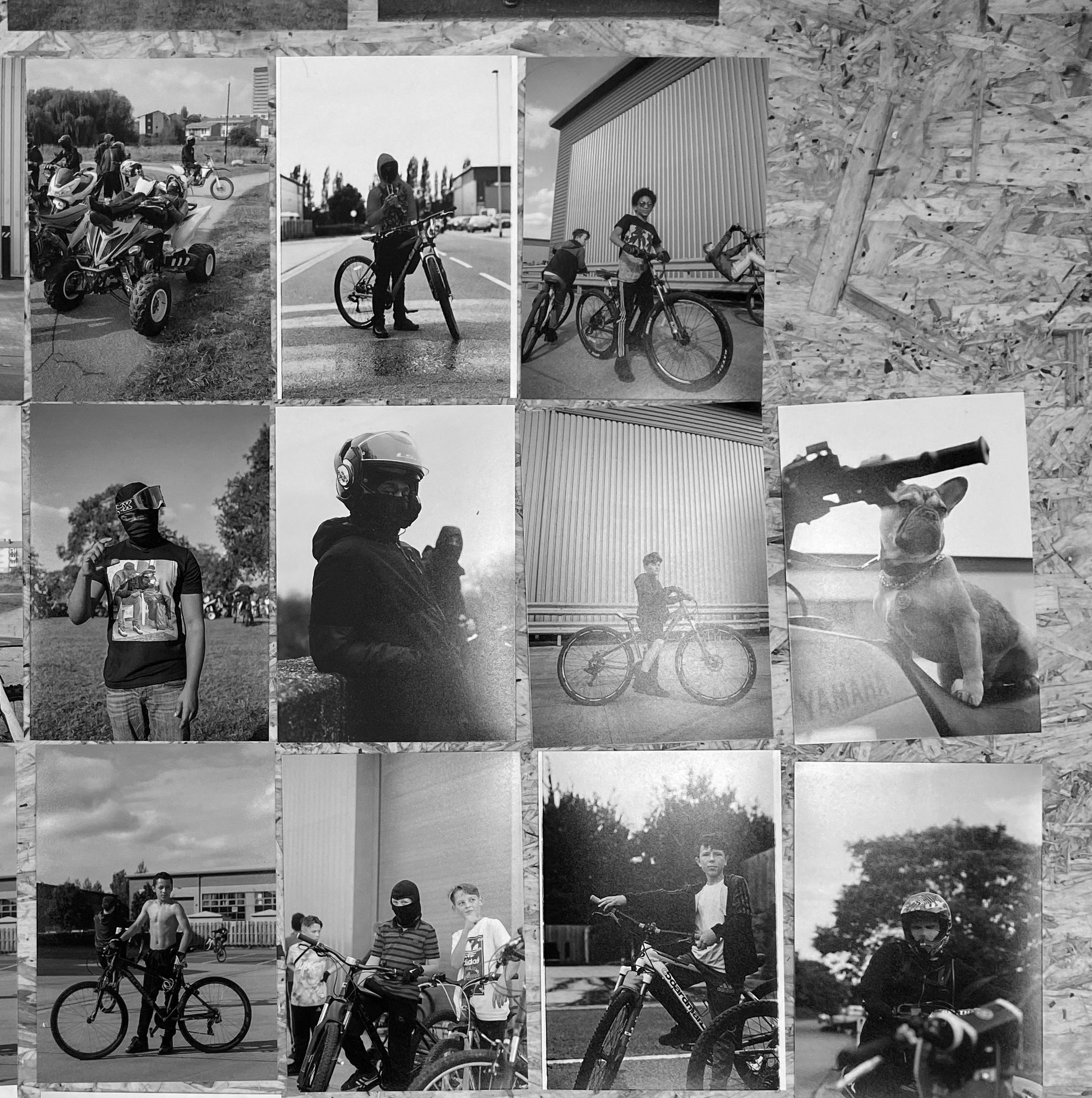
The first week consisted of trawling through hard drives and collating all of my images from a specific documentary project and then re-editing a chosen selection of images to be printed. The work in question was a documentary project shot around the UK over the past 7 years focusing on the bikelife subculture and movement. Revisiting old work with fresh eyes and new perspectives allowed me to view previously ignored work in a completely different light.
I then printed a wide selection of images for my second week at Talking Birds so that I could see the work in its physical form and as a ‘project’ for the first time. Having the space in the studio to lay out my photographs next to each other allowed me to see what worked together and create ‘categories’ and ‘collections’ of images. It also highlighted where the possible gaps are in the work, so that I can see what is missing and now plan what needs to be photographed in order to complete the project.
The Nest is a great creative hub, with clean and spacious studios to work from. I was lucky enough to experience two different studios due to my residency being spread across several weeks; Space Odyssey in my first week and Solid Blue in my second week. Changing my environment often leads to an increase in productivity and I was very lucky to have this unique experience of being able to enjoy two studios at The Nest.
An extra benefit was having interesting and inspiring conversations with staff and other residents. Other Coventry photographers were doing a different residency towards the end of my time at The Nest and I was able to show them my work for critique and exchange ideas / opinions.
Thank you to everyone I met at The Nest, I promise I won’t be a stranger. To any creatives in Coventry reading this, make sure you apply for a residency if you think you could benefit from it, as it’s such a great opportunity within the city.
(Paul Tafaro reflects on his recent Nest Residency)
Plan first
March 2022. I was pleasantly surprised to be offered a two week residency at Talking Birds. I clenched my fists and shook them, a gesture from footy. I’d found every excuse not to work at home. Here were two weeks, ten days, in a room, giving myself permission.
I had thought about writing this play for over a year. Subconsciously working on it perhaps. Every time I mentioned it, friends said ‘YOU HAVE TO WRITE THIS!’ I’d reply, ‘No you write it!’. Untrue.
A few months earlier, I had collated all of my notes (iPhone notes, email drafts, WhatsApp conversations, underneath loaves of bread) into a 29 page Word document. I distilled these notes ‘research’ into an 8 page scene plan. I had written out the plan a few weeks before the residency. The plan consists of scene headings, bullet points with tent poles of interesting things that should be included in the scene, the main action of the scene (the thing that needs to happen) with snatches of dialogue to consider including. This plan went through a few drafts, as I initially had fifteen scenes. When I have written a plan I know that the play can be written. On the residency I’d forget what the next scene was, but the plan steers me back and keeps me above sea level.
I figured I had a three act play. Nine scenes. One location. Each scene would be a mini pressure cooker play in itself. The audience a fly on the wall.
I had also worked out who would be on stage at the start of each scene. This was to create contrast, and focus on different dynamics within the play. Act I I C & E II A & D III B & C IV E Act II I A II D III B Act III I A II C
Interior design
On the first day of the residency, I completed emails before lunch, drawling the line under the first stage of another project. It took me two days to complete scene one. The longest scene (16 pages). The first scene of a play is sometimes tricky. I was introducing five characters and had some exposition. But it was also the scene where everyone, for the most part, is getting along. On the second day, I was behind, sat in the comfy chair and had a rest.
I was in the blue studio and decided to move the room around a little. On the second day, I had pulled out diva card #31 and asked for a computer chair from downstairs. This was kindly accommodated (brought up in the lift didn’t you know!) by Philippa. I adore natural light and faced the window but didn’t want my back to the door (opposite the window). I positioned myself near the radiator. This was partly so I could see if people were at the door. Whilst writing, I sometimes listen to classical music in the background – like Mahler or Shostakovich. Anything grand that I don’t need to dance to.
After the request for the computer chair, I realised that I’d also got used to the laptop at a particular height. I’ve lived in places without a desk before and used a chest of drawers that I opened up and balanced the laptop atop clothes. I was currently using some cardboard boxes and a Jamie Oliver (useful Xmas pressie) cookbook at home. What could I use here? Is that a bin?
It all seemed minimalist, possibly Scandi and in keeping with TB principles (I seem to have removed the bin for the photoshoot). Frances also kindly brought up the cushion in the photo for my arms leaning on the wooden table. I never knew I was this unbelievable. Scene a day.
Journey not the destination was that?
On the journey to the residency, I find myself noticing the tops of buildings. What was the story behind these? What were/are these rooms used for? There’s a moment when you drive into Radford, by Barr’s Hill, on a bus, that you are really quite high and can see quite far. I find myself wondering what the structure rising high above the rest was? Was it Warwick University? Was it, no surely, student accommodation?
On one journey, I see adult twins dressed in the exact same outfit, holding the exact same gym bag each. I think about mistaken identity … I wonder if there is enough lightness in what I am writing?
One morning at a stop, I watch a lady collect something off someone. She goes to another. I realise that she is asking for money. Out of four people, two stop and hand something to her. I think about what the money might be spent on? Who this person lives with? Why did I believe out of four people, four would not have given her anything?
12.38pm Lunch
The communal lunches were lovely. For an hour a day, everyone at TB generally gathers for their lunch downstairs, sometimes outside, if the sun’s got the memo it lands on Janet’s plants, everyone finishes their lunch and you can stay outside a little longer and sway to a summery song like Two Occasions by The Deele. For these two weeks you are freelance, child. On different days, different people are in. Some days my lunches lasted an hour, others two. Dez is an extraordinary raconteur. I needed any excuse not to work.
Plot twist
There would be an event and co-working day on Friday, the last day of residency – this meant no work Friday for me. Co-working days are a chance to chat and try brownies. Sometimes, I look at brownies through glass and imagine their taste. A van comes every day at lunch and sells food and drink. I haven’t bought a large Bakewell tart since Memorial park 2006 so I did relent once. I figured that I needed to finish the play on Thursday.
Work then
A working day might be 10.30 – 12.30, 2.30- 4.30 if the scene wasn’t finished, 9:30pm – 1:30am in the evening. A brilliant thing about the nest residency is that there is no expectation to create something, and you don’t need to be in the office.
I was surprised at how clearly the characters voices were in my head. One joy about playwriting, particularly when it works, is when characters surprise you. I had written out a plan with things that should be in the scene, but sometimes they didn’t end up in it, or characters entered the scene wanting something different (affecting but not changing the main action).
Some playwrights prefer to write by hand, even typewrite, but I like how the laptop can accommodate the speed of an actors thought.
Installation
The toilet upstairs is illuminated by a wondrous green light. I often used just this light when using the loo. It reminded me of a sort of nostalgic Megabowl laser quest/Drayton Manor ride which was potentially waltzers in the dark but I don’t remember. One day I was in there, I heard birds chirping? Later informed that this wasn’t from the NPO auditory access budget but real birds! Highly recommend a visit.
Wet Wednesday Will
Non-stop rain perfect working conditions. Dez made steps with a new score. I completed the first draft of the play. A year in the making, under the cover of rain. James Horner’s Brainstorm haunts me as we print double-sided. Feels like we we’re doing something forbidden. I had wanted to write this for a long time and was excited to get to the end. There were times when I’d come down for the communal lunch after an argument between characters (in my head) and the quietness of the adults in real life at lunch was an interesting juxtaposition. I really appreciated not being alone with my thoughts as one would normally write.
I used Thursday to learn how to put captions onto a YouTube video, thanks to an empowering tip from Janet.
I then spent a few days celebrating, resisting reading the first draft, a few more stretches of joie de vivre.
The residency was a beautiful experience. I had some lovely conversations. I spent one evening going to a dance class and another seeing The Batman. The weekend on another writing project. Knowing that I would be turning up for a few hours in the studio gave me a structure and time to focus. A laid back process. This was my first paid residency experience. Thank you very much.
melissandre varin reflects on their recent Nest Residency
i had my third residency with Talking Birds between the 7th and 18th of March – in-between spaces.
i had access to “Odyssey” studio space at the Nest, received £1000 financial support, and found comfort (once again) in a warm hug, a half-pronounced joke, an overdue catch up and a permission to be – me.
i ended up inhabiting the studio offered to me about 4-5 days across a 2 weeks residency, i never felt like i was feeling the space as i needed to. Was i avoiding the spaces i intended to investigate with this project? i guess that this question will stay in suspension. It is only at the last moment, last day of residency that i started to connect threads, bits and pieces of me in regards to this inavouée (undisclosed) feeling.
Where i needed to be was at linoleum dreams parked on the parking of the Nest.
But – i did not feel ready, in all the complexity of what being ready to re-visit an artwork i sweated in, dreamt in, loved in – could (have) mean(t).
i felt like avoiding, and accepting the fact that i came to this residency depleted for multiple reasons that i will keep silent in typed words but could expand on if you ever see me in the detour of a street, gallery, theatre.
– depleted – it is when i am most vulnerable to external forces. i felt the pressure to produce for the first time in a while at the beginning of the residency. But – returned to myself spiritually guided by (non)living ancestors. i paused on the fact, the need to have such pockets, portals, moments to come depleted, stay depleted – feel its wind of change and its static corners – without pressure to ‘sort it/myself out’. As an artist with mood swings, chronic depression, and care responsibilities – i never paused on the thought that maybe feeling whatever i am feeling, including depleted, did not have to be a feeling, space i needed to unknot but could – be – with/in.
Without performing Black joy, without performing Black queer trauma, without performing but being and trusting the fact that what was (not) happening was ok.
Sym and mel inside linoleum dreams, parked on the parking of the Daimler Power House, kindly supported by Talking Birds
i had pleasure though! Surrounded by beings i love and did not see in a while, taking time to share a cuppa, nurturing friendships learning about how/where Black queer artist friends grew up in in Dakar, Birmingham, Nairobi… working at Odyssey studio with a friend part of B.O.O.K (Building Our Own Knoweldge) working group, inspired by friend and collaborator Samiir Saunders i wrote the first version of my access rider (happy to share with anyone interested) – i got to know about myself and share it to the world.
Ok now that i am starting to list things it actually sounds like it was 2 full wholesome weeks. But i want to highlight the reality that these were interrupted with times when i had to cancel my days as i felt the need to stay still – i must admit that i spent a whole day watching Love Is Blind season 1 and 2 as well (learnt so much!)… . Also learnt a lot navigating the British Arts Show in Wolverhampton as part of a day trip investigating this aching research question: how do we create loving environments? (perspectives from Black queer artworkers who grew up on the African continent and in the EU/UK-based diaspora) –
this residency has been transformative – quite in line with most of Talking Birds’ work. as i am ending this annotation on the residency, i would like to share my love for the being making this organisation – a warm womb i (re)turn to while excited, on a high, depleted, lost ….-
Talking Birds, and its residencies programme is an essential example of what mothering could mean when it comes to the arts sector.
More on this slow-birth-ing creature i am working on or that is working within me in due course.
here is a snippet of a tentacle of this thingy that works and mixes my within for almost a year:
i would like to have conversations with members of my chosen family (mainly (Black) queer artworkers) this time and compile the transcripts of them – both work will inform a multi-language performance and multi-sensory installation i feel the impulse to make. With this project that lives in my heart i have the desire to investigate how senses of aesthetics, of what is art and what is not – are formed and informed by the built environment/ interior design/ furniture/ type of flooring / wall-paper and so on – we grew up in? How can this inform the creation of loving environments in the arts (too)? How can we create loving environments? Dissecting these questions by looking back at our immediate roots and acknowledging the power of ‘things’ in contributing in making us who we are now – i am currently thinking of expanding my understanding of my vibrant materialist approach.
As a dear being sent me on a low a couple of months ago: Octavia E Butler’s assertion in Parable of the Talents, “To survive let the past teach us”
These words will definitely find home on my skin through ink asap.















 Words from the Birds