PostPartum – Patsy Browne-Hope reflects on her Remote Nest Residency.

About me
My name is Patsy Browne-Hope and I am a Birmingham based choreographer, rehearsal director and freelance lecturer. I am currently researching and developing a short dance film based on the postpartum experience.

Transition
I am an ex-professional dancer who toured nationally and internationally with UK based companies and decided to step away from the profession in 2015 to start a family. Having my children and a break from the industry was like pressing a huge reset button. There wasn’t much time to really think about dance at depth during this time but to be honest, this was welcomed. We started a family knowing I wasn’t entirely certain where I would end up work wise on the other side and I found this an exciting prospect.

As it turned out (2 children later) my passion for movement and dance had not dimmed – I had just felt stifled creatively and needed a bit of time to lead a life not so consumed by dance after 12 years of constant training and working. Before my children I was feeling exhausted by the industry, a bit lost with direction and a bit low on self-esteem. After having my sons I gained perspective, cared less about what people thought and once sleep became a ‘thing’ again I felt ready to start trying to make sense of the world through my craft… I decided my first stop with this would be ‘Postpartum ‘…..

‘PostPartum’ is a short dance and movement film with original music that intends to highlight, celebrate and normalise the postpartum experience which sadly can be tainted by huge societal pressures. Both pregnancy and early motherhood had unexpected surprises for me. Strangers shared unwanted opinions on my body shape and I regularly heard ‘Mom shaming’. Comments on how a woman was raising her baby, when they chose to start a family, opinions on how much she works or doesn’t work, how they fed, how they slept. Nothing seemed to be off limits.

As new mothers we can find ourselves spending hours on end with a screaming baby, a body that doesn’t feel like our own and, thanks to raging hormones, a mind we don’t recognise. We should probably ask ourselves if the intense scrutiny of mothers is really all that necessary…

Why
My desire is to create some compassion through film; at a time when a woman feels most vulnerable, we hit her hardest with our attitudes and judgements.

I want to create something where new mothers feel a little less alone and a little more understood. How do so many first time Moms not know about all the bleeding, the colic, the mastitis, the intense sleep deprivation and the detriment this can have to her mental health, the loss of self and the knowing that eventually, you somehow manage to work it out.

Perhaps if they were armed with some knowledge, championing and solidarity they would cope a little better and be a little kinder towards themselves?

Talking Birds
Due to the sensitive nature of the topic and my desire to work with women from the community to help research this I was looking for an opportunity to test these ideas out on a small and intimate scale.

I was thrilled to be selected for a Fledgling Residency to help explore this. As a result I was able to develop a private research group on social media and run an online community workshop led by Lindsay Jane Hunter (Therapeutic Art Practitioner). I undertook deeper research into the ideas and themes found here and was then able to collaborate with Katy Rose Bennett (Composer) and Oliver Whitehouse (Filmmaker). Dancer, Lucie Labadie, came on board to help me test and explore movement language specifically for film.

Reflections
This is the first time I have been able to so closely communicate with collaborators on my own project idea. It has opened up many more questions for me and the vision I have for the work going forward which is incredibly exciting. I recently secured Arts Council funding for a larger phase of R&D into PostPartum and this development opportunity with Talking Birds has been the perfect precursor.

I am going into my ACE activity more informed about how we develop this work, how I successfully communicate my ideas to the collaborators involved, what works, what doesn’t and just how far I hope to push the visuals for the final film.

Mentoring
The final part of my Talking Birds support was concluded with mentoring from Janet Vaughan. I was able to spend time discussing the process, the outcome, what I would like to do differently and most excitingly, potential life for the final film. We discussed, at length, various venue ideas including unusual and outdoor spaces as well as partners to be considered and approached for the film development. This will be hugely informative to my next planning stages and I very much look forward to updating Janet on the project life!

Follow Patsy on Instagram

Tipping Point

Angela Mhlanga reflects on her Nest Residency.

Have you ever thought about the concept of ‘throwing away’? Neither had I, until I had a very interesting Google chat with Dominic of Ludic Rooms (a company based right here in Coventry). The gist of the conversation came from this concept of ‘throwing away’? What does this even mean? Where does all this stuff go? Stuff just moving from one to place to another. To quote Jerry Seinfeld, ‘all things on earth only exist in different stages of becoming garbage’. I pondered this on one of my now regular walks along Coventry’s Canal path. I had not long discovered the small minority in the city who ‘magnet fish’ in the murky waters. What on earth is that, you may ask? I indeed had the same question. The man made canal, built for the purpose of transporting/exchanging goods from county to county and once functioning as an additional life line to the city, has now become somewhat of a dumping ground of antiques and lost treasures but for the most part, a passing place of plastic and takeaway boxes. This bothers, but the silver lining is Coventry’s up and coming rise and it’ll be interesting to witness the Canal’s placement in all these developments.

Having these interesting and dynamic conversations with Dominic about Coventry’s relationship with water formed a unique focal point to explore – as for the most part Coventry is pretty much land locked.

On a not so particular day, I walked out of my front door and realized that I just about walked every direction out from my front door. I then remembered the entry to the canal – bridge number five to be specific. Off I went and set off for a new adventure. It was around about midday that I realized everybody and their mother was outside using their government issued hour – so it was not so much of the solitary walk I’d envisioned, but on that given day that’s exactly what I needed. Like a radio frequency all the bars within me had gone from red then slowly orange/yellow and just like that, green. The spring in my step restored as I gazed upon the boats, whistling with birds, dodging fast paced cyclists in balletic pirouettes as if living some sort of alternate musical reality.

The feeling didn’t last too long as I approached the long and dimly lit tunnel towards Gallagher – did I mention it was long? The solitude I’d initially hoped for somehow became very apparent. Then I saw the light at the end of the tunnel and kept moving. I began to think back about how I discovered the Canal, it was about two years after we’d moved to the city. It’s an easy miss but there’s a life force of its own that runs underneath the city. Back then the waters were clean-ish (well there wasn’t as much rubbish everywhere). Though this first walk was initially relaxing but the rubbish was always drifting in the corner of my mind.

A few months later, my sister and I took a walk in the opposite direction on a sunny day. The clear blue sky reflecting in the man-made waters, ducks in a row flowing in a steady stream and somehow coinciding with the piles of takeaway boxes, plastic bottles, foil paper and blue off licence bags.

One object in particular called out to me the most and I thought it’d be really interesting to explore the Canal for my Talking Birds residency. Particularly the scattered blue bags from off licence shops and Coventry market that have somehow found their way to waters. Blue in association with water usually represents serenity but the murky waters of the Canal were anything but, as the blue drifting around posed a looming threat for all the natural creatures trying to cohabit with the trash in this space.

Walking along and also noticing the reflections and shadows cast in the water inspired me to further explore the Canal’s essence.

Though scenic for the most part and providing a sense of ease and solace with a gentle movement of current, every so often that is disturbed by litter. Beer bottles, takeaway boxes and strikingly blue off- licence plastic bags (which I found particularly interesting as blue is Coventry’s color and often associated with water.) I explored this further – particularly in how the nature of the canal has adapted to this.

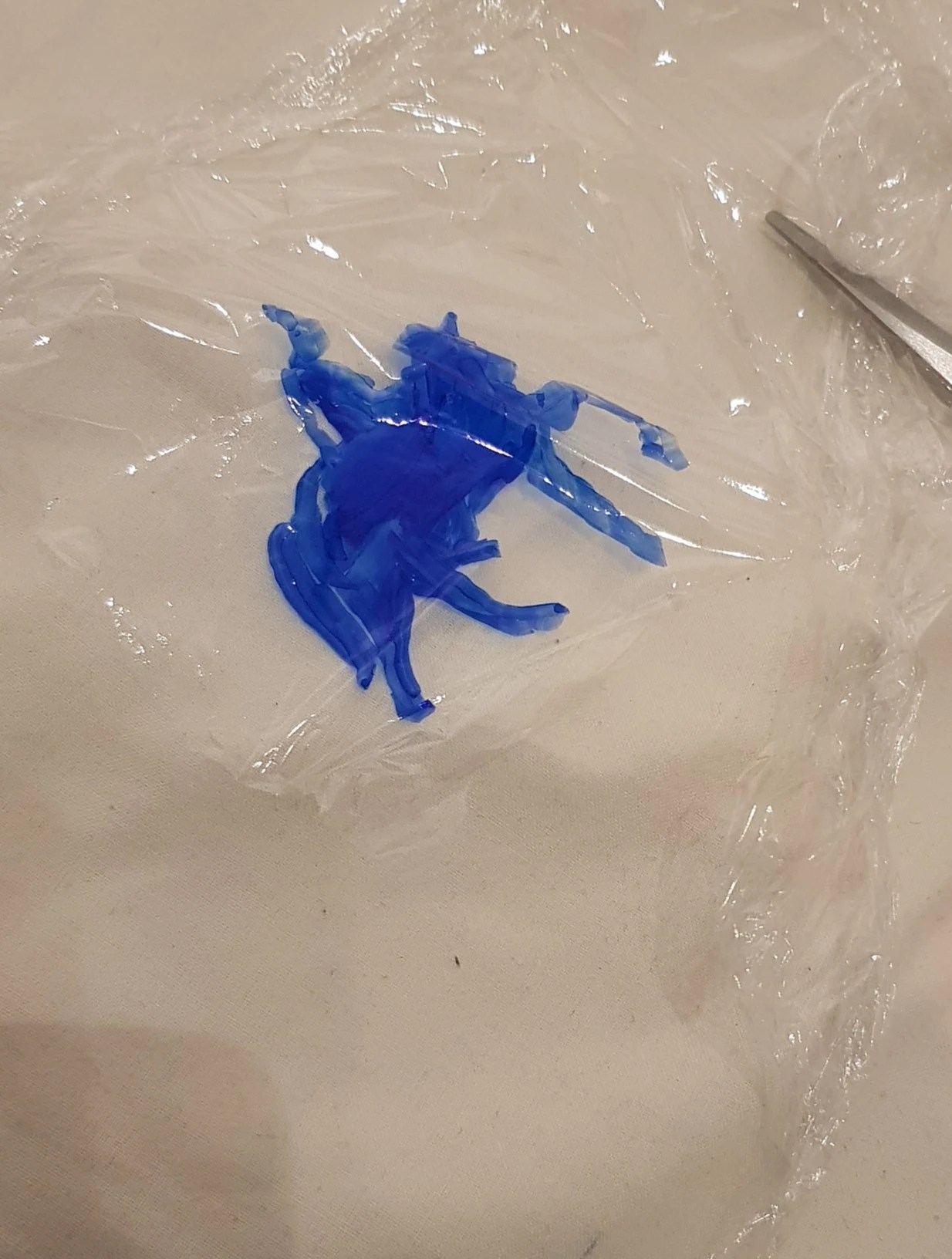
The materials used to create the puppet were a blue off licence bags with a plastic water bottle (magnet) fished from the water to create the bodice, synched in with the cuff of a Culture Coventry uniform.

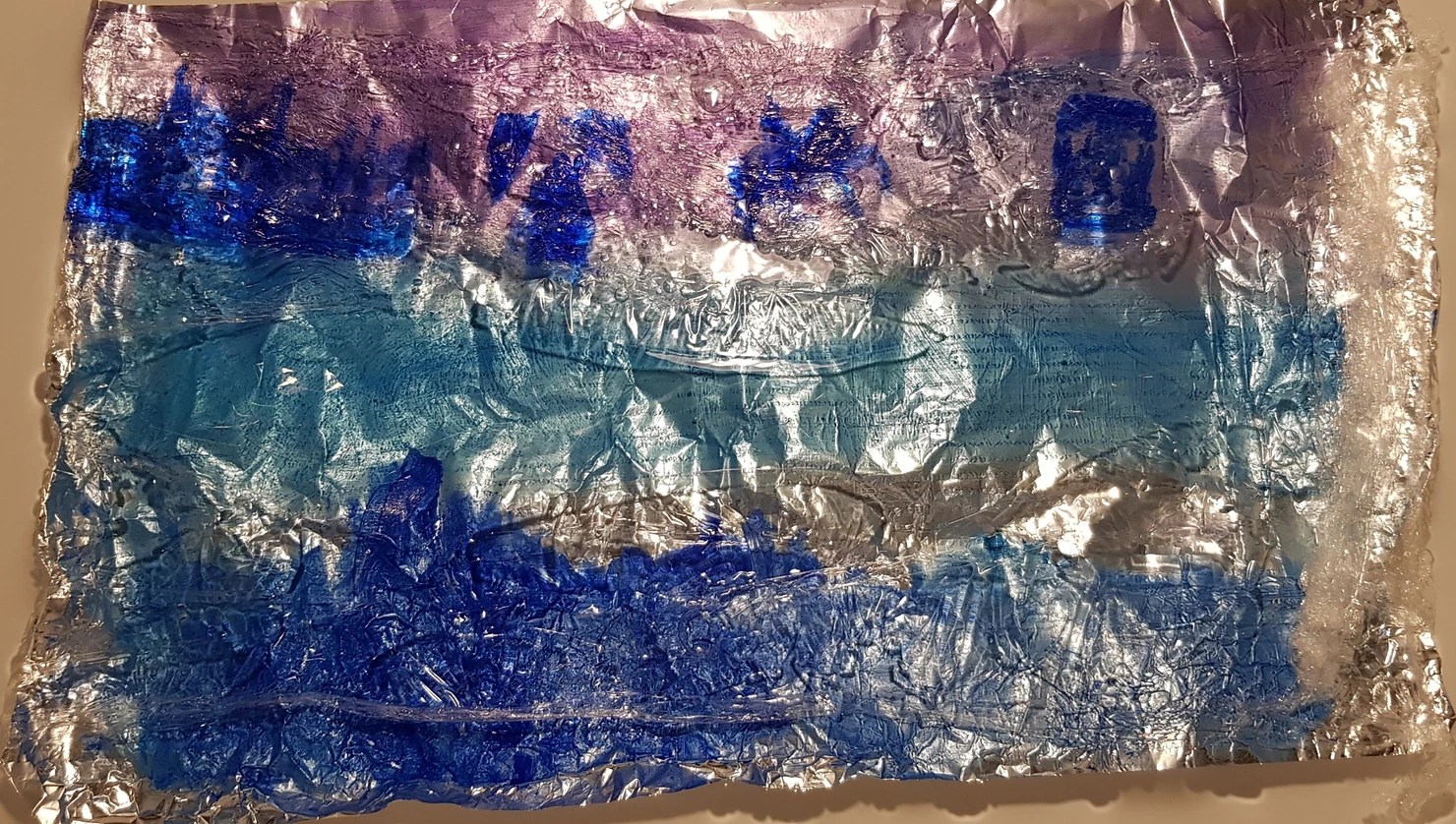
I then painted a background of hues on foil paper that feature a silhouetted crowd representative of the people of Coventry.

To add to the final layer of the piece- I used a blue marker to draw some of what Coventry is best known for, for example-: the statue of Frank Whittle, the logo for Coventry FC, Lady Godiva’s statue and an Outline of the Coventry Cathedral.

It was crucial to use materials that would cope with being submerged and not affected by the water- much like the litter found in the Canal.

Final projections

Filmed with a highlighted plastic bottle lens cap to create a filtered effect whilst in a way symbolically filtering Canal waters and revealing the beauty of the city. I hope to further explore this project with the help of the amazing Talking Birds company with the first flight residency and collaborating with Ludic Rooms. My aim is to help clean the canal, magnet fish and create sculptures from what I find in the water and rebuild the art trail. Time to to unclog our cities vessel and clean up the Canal!

“There is just wonder right in front of us, and we don’t spend enough time thinking about it.” — Michael Pollan

My artistic practice heavily involves the exploration of shadows, reflections and silhouettes. I’ve always been draw to these elements because that is the only way we can physically view ourselves. On a bright sunny day your shadowed figure mirrors your movements in synchronicity and is always right behind you. When you look at yourself in the mirror it is merely a reflection of you but somehow we’ve become accustomed to how we view ourselves this way.

As Coventry is formed of different energies, cultures and communities – I began to view the city more like a body and how the canal is a vessel. I began to value its importance and need for it. Spending a lot time around the canal has made me become consciously aware of its unconscious clogging. The level of plastic is suffocating to the environment. To detail my process: I knew I was searching for a solution and there were all these pieces of the puzzle hovering in the air, waiting to be put together. The canal is forgotten. The Art trail is abandoned. Almost as if the pieces of it were drowned in the water.

On a now regular walk along the canal path- I took my scooper and reusable bag and began my first round of magnet fishing. I picked up a lot of treasure – a blue off license bag, a plastic water bottle, foil paper, cling film and many other items but these in particular are the ones I decided to use.

Initially I had aimed to show reflections of the canal on iconic structures in Coventry (and I still might) in hopes of commenting on how, as ‘the body’ of Coventry, we view the city. I then came up with the idea of drawing iconic landmarks and statues of Coventry on cling film as I’d seen a lot of its scrunched presence surrounding the waters. I took a liking to the transparency of it but when I tested the sketches in the water, I realized that it was mainly the base of my tub that was bringing out these images. The practicality of it became unfeasible at this stage because one wouldn’t be able to see the projected images.

It was around about this time the foil paper stuck out to me, I began to think about how this would provide a perfect foreshadowing to the sketches of cling film. I thought about just having the sketches on foil paper and decided against it as the floating, threatening motion of the plastic in water differed from any other material I had found.

What can we do to make the city more ‘green’? In Coventry’s case, it’s more like, what can we do to make the city more ‘blue’? Blue like the sky or water. Blue represents clarity, stability and tranquility. In a city full of wheels and fast motion, the canal represents a break away for its residents or a moment of pause for the locals.

The lens I created from blue and pink highlighters and the bottom of a water bottle helped create the filter used in the final projection. The video itself metaphorically symbolizes the filtration of the waters whilst the sculpture, sketches and foil papered backgrounds represent the sources of materials that can be used to recreate the art trail.

When I first started this projected I’d hoped to run a lot of the tests by the canal but the sun set way late as it was still summertime then. My only other choice was to test these images in my tub – which in a sense follows suit with the man-made essence of the canal. Granted I didn’t have to adjust myself as I would have, testing outdoors but I rather enjoyed the solitary experience of forming my findings of what I had discovered from Coventry’s vessel.

For more detail about Angela’s work, visit her blog.

Home: people, objects, rituals and delineations of space

[Sinead Brady reflects on her remote Nest Residency]

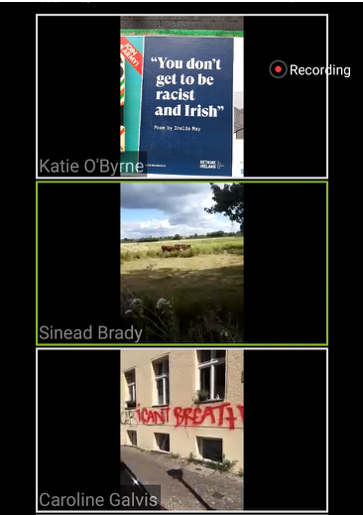
From my home in the UK, I recently collaborated with Berlin based theatre maker Caroline Galvis and Dublin based theatre maker Katie O’Byrne in a ‘Hatching’ Remote Nest Residency to explore the theme of home.
Caro, Katie and I met while studying an MA in Barcelona. We found a common interest in reshaping and reframing our collective history and formed international Rule of Three Collective to create theatre that celebrates togetherness.

Before the pandemic, whilst Katie and I were visiting Caro in Berlin, we began questioning what home means to us. Since then we have had lots of time to think about our surroundings in lockdown in three different cities.
Whilst working from home, we have each been adapting to physical and political changes on a private, local and global level. This has led us to pay more attention to our own rituals and routines and question our delineations of space: What do we consider home? Why does home exist within these parameters? What is our relationship to our home, the planet?
Having started previous creative processes by writing together, we decided that this time we wanted to try to begin from a visual perspective.

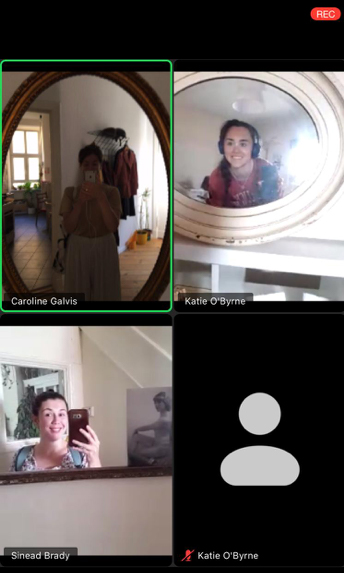
At the start of the residency we had an incredibly stimulating mentoring session with Janet from Talking Birds, which helped us consider how to approach the process visually. We were inspired to draw floor plans of our houses and maps of our local areas with places which were important to us. We took each other on virtual tours of our homes and neighbourhoods. Along our routes, alternating who would lead the way, we found similarities but also many differences.

We then began to explore our ‘home rituals’ through movement and were interrupted by all of the unpredictable things that can happen when working from home such as wardrobe doors flying open when jumping on old, creaky floorboards and little neighbours determined to finish their beginner’s level recorder practice.

We ended up paying a lot of attention to the sounds in and around our houses, comparing the different bird song we wake up to… do seagulls fighting outside your bedroom window count as bird song?
Another theme which emerged in our mentoring session was the idea of building and destroying a home or the contents of a home. Experimenting with this idea fascinated us – it was tricky to explore from a distance, but it is something we plan to look at when we are physically together.

The Remote Nest Residency helped us carve out space and time and provided us with the support to come together to experiment and create. The fact that we were given no specific deadline or end product goal was invaluable and really encouraged us to keep on exploring, sharing thoughts and working in ways we would not have felt as free to do otherwise.
The residency has enabled us to reconnect and refocus. We have found new ways of working together at a distance, which will have a great impact on our creative process when we are able to be physically together again.

**If you are an artist based in or near Coventry and you have an idea you’d like to explore, please consider applying to our Nest Residency Programme.**

Aliens, Autism, and Napping on the Floor

Katie Walters’ Nest Residency reflections:

For as long as I can remember, I have been obsessed with space! Although not so much in the way that you might expect from an autistic person; I have very little interest in the science of it all. I don’t know much about nebulae (I had to google for the plural), or space travel, or the names of any stars beyond our own. But my artist’s brain has always loved the *idea* of space. I like how big it is. The incredible potential of infinite planets! The possibility of aliens! And how very small and insignificant that makes our Earth.

When I was 15, my interest in space was thrown into starker clarity when I received a diagnosis of Autism Spectrum Disorder. The diagnosis itself was unsurprising. I’d always moved through the world in my own strange way, and by the time I was referred for diagnostic assessment, I was thoroughly alienated from my peer group. I already knew that I was different, and, more problematically, all the other kids knew too. But what did surprise me was how my diagnosis made me feel. Suddenly I was able to understand myself. It was like someone had turned on the lights. When I looked back over my life, for the first time, everything made sense. One of the many things I came to learn about myself was why I was so obsessed with the idea of other worlds. I wanted to believe in a world where I could make myself understood.

This is where Planet Alex came from. Planet Alex is a terrible novel that I wrote as a teenager in the aftermath of my diagnosis. And, thanks to my Nest Residency, it’s now a (hopefully less terrible) play!

Mainstream stories about autistic people usually have a few things in common: they’re about boys or men, they’re written by people who are not autistic themselves, and they address autism as a problem to be overcome. That’s a problem, because autism is not a monolith – the autistic community is vibrant, diverse, and thriving. I wanted to tell a story that was true to my experience of autism, which is strange and difficult, but ultimately very positive. As I grew older and moved on to other projects, I never stopped believing in the idea at the core of my terrible novel. I kept trying to find the right way to tell Alex’s story. My Nest Residency was the perfect opportunity to bring her to life.

I found out about Nest Residencies through a digital flyer on twitter, and knew right away that I wanted to apply. There was no pressure to produce anything, and the time was intended for experimentation. I didn’t need to worry about getting things wrong, so I was free to write something strange and new, and the opportunity was intended for disabled artists, so I knew that my access needs would be met.

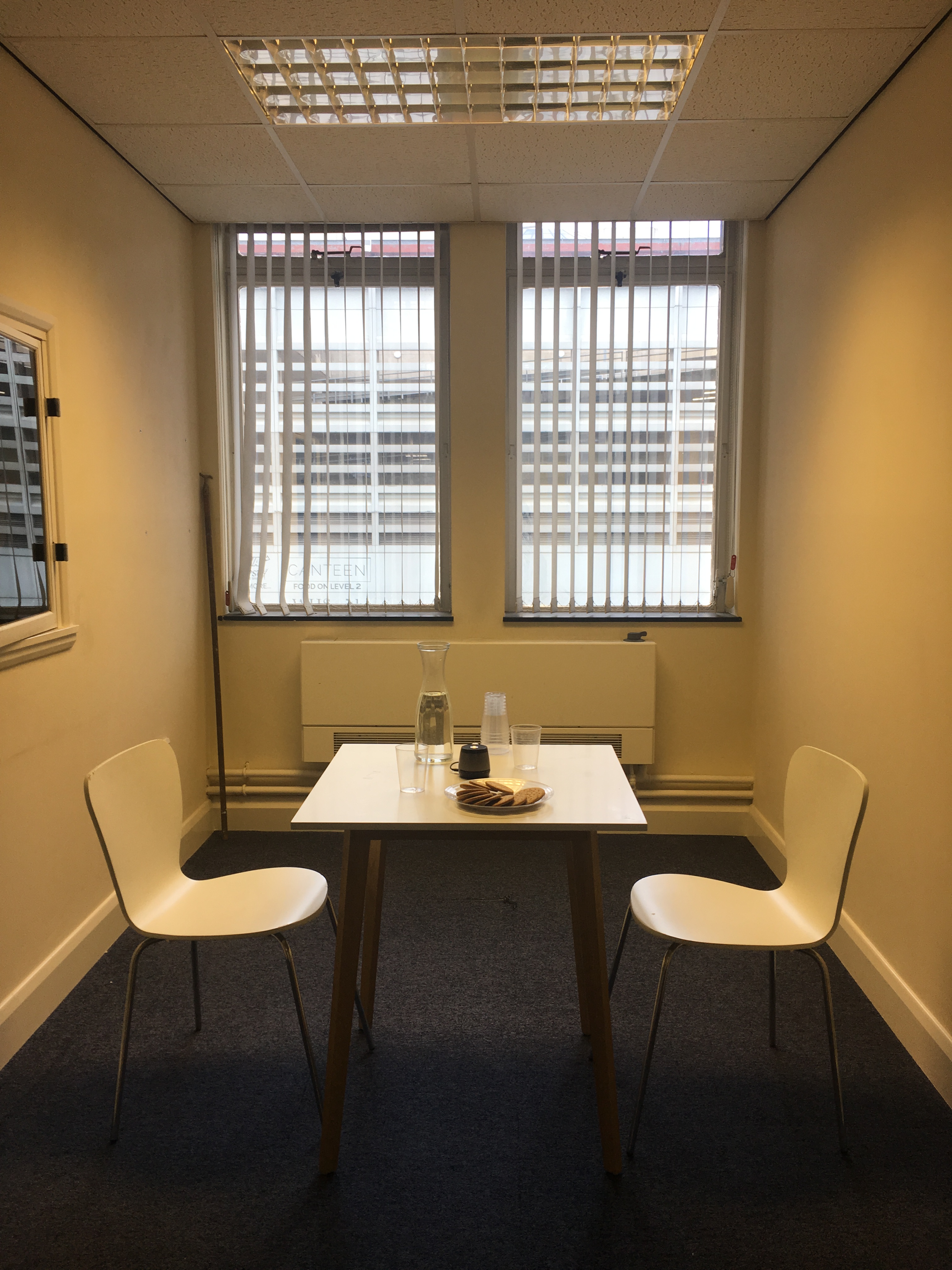
As well as autism, I have a chronic illness called Myalgic Encephalomyelitis (ME). It’s a complicated condition, and how it impacts me can vary day to day. Because it’s so variable, it’s very important for me to be able to work flexibly, take regular breaks, and take time off if I need to. Talking Birds provided me with a private space to work in, where I was able to set up a makeshift bed so I could work lying down if I needed to, or even take a nap! They were also very understanding of my strange work hours, which I keep because my ME seriously disrupts my sleep and makes it very difficult for me to maintain a regular sleep pattern.

Because of the support that my Nest Residency offered, I was able to make a really solid start to Planet Alex as a play, and I have a great foundation to build on moving forward with the project. I’m really excited to find out what’s next for Alex and her alien friend, and I hope that I’m able to bring her story to as many people as possible.

If you are interested in applying for a Nest Residency, you can find more details here.

(re)valuing the labour it takes to breath, be, perform together

Melissandre Varin reflects on her Work From Home Nest Residency:

This text and selected moving and still images are an autoethnographic account of my first art residency with Eole, 16 months old. I would not have the pretention to speak for Eole, thus I wish to highlight that articulations are mine.

I discovered about home-based Nest Residencies offered by Talking Birds during the first F13 Zoom meeting following COVID-19 lockdown. I was immersed in the image of feeling/being underwater at that time. I was partly feeling this way because I thought that I will be incapable of managing my multiple roles. I was not wrong.

image1-30
Making nearby Eole
(melissandre varin and Eole Varin Vincent April- May 2020)

I self-define as a Black queer artist-researcher PhD student doing Practice As Research while mothering 16 months old Eole. There is no strict order nor hierarchies to my roles, except that I am always other than a mother while caring 24/7 for Eole. COVID-19 lockdown forced me/us to act upon burning issues from the inside.

I re(-)member how it felt growing up both as a witness and a recipient of domestic violence – behind closed doors. Being/Feeling under the water I had to work around traumatic memories challenging the reasons why I would spend money I do not have in day care to maintain a distance between Eole and I or as I used to disguise it “to make sure that they have social interactions with other little ones”. I had to unpack the limitations of Eole’s and I’s mothering relationship, we played, with it during our residency. I ended up having a significant transformation of what I consider work, and how I perform, and I value it.

The experience of making nearby Eole was intense for the least. Eole and I were, in our own ways, challenging and articulating counter-hegemonic ways of holding conversations in Gayatri Chakravorty Spivak’s terms (2012). In doing so we were also (re)valuing the labour it takes to breath, be, perform, together, as I distanced myself from reading (except children’s stories) and writing (ethnograffiti-interruption) – weaving embodied dialogues instead.

image2-32

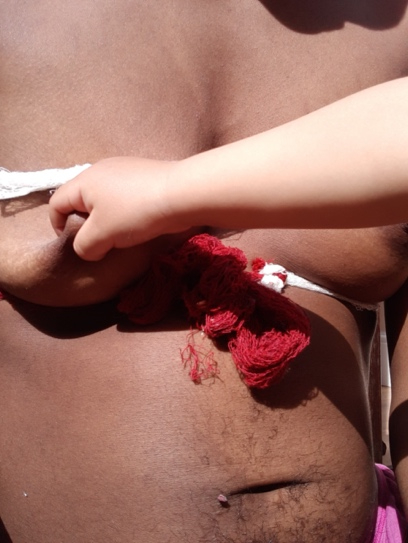
In this experimental approach to making nearby Eole, I facilitated ways for us to archive our work beyond our embodied memories. I took still and moving images alternatively with a smartphone or an old home digital camera as they were both sitting there, part of our home.

image3-34Jarring (melissandre varin and Eole Varin Vincent, 2020 + LaRi witnessing)
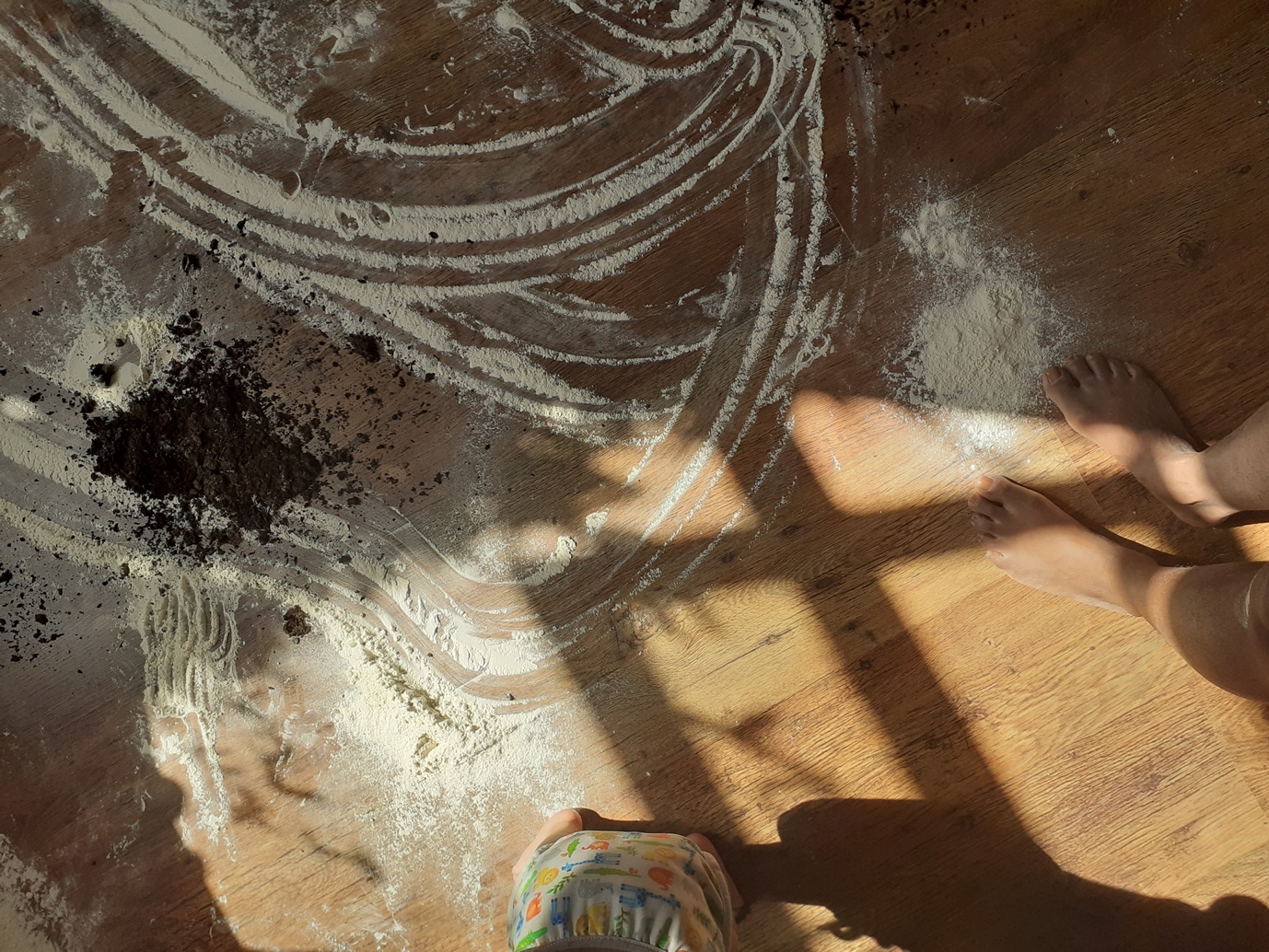
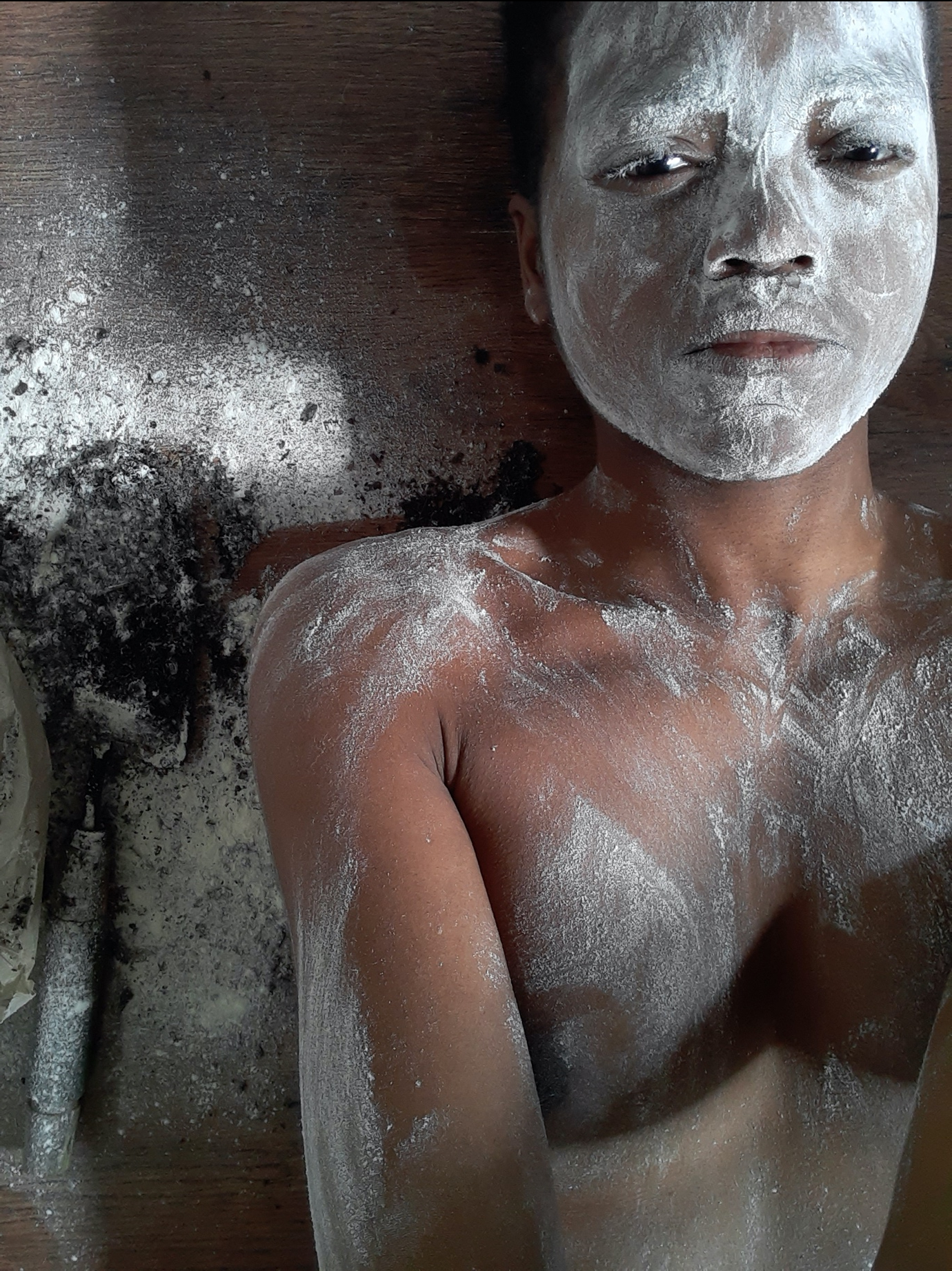
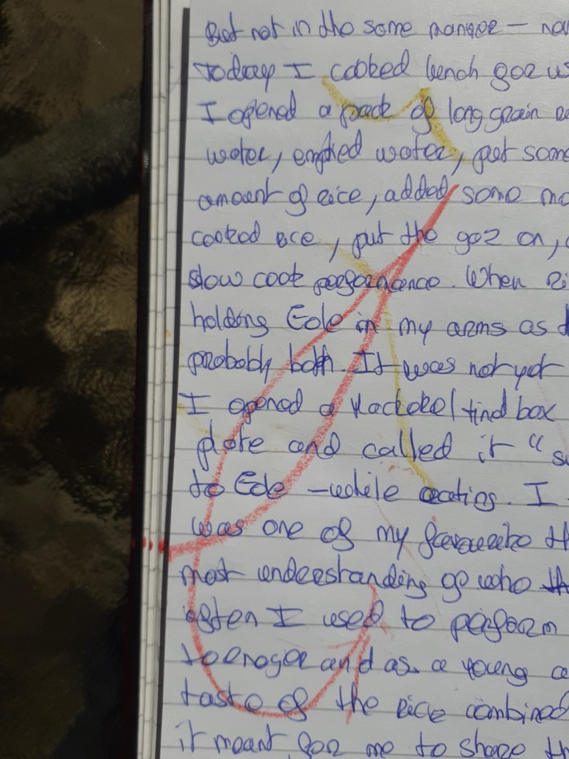
Early afternoon with Eole or late at night with Jb, my partner, we collected the remaining of our everyday performances at home gathered in ritualistic balayage (sweeping) followed by a jarring-process. We used a broom, a stainless dustpan and empty jars that were part of our home. This process brought me back to a master’s dissertation I wrote using a vibrant materialist approach when I was being trained in Environment and Sustainable Development. I have never undertaken paid work in this field but always felt that this baggage followed me in many ways. Here is another manifestation of it as Eole was leading the way in allowing me to lay down and critically observe the details of our living space and by extension of our relationships in/to the space.

Home was not the ultimate location of domesticity. I reduced its potential, as I (ab)used of this space attempting to domesticate it in order to construct a place where I finally belong. Divides between being with Eole in private and working in public were the heritage of a colonial/ capitalist/ white/ heteronormative/ patriarchal delimitations of my (im)possibilities. One of the roots of my complicity in partaking in this divide was my attempt to escape from what happened behind closed door during my childhood and still reproduce itself when I close my eyes.

My biggest challenge has been to have proper time to read and write. However, the fact that Eole have repeatedly negated me time to read academic books and articles gave us the opportunity to be attentive and focus on senses that I had underestimated in my artistic research. We sat together apparently doing nothing as we deepened our listening practice, listening to birds as spring unveiled, and we looked at each other. It can be framed as a political intervention into my PhD research journey as Jane Bacon write about her sitting practice (2010).

I noted that we share stories some of which have not yet been told but make us the different beings that we are. After Jenny Odell’s How to do nothing (2019), another book which I did not manage to read during the residency, but an online audio-visual presentation that Eole and I listened to, my practice is not so much embedded in a modernist idea of making but of finding. During this precious time, making nearby Eole, I found ways to take time and make space for us to be.

“I collect words from others’ mouth, fingers, and bodily performances. I re-call my present from observing my body and contemplating the most beautiful creation of mine/theirs be their own assemblages of us/them/its. I lay my body down and occupy space that I have had the privilege to imagine, to walk in, and I interrogate those who created them against marginalised others/us I ask – what if life did not have to be so complicated – for us too?

I thank you Eole for reminding me that there is more to life than throwing ‘garbage’ away by picking up, being amazed, paying your respect to the smallest, putting ‘dirt’ into your mouth, and protesting in front of me. What if I/They was/were wrong to forbid you/us to be, what if I had to learn from you to reconnect to our story, to the environment?” (nap time autoethnographic note, time: 11.23 date: 16/04/2020 location: CV56GQ)

Closely collaborating with Eole we worked around practice/notions of maintenance after performance artist Mierle Laderman Ukeles, in-betweenness both from Homi Bhabha and from Fleur Summers, and Angela Clark (2015) and deviant (Charles Esche 2011) mothering. My practice has been politically strengthened, gradually gained in gentleness and cracked into fluidity. Eole and I have started to pave routes for us to challenge gender norms as I walked/ran shirtless as a local urban intervention inside and outside during our daily physical exercises. We have contested monolithic discourse around figures of mother and on children inspired by Haircuts by children by Toronto-based Mammalian Diving Reflex. I have devised performances making visible gendered-racialised labours to which Eole added an extra layer of complexity https://vimeo.com/408973998.

We have immersed ourselves in flour and earth, queering conventional use of these materials to interrogate what life happening within four walls is ultimately about, drawing on racial, gendered, classist charges for a Black femme mothering a mixed-race being.

image4-36image5-38Documentation of “Of flour and Earth” (melissandre varin and Eole Varin Vincent, 2020)

We have performed for smartphone and cameras and for one another impatient to open the doors of this space to others when it is safe to do so. Eole and I spent a certain amount of time singing/screaming, laughing/crying, being as never before, and it seems appropriate to add that none of us have been hurt in the process.

I am extremely grateful for Talking Birds for supporting this deepening in my/our practice at the fictious interstices of public/private divides. Eole and I lived fully every moment of our first collaborative art-residency.

Sharing the love (chronologically):

Spivak, G. 2012, “Who Claims Alterity”, An Aesthetic Education in the Era of Globalization, Harvard University Press, Cambridge, Massachusetts, p. 57.

Bacon, J . (2010) Sitting/Walking/Practice: Reflections on a Woman’s creative process, Gender forum, an internet journal for gender studies, Gender and performance. Theatre/ Dance/ Technology, Edited by Prof. Dr. Beate Neumeier

Jenny Odell. 2019. How to do nothing: resisting the attention economy
2017. How to do nothing, online talk (57.29min) : https://www.youtube.com/watch?v=mNRqswoCVcM

Mierle Laderman Ukeles https://hyperallergic.com/355255/how-mierle-laderman-ukeles-turned-maintenance-work-into-art/

Bhabha, Homi K. 1994. The Location of Culture. New York and London: Routledge.
Summers, Fleur and Angela Clarke. 2015. “In-Betweenness: Being Mother, Academic and Artist.” Journal of Family Studies 21(3):235–47.

Esche, C. 2011, “The Deviant Art Institution”, in C. Esche et al. (eds), Performing The Institution, vol. 1, Kunsthalle Lissabon, ATLAS Projectos, Lisbon.
Holert,

Mammalian Diving Reflex https://mammalian.ca/projects/haircuts-by-children/

———————————-

If you are interested in applying for a Work From Home Nest Residency, you can find more details here.

“a demonstration of the importance of human connection”

Luisa Freitas reflects on her Work From Home Nest Residency:

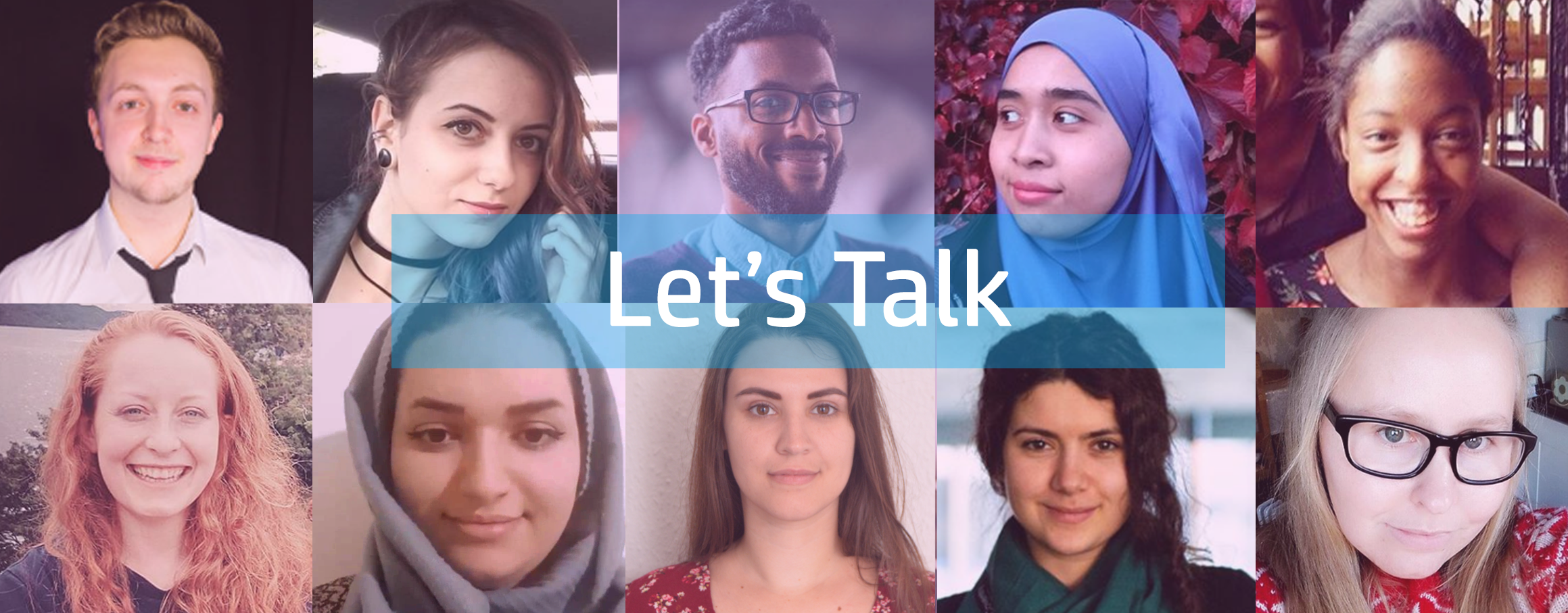
“Let’s Talk” is a social art project focusing on human connectivity shaped in the form of a platform where the audience can express themselves in an honest way, joining together groups of people from different backgrounds and therefore allowing strangers to get to know each other and their stories, in a way that otherwise wouldn’t be possible. The final product consist of a series of audio visual work through individual interviews, where each person is asked a question that reflects their personal experiences. This project was developed during a Fledgling artist residency supported by The Talking birds Theatre company. I got to know of the Talking Birds during one of the “Artist drop-In” meetings at Coventry Artspace and was immediately captivated by their principles in accessibility, social and environmental concerns and particularly searching for new ways to aid emerging artists from all practices to have a space to create their art. Since I’ve only created work about individual interests and inside my house, I felt that this was a unique opportunity to expand outside my comfort zone and create with the audience in a public environment.

LetsTalkLogo

Initially the production was supposed to take place in the Talking Birds head office but due to the initial virus Covid-19 outbreak (uh-oh) I was relocated to an art studio The Row in Coventry, but then after the official quarantine all art studios closed and I was (literally) sent to my room. I was so close to having my “real” first art-residency and now I was isolated in my small space once again, which was precisely what I was trying to change by placing myself in the outside world and work with the public for once. But I didn’t let that discourage me and I continued the project by focusing on what I believed in and what I was trying to prove: Art connects! So I altered the live interviews into online call interviews, and proceeded with the project. This drastic change in production meant that the visual quality of my work deteriorated significantly but on the other hand my reach of interviewees expanded considerably, and I managed to interview not only people in the city of Coventry but also in other areas of the UK and even internationally. I want to give them all a special thanks for having given their time to make this work possible, despite the limitations and concerns of the virus and its impact in their lives.

Despite the fact that there are few – but good – interviewees, the result was a success, there are not only three but four videos exploring questions ranging from very personal matters to abstract concepts such as “inspiration”. Naturally, being an art-residency, this platform also touches on the art discourse, now debated not only by artists themselves but also by members of the general audience outside the field of Arts. This union between the “outside world” and art practice has always been a passion of mine and thanks to this project I managed to bring the arts to the non-artistic audience together and allow them to talk about their experiences and thoughts about art.

This Fledgling residency really helped me organise my thoughts on this project and understand how far I can take this subject within my possibilities, and made me realise that what I actually intend to do is create an online platform about the art discourse itself made for the public with the public, in an accessible way and in this manner break the existing barriers between the general audience and Arts. This new platform will take its identity as a YouTube channel, under the name “Art Chat”.

LetsTalkbanner
In many ways this residency was crucial for my development in thinking outside the box, exploring themes I never have before, finding solutions to the obstacles presented during unprecedented times and meeting so many amazing people, who inspire me to try new things and meeting many more strangers to come. The Talking Birds was also incredibly generous and patient in allowing an extension of my work due to the situation with the quarantine, and so my residency which started at the end of March 2020, ended almost at the end of April 2020. But perhaps precisely due to the difficulties presented by the virus this project was more effective in its function as bridge between various peoples and the demonstration of the importance of human connection.

You can watch the videos on Luisa’s website, by following this link.

Outbreaks of kindness

There’s been some great and inspiring outbreaks of kindness all over the internet this week, demonstrating just how amazingly selfless and supportive the arts sector is. So many brilliant people and ideas, giving us a glimpse of how humans can shine in a crisis, how much better we are when we work together, and how this worrying time could actually sow the seeds of – or even prototype – a better world.

Continue reading

Discursive Ability

Jazz Moreton reflects on her Nest Residency

Having graduated with First Class Honours in Fine Art from the University of Gloucestershire in 2017, I spent years finding my feet and doing little bits of (mainly unpaid) work in the arts. After moving back to Warwickshire, I began to network with artists in Coventry. When somebody mentioned the Nest residency in a meeting, I knew that I, as an artist with multiple disabilities, had to go for it!

My residency was jointly supported by Talking Birds, Coventry Artspace, Coventry Biennial, and Disability Arts Shropshire, and would lead to whatever my outcome might be being exhibited in Coventry Biennial of Contemporary Art 2019.

I proposed that I, as an artist who had never worked with or edited sound, would create a sound-based piece that showcased the abilities that people with disabilities have, in the face of a government, and a wider society, that discriminates against us in many ways (my bugbear since graduation was that people still often assumed that I was stupid due to my neurogenic stammer and dysarthric speech) and, after a nerve-wracking interview with a gatekeeper-esque panel of arts professionals (who, upon getting to know them throughout my residency, turned out to be some of the most delightful people I’ve had the chance to work with), I was thrilled to receive the news that I had been selected.

My piece, which I titled ‘Discursive Ability’ at the point when somebody asked me what it was called for an interim exhibition, was my first proper socially-engaged work. Making it involved me inviting people that I either knew personally or had found through networking to my studio or going to public venues, workplaces, and houses and recording one-to-one conversations about their experiences as people that have disabilities.

7D9CC1AB-246B-4ECB-9FBA-1D2C280D5233I have lived with multiple disabilities caused by a ‘massive’ stroke when I was thirteen, and I have faced a huge amount of discrimination in most situations. However, it was easy to feel saddened, shocked, appalled by the discrimination- and even abuse- that other people told me, during our recorded conversations, that they had suffered, and do suffer, week in, week out, in Coventry. It is absolutely vital to remember that the issue of Disability Discrimination, inequality, and abuse exists in every locality across the country if not the world, and the sample of Coventry people that I selected were mostly not connected (apart from in the respect that they all knew me). It’s a bit sad that it takes an artist to start to talk about this, rather than world leaders, but there we are.
After recording a long series of fascinating conversations, I had the huge task of editing them onto one soundtrack (which took about ten times longer than holding all the conversations). Thankfully, Derek of Talking Birds is a sound-editing pro (amongst his other talents), and he was able to offer really useful advice, such as switching to a different piece of software (it’s lucky I’m a fast learner)!

It was fantastic to have a studio space that I could use for up to eight hours a day (based on bus timetables) to edit in. At the time, I was living on a narrowboat and didn’t have facilities (or, in fact, electricity and broadband) to make any sort of digital work, so the Nest enabled me to work in a way that I otherwise would not have had the chance to.

I showed the final version of ‘Discursive Ability’ in Coventry Biennial of Contemporary Art, which was my first major exhibition. Having my audio work displayed in ‘the Row’ has led to other opportunities, and I am currently working on an engagement project for the Midlands Arts Centre, for which I was head-hunted after their curator heard the work that I made in residence during the exhibition.

I’ve also been working really hard on scoping out other opportunities, and I have one or two personal projects at quite a conceptual stage. All I can say is that I will be back!

Jazz Moreton (see Jazz’s AxisWeb profile here!)

‘How fragile time is…’ Chloe Allen reflects on her Nest Residency

I first learned about Talking Birds when my friend told me about her Nest Residency at Eaton House. I decided to look them up online and was pleased to discover that they aim to make residencies more accessible to people with disabilities and conditions like myself. I graduated from Coventry University in 2018 with an MA in Contemporary Arts Practice and, until my Nest Residency began, hadn’t had access to a space to be able to make work for a whole year – so I knew that this would be a perfect opportunity for me and was so pleased when my application was accepted. My residency began in December 2019 and finished in February 2020, during this time I was able to further explore the effects that Narcolepsy has on my life. In 2012 I was diagnosed with the chronic sleep condition Narcolepsy, this causes me to experience Excessive Daytime Sleepiness and so I can have a sleep attack at any time anywhere. Due to my constant fatigue I often don’t leave the house for weeks at a time and so to have a work space away from home was a great motivation for me to actually get out of bed because I knew I had the chance to actually make work again. During my residency I felt content in the knowledge that I could take naps and not be disturbed, I was safe inside the studio space, I wouldn’t be in anybody’s way, taking naps allowed me to gain just that little bit more energy to then continue to make work once I’d woken up.

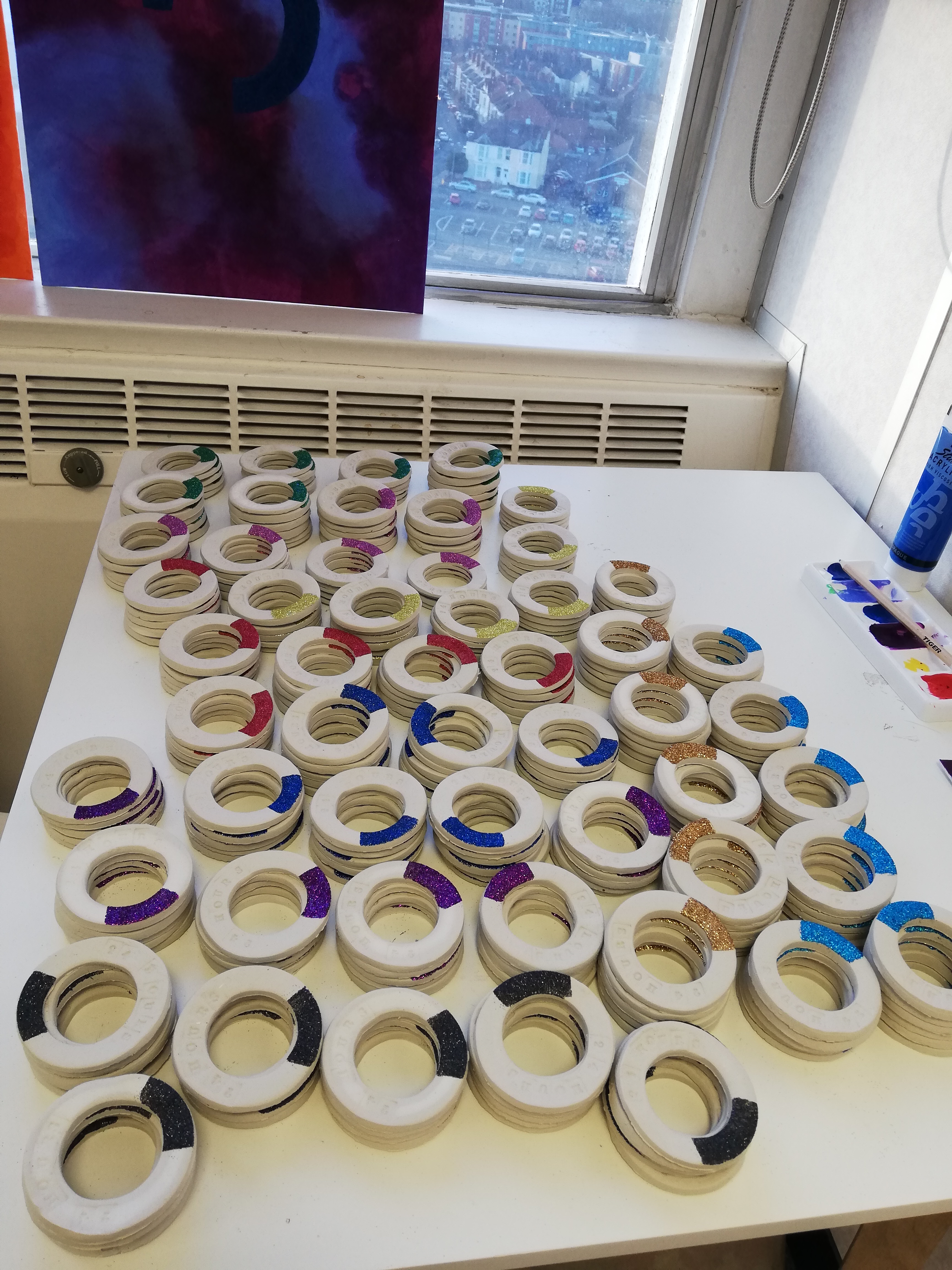
This residency has allowed me to further explore my ideas in relation to time being wasted due to Narcolepsy. For the past 5 years or so I had often used raising awareness for Narcolepsy as the main idea for my work but once I had graduated this all came to a sudden halt. Being in a studio space has allowed me to spread my work out across the floor and experiment with different ideas, having this space gave me the motivation to push myself further with my work thus I created 366 clay circle ‘time tokens’, had I not had the studio space I wouldn’t have been able to do this because creating something like that isn’t too easy on a cramped bedroom floor!

IMG_20200212_163031

To begin I started creating work in my comfort zone of acrylic on canvas, I’ve often used text art in my previous works and so knew that this would be something that I’d be pleased with aesthetically. I worked on canvas boards and the pieces were relatively small, after reflecting on this I decided that I wanted to make work on a larger scale especially since I’d got the space in the studio and so I got some plastic sheeting and bought some clay. The image of a circle was at the forefront of my mind, based on a clock. I began by creating rings from the clay with circle cutters, then cut segments from these circles based on how much time I’d wasted napping, I then used metal letter stamps to press words in to the segments, the words were the things I’d missed out on by napping e.g. family dinners, however, despite these turning out well I knew that I still wasn’t entirely achieving what I wanted. I researched into artists that created work based around time and came across Alyson Provax, her works in ‘Time Wasting Experiment’ really inspired me, she would state how many minutes were wasted and what the time was being wasted on. I could time every single nap I’d taken but because of my condition I don’t always get to choose when I nap and sometimes I don’t even know that I have napped – it’s sometimes hard for me to tell the difference between my dreams and reality because I nap do frequently. Narcolepsy affects me all day every day so I decided that I would make a circle for every day and instead of cutting out segments I would create segments on the circles with glitter. I created 366 (as 2020 is a leap year) circles, using different coloured glitter for each month. Each circle had ’24 HOURS’ printed on to them, each a token of time that we choose how to spend, the circles weren’t fired and so could very easily break, should they break this will only demonstrate how fragile time is.

The Nest Residency was so valuable to me, I was able to explore ideas, set myself bigger challenges and my importantly create work again. I also found it very useful to be at Eaton House and attend the First Thursday Drop-in, this gave me chance to network with other artists and instead of just explaining about my work as I had previously I also got to show people my studio space to that they could see the processes I was going through to create my work.

“Thought provoking and engaging with a neat pay off.” [Audience Comment]

We had a fantastic time testing the new version of Capsule at the weekend and we are really pleased with how well it works!

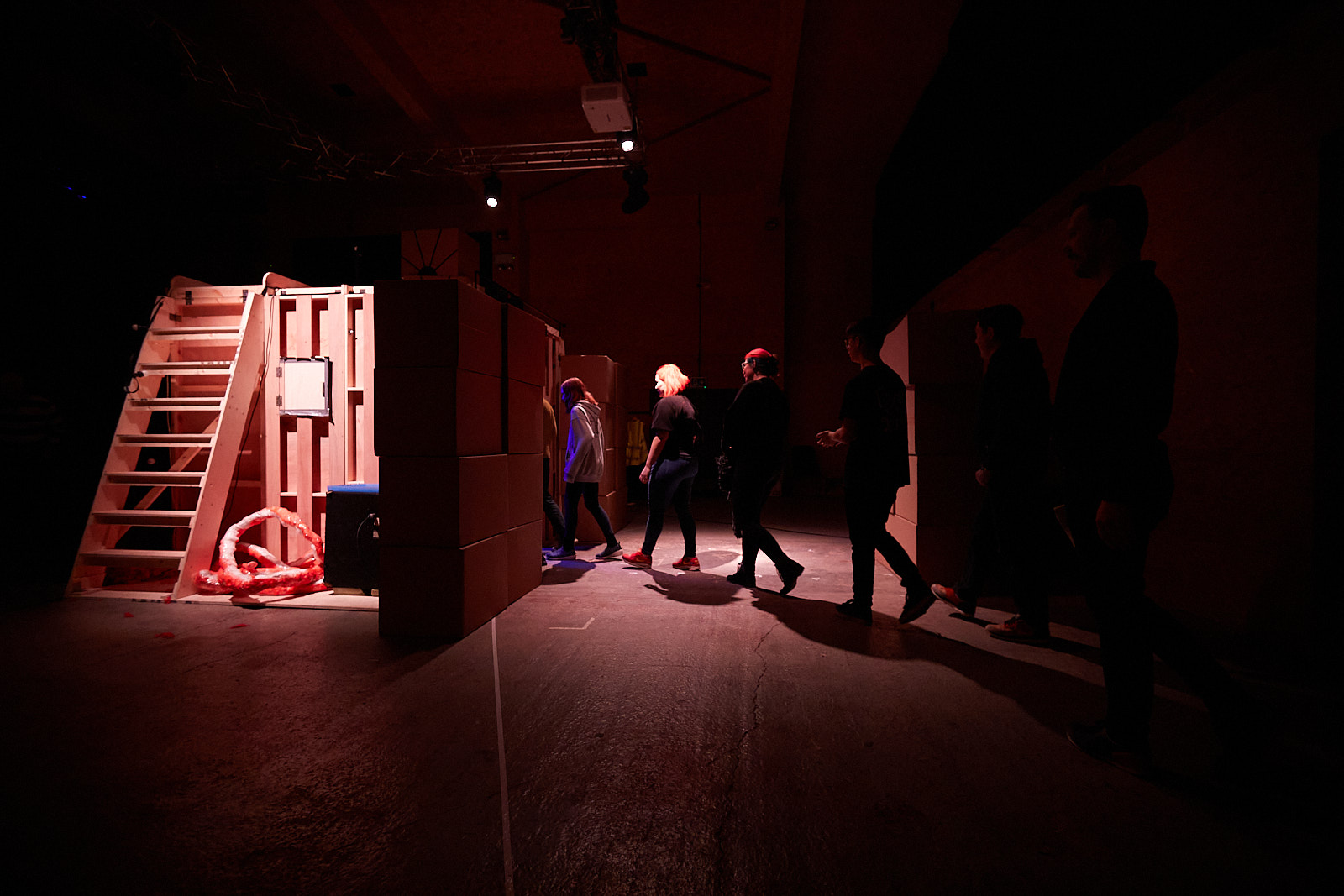
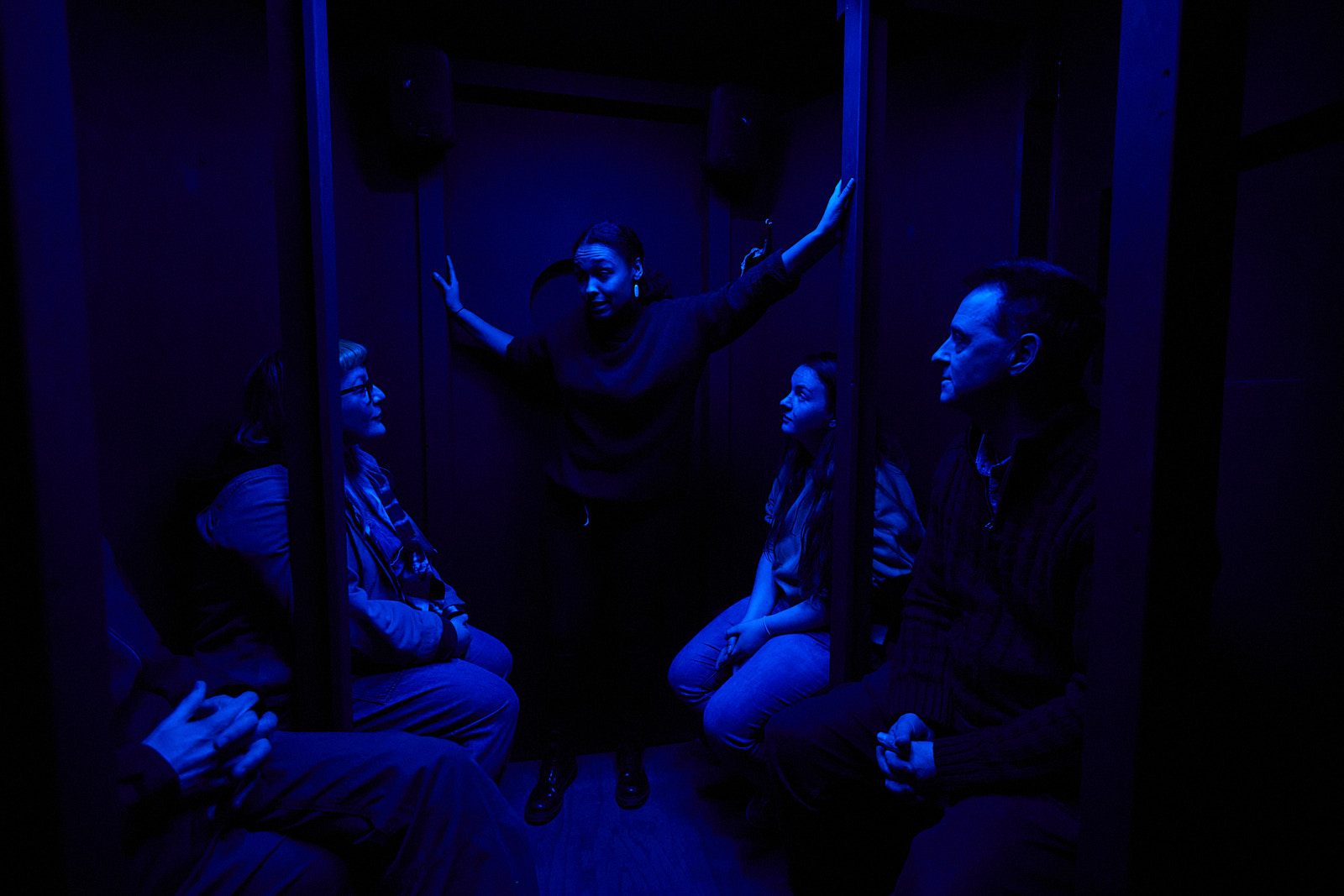
We can’t say too much for fear of spoiling it, but see below for some of the great feedback we received, as well as a couple of teaser pictures taken by Andy Moore. But where can you buy tickets? That’s easy… Right here! Public performances start are from this Saturday to Tuesday.

8933974E-84BD-4096-888D-83D870BC2C48

“Really impressed – it was fully immersive!”

AC6CB1D6-0243-4F82-8BF4-0B28CE149783

“Fantastic experience! A great way to spend an afternoon…”

ADF069D0-BC8E-459D-A52F-79632F2EA2C0

“A unique opportunity for audience.”

Capsule

What’s inside?

Capsule
The Box, FarGo Village, Coventry, CV1 5ED.

25th-28th January

Join us on an immersive, thrilling voyage over and under water where nothing is quite as it seems. You can expect music, an intimate story and, once you disembark, you’ll want to pass on all that you have learned.

Capsule is a unique experience for 6 people at a time, we’d love for you to be a part of it. See here for tickets and more info!

“A different kind of experience.”

Audiences for Capsule are capped at 6 people at a time, so make sure you get your tickets for your preferred time slot sooner rather than later to avoid disappointment! We can’t wait to share this experience with you, meet us inside…