On the occasion of Shakespeare’s 456th birthday, we thought we’d join in the #SaluteToStratford celebrations by reminiscing (only slightly self-indulgently) about our various brushes with the town over the years. It’s (almost certainly) true to say that Stratford holds a special place in our hearts (and that’s not entirely because of the excellent coffee and percussion instruments we have purchased on Rother Street over the years…)
Continue readingReflections and Thoughts
Outbreaks of kindness
There’s been some great and inspiring outbreaks of kindness all over the internet this week, demonstrating just how amazingly selfless and supportive the arts sector is. So many brilliant people and ideas, giving us a glimpse of how humans can shine in a crisis, how much better we are when we work together, and how this worrying time could actually sow the seeds of – or even prototype – a better world.
Continue readingDiscursive Ability
Jazz Moreton reflects on her Nest Residency
Having graduated with First Class Honours in Fine Art from the University of Gloucestershire in 2017, I spent years finding my feet and doing little bits of (mainly unpaid) work in the arts. After moving back to Warwickshire, I began to network with artists in Coventry. When somebody mentioned the Nest residency in a meeting, I knew that I, as an artist with multiple disabilities, had to go for it!
My residency was jointly supported by Talking Birds, Coventry Artspace, Coventry Biennial, and Disability Arts Shropshire, and would lead to whatever my outcome might be being exhibited in Coventry Biennial of Contemporary Art 2019.
I proposed that I, as an artist who had never worked with or edited sound, would create a sound-based piece that showcased the abilities that people with disabilities have, in the face of a government, and a wider society, that discriminates against us in many ways (my bugbear since graduation was that people still often assumed that I was stupid due to my neurogenic stammer and dysarthric speech) and, after a nerve-wracking interview with a gatekeeper-esque panel of arts professionals (who, upon getting to know them throughout my residency, turned out to be some of the most delightful people I’ve had the chance to work with), I was thrilled to receive the news that I had been selected.
My piece, which I titled ‘Discursive Ability’ at the point when somebody asked me what it was called for an interim exhibition, was my first proper socially-engaged work. Making it involved me inviting people that I either knew personally or had found through networking to my studio or going to public venues, workplaces, and houses and recording one-to-one conversations about their experiences as people that have disabilities.
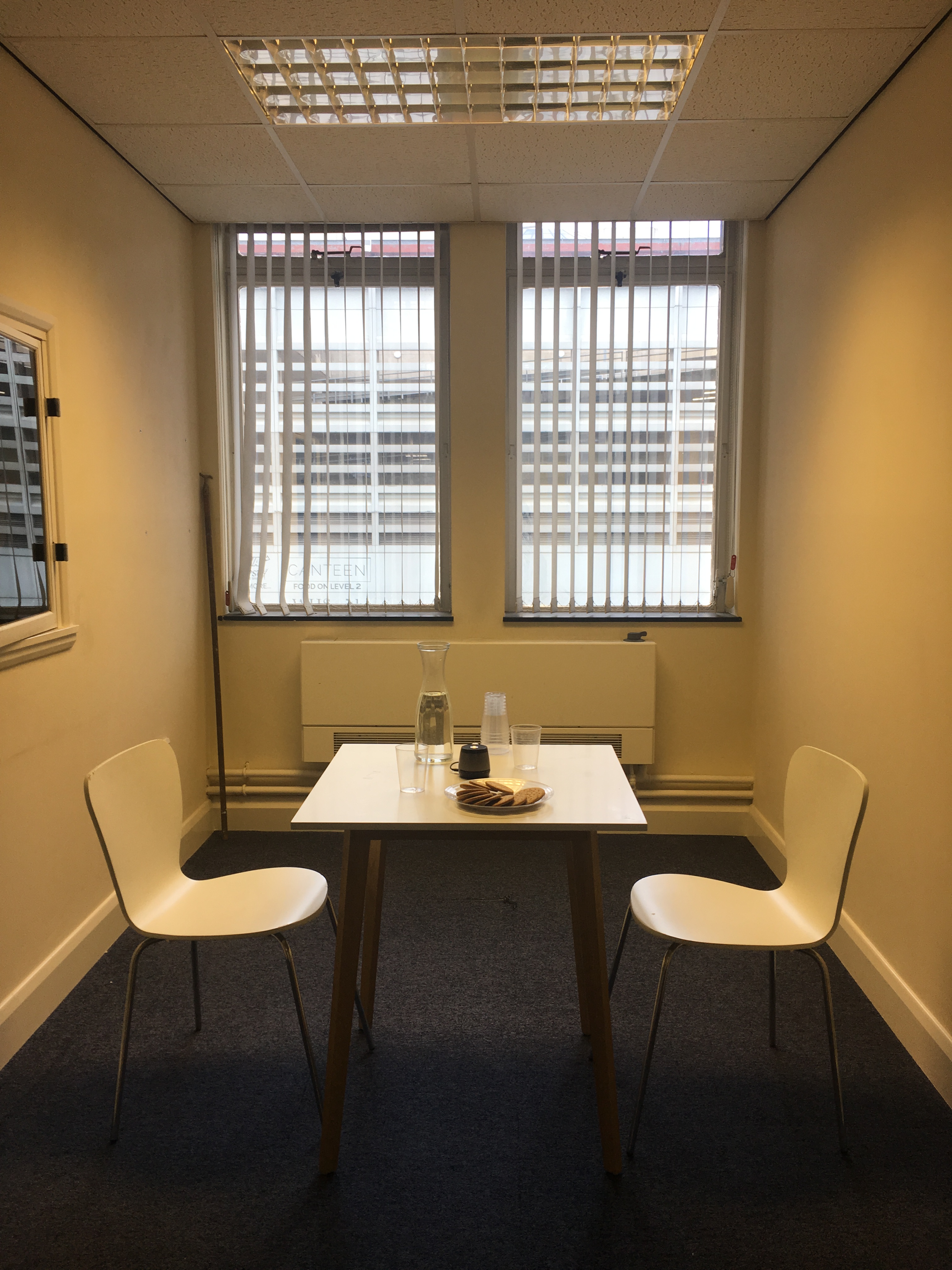 I have lived with multiple disabilities caused by a ‘massive’ stroke when I was thirteen, and I have faced a huge amount of discrimination in most situations. However, it was easy to feel saddened, shocked, appalled by the discrimination- and even abuse- that other people told me, during our recorded conversations, that they had suffered, and do suffer, week in, week out, in Coventry. It is absolutely vital to remember that the issue of Disability Discrimination, inequality, and abuse exists in every locality across the country if not the world, and the sample of Coventry people that I selected were mostly not connected (apart from in the respect that they all knew me). It’s a bit sad that it takes an artist to start to talk about this, rather than world leaders, but there we are.
After recording a long series of fascinating conversations, I had the huge task of editing them onto one soundtrack (which took about ten times longer than holding all the conversations). Thankfully, Derek of Talking Birds is a sound-editing pro (amongst his other talents), and he was able to offer really useful advice, such as switching to a different piece of software (it’s lucky I’m a fast learner)!
It was fantastic to have a studio space that I could use for up to eight hours a day (based on bus timetables) to edit in. At the time, I was living on a narrowboat and didn’t have facilities (or, in fact, electricity and broadband) to make any sort of digital work, so the Nest enabled me to work in a way that I otherwise would not have had the chance to.
I showed the final version of ‘Discursive Ability’ in Coventry Biennial of Contemporary Art, which was my first major exhibition. Having my audio work displayed in ‘the Row’ has led to other opportunities, and I am currently working on an engagement project for the Midlands Arts Centre, for which I was head-hunted after their curator heard the work that I made in residence during the exhibition.
I’ve also been working really hard on scoping out other opportunities, and I have one or two personal projects at quite a conceptual stage. All I can say is that I will be back!
Jazz Moreton (see Jazz’s AxisWeb profile here!)
‘How fragile time is…’ Chloe Allen reflects on her Nest Residency
I first learned about Talking Birds when my friend told me about her Nest Residency at Eaton House. I decided to look them up online and was pleased to discover that they aim to make residencies more accessible to people with disabilities and conditions like myself. I graduated from Coventry University in 2018 with an MA in Contemporary Arts Practice and, until my Nest Residency began, hadn’t had access to a space to be able to make work for a whole year – so I knew that this would be a perfect opportunity for me and was so pleased when my application was accepted. My residency began in December 2019 and finished in February 2020, during this time I was able to further explore the effects that Narcolepsy has on my life. In 2012 I was diagnosed with the chronic sleep condition Narcolepsy, this causes me to experience Excessive Daytime Sleepiness and so I can have a sleep attack at any time anywhere. Due to my constant fatigue I often don’t leave the house for weeks at a time and so to have a work space away from home was a great motivation for me to actually get out of bed because I knew I had the chance to actually make work again. During my residency I felt content in the knowledge that I could take naps and not be disturbed, I was safe inside the studio space, I wouldn’t be in anybody’s way, taking naps allowed me to gain just that little bit more energy to then continue to make work once I’d woken up.
This residency has allowed me to further explore my ideas in relation to time being wasted due to Narcolepsy. For the past 5 years or so I had often used raising awareness for Narcolepsy as the main idea for my work but once I had graduated this all came to a sudden halt. Being in a studio space has allowed me to spread my work out across the floor and experiment with different ideas, having this space gave me the motivation to push myself further with my work thus I created 366 clay circle ‘time tokens’, had I not had the studio space I wouldn’t have been able to do this because creating something like that isn’t too easy on a cramped bedroom floor!
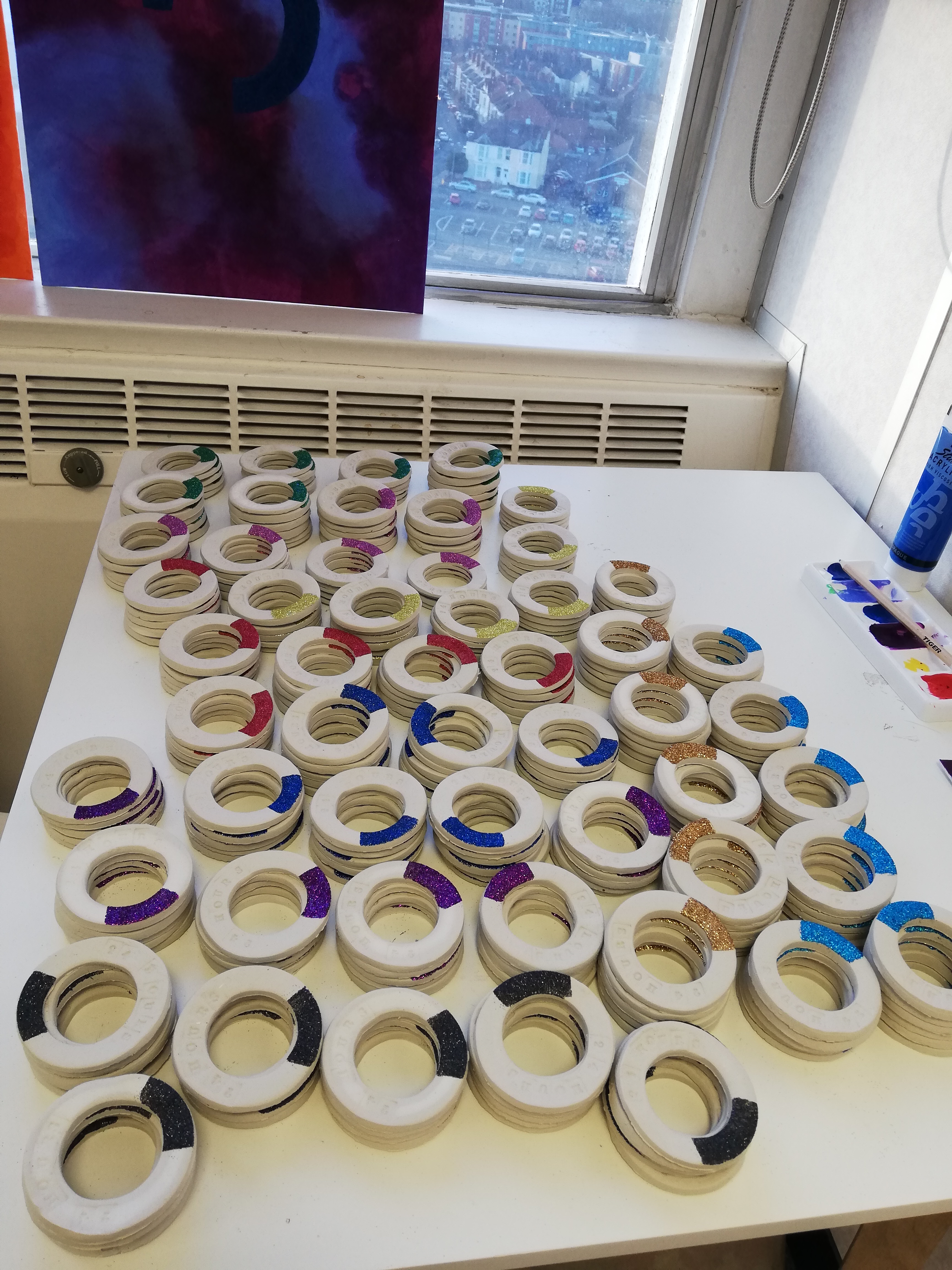
To begin I started creating work in my comfort zone of acrylic on canvas, I’ve often used text art in my previous works and so knew that this would be something that I’d be pleased with aesthetically. I worked on canvas boards and the pieces were relatively small, after reflecting on this I decided that I wanted to make work on a larger scale especially since I’d got the space in the studio and so I got some plastic sheeting and bought some clay. The image of a circle was at the forefront of my mind, based on a clock. I began by creating rings from the clay with circle cutters, then cut segments from these circles based on how much time I’d wasted napping, I then used metal letter stamps to press words in to the segments, the words were the things I’d missed out on by napping e.g. family dinners, however, despite these turning out well I knew that I still wasn’t entirely achieving what I wanted. I researched into artists that created work based around time and came across Alyson Provax, her works in ‘Time Wasting Experiment’ really inspired me, she would state how many minutes were wasted and what the time was being wasted on. I could time every single nap I’d taken but because of my condition I don’t always get to choose when I nap and sometimes I don’t even know that I have napped – it’s sometimes hard for me to tell the difference between my dreams and reality because I nap do frequently. Narcolepsy affects me all day every day so I decided that I would make a circle for every day and instead of cutting out segments I would create segments on the circles with glitter. I created 366 (as 2020 is a leap year) circles, using different coloured glitter for each month. Each circle had ’24 HOURS’ printed on to them, each a token of time that we choose how to spend, the circles weren’t fired and so could very easily break, should they break this will only demonstrate how fragile time is.
The Nest Residency was so valuable to me, I was able to explore ideas, set myself bigger challenges and my importantly create work again. I also found it very useful to be at Eaton House and attend the First Thursday Drop-in, this gave me chance to network with other artists and instead of just explaining about my work as I had previously I also got to show people my studio space to that they could see the processes I was going through to create my work.
‘…a totally enclosed window for us to explore, experiment, and create exactly what we wanted…’
Ryan Leder of Theatre in Black reflects on their recent Nest Residency:
‘Loop’ was conceived between myself (Ryan Leder, playwright) and Helen Crevel (performer) on a week-long residency in ARC Stockton. At the time, we didn’t know what we wanted to make – we arrived with only ourselves, a loop station, and a copy of Duncan MacMillan’s ‘Every Brilliant Thing’. Originally, we thought we were exploring legacy, but by the middle of the week – we were talking about a subject we both felt much more personal about: loneliness.
This meant we were making a show for people who felt lonely. This meant we couldn’t expect audiences to come to us. We needed to make a show that reached our audience physically and with resonance. Walk in: Talking Birds.
Our introduction to Talking Birds was one of those wonderful accidents – I was taking part in China Plates’ Optimists scheme where Talking Birds were a guest speaker. As they spoke about non-conventional spaces and reaching audiences, I felt like the stars had aligned. I only approached them to ask for some advice, but was instead encouraged to apply for the Nest Residency. We did, it was successful, and suddenly the whole project seemed considerably more achievable.
Our residency took the form of: a week-long research and development in Theatre Absolute’s Shop Front Theatre in Coventry: a financial contribution to help with the costs of that week: access to the difference engine for ‘Loop’s tour this November/December.
For those of you unaware, Shop Front Theatre is exactly as it says – a converted shopfront in a shopping centre, now one of the most exciting and unique theatre spaces in the Midlands. The team and I personally dubbed it “the perfect place for research and development, the worst place for rehearsals” – because being there didn’t feel like work.
There was no pressure, no outside eye asking us to justify our time – we were in a safe and supportive space that we were allowed to temporarily make our own. We were literally given a key – and thus offered absolutely flexibility to work exactly how we felt necessary for the process. It was a joy to travel to that space each day – and some of the best work of my career so far took place with the city centre right outside the theatres window walls.
The financial contribution was the addition that made it feel as though the whole thing was too good to be true. So often at these emerging stages space and support can feel like all you deserve, but Talking Birds recognised the time and risk involved – and offered to take it off our hands. Suddenly the space they’d provided became not only a physical one, but one in time – a totally enclosed window for us to explore, experiment, and create exactly what we wanted for the betterment of our audience.
At time of writing, we are a few weeks away from rehearsals for ‘Loop’, and Talking Birds’ support has been integral. The show has grown and evolved in ways that we couldn’t have anticipated 2 months ago, yet alone one year, and we now feel like we have something that can truly achieve our aim of reaching audiences, physically and with resonance.
Thank you to Talking Birds.
If you’re interested seeing our show, we’ll be performing at:
The Core at Corby Cube, Nov 22nd
ARC Stockton, Nov 27th
Mansfield Old Library, Nov 28th
Arena Theatre, Nov 29th
Forest Arts Centre, Dec 3rd
Attenborough Arts Centre, Dec 5th
Ryan Leder, Theatre in Black
Cinematica: Artist Rosa Francesca reflects on her Nest Residency visualising brain data.
Artist Rosa Francesca reflects on her Nest Residency:
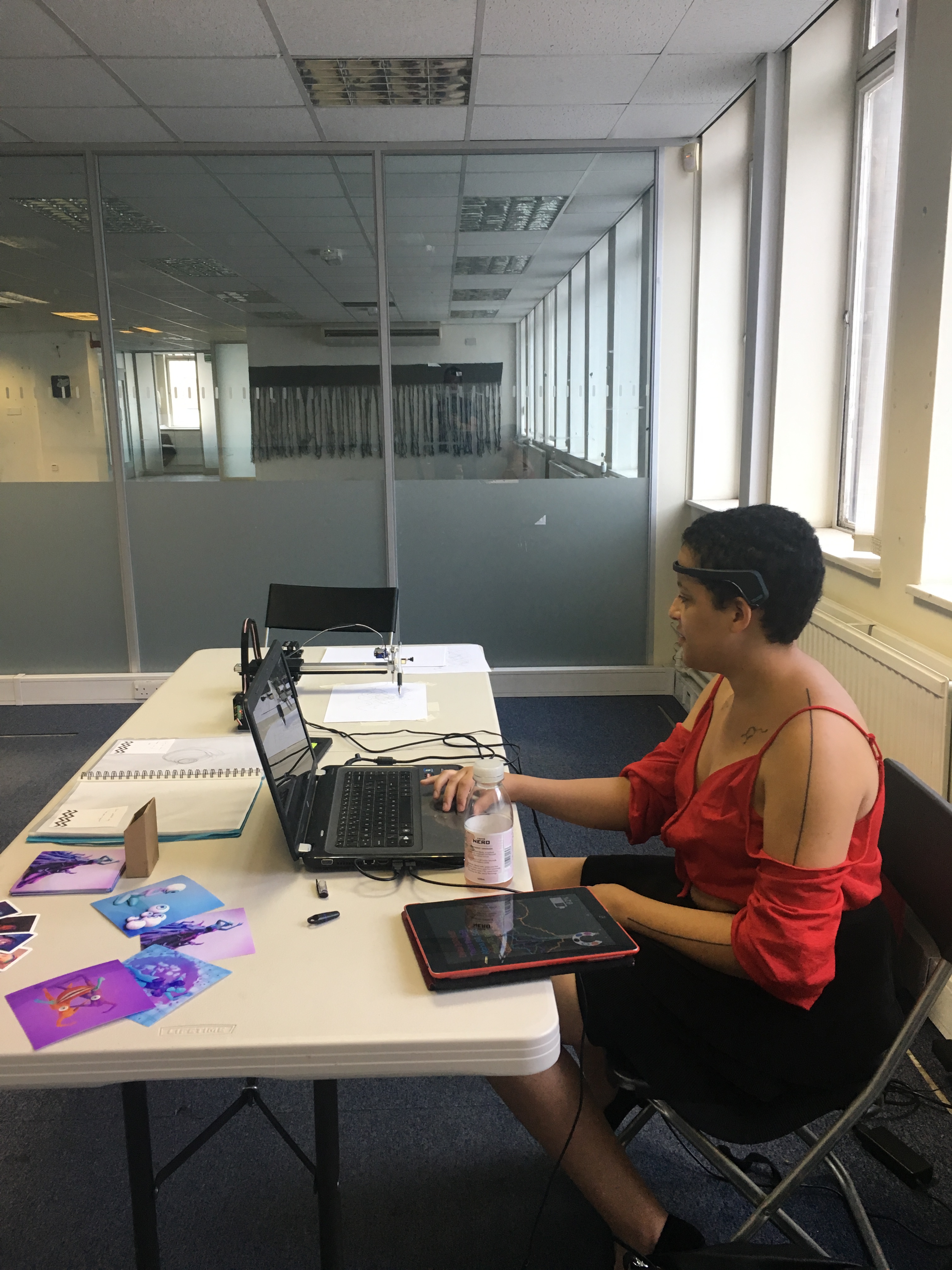
Cinematica is a digital art project using an EEG monitor in conjunction with an XY pen plotter to create visual art. The participant is invited to wear the EEG headset and their brain data will then be sent to the plotter giving it directions in which to draw, producing in the end a ‘mind-controlled’ drawing. This project was developed during a Nest Residency supported by Talking Birds.
I began my residency at the start of June 2019, and I had applied to Talking Birds in particular after hearing about them through the Coventry Biennial open call. I was particularly impressed with their commitment to accessibility, working with disabled artists, and creating environmentally conscious work. I felt that their views aligned with my own, and in particular related to the aims of my work.
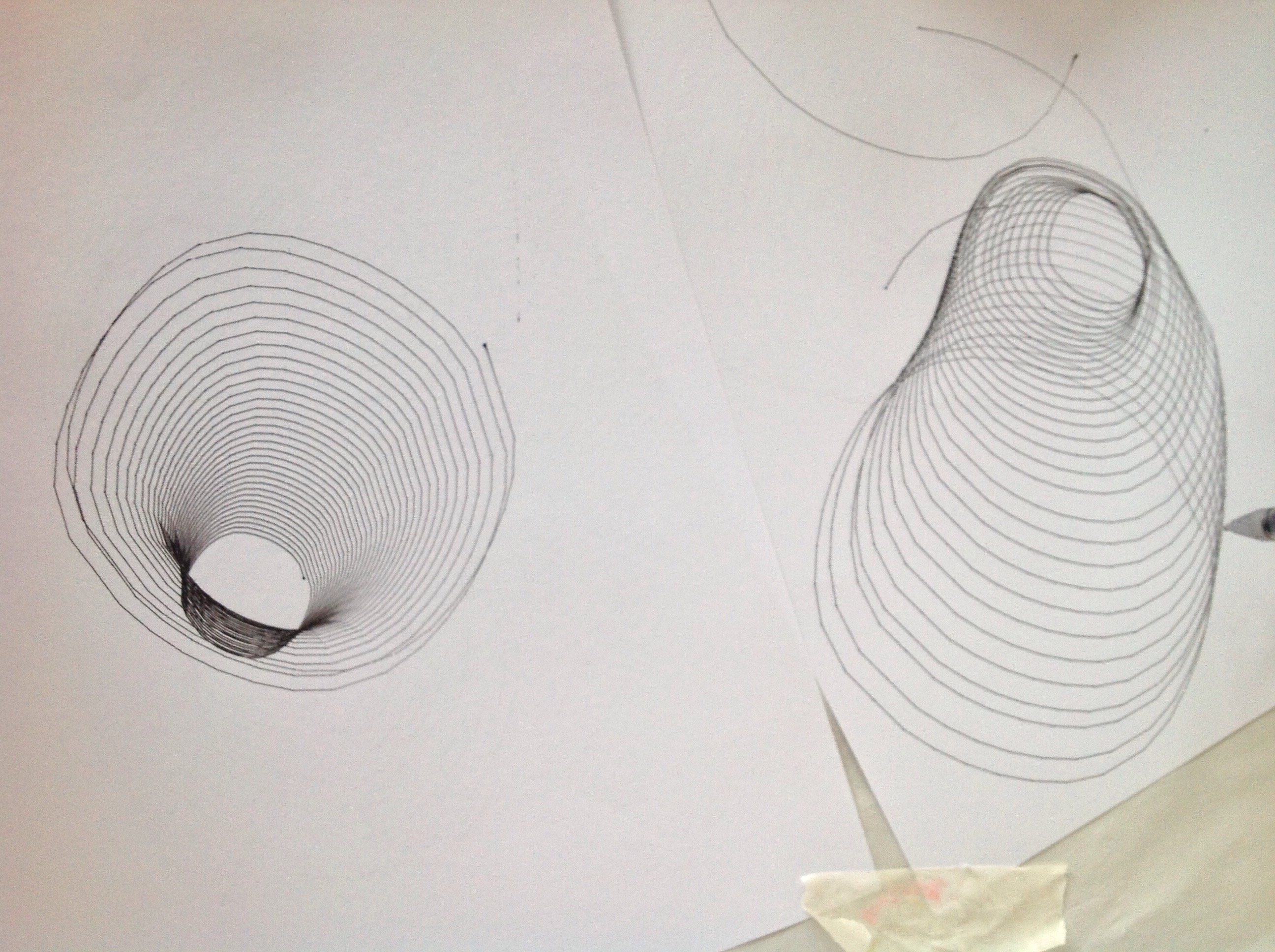
I first had the idea for Cinematica after being diagnosed with Tourette Syndrome at the start of 2018. I had suffered from motor tics and a few vocal tics for most of my life, and waited until adulthood to seek diagnosis. Although it no longer affects me as harshly as it did during my teenage years, I am a member of an online community for adults with Tourette Syndrome and can see the debilitating effects on others less fortunate than myself. One man described how he was no longer able to make art because of his motor tics which rendered his hands to unsteady to hold a pen or a paintbrush. Other members suggested that he tried digital art, but he wanted the ability to create a physical drawing. I decided then and there to create a means of physical art creation without the necessity of fine motor skills.
I had recently purchased an EEG monitor for artistic purposes anyway, and thought it might be good to put it to good use alongside a plotter, which is a robot arm that draws with a pen and paper moving along an XY axis. Through my Nest Residency, I was able to get support to purchase a plotter and to learn to manually code it and figure out how to send data from the brain monitor to the plotter to create real life brain drawings.
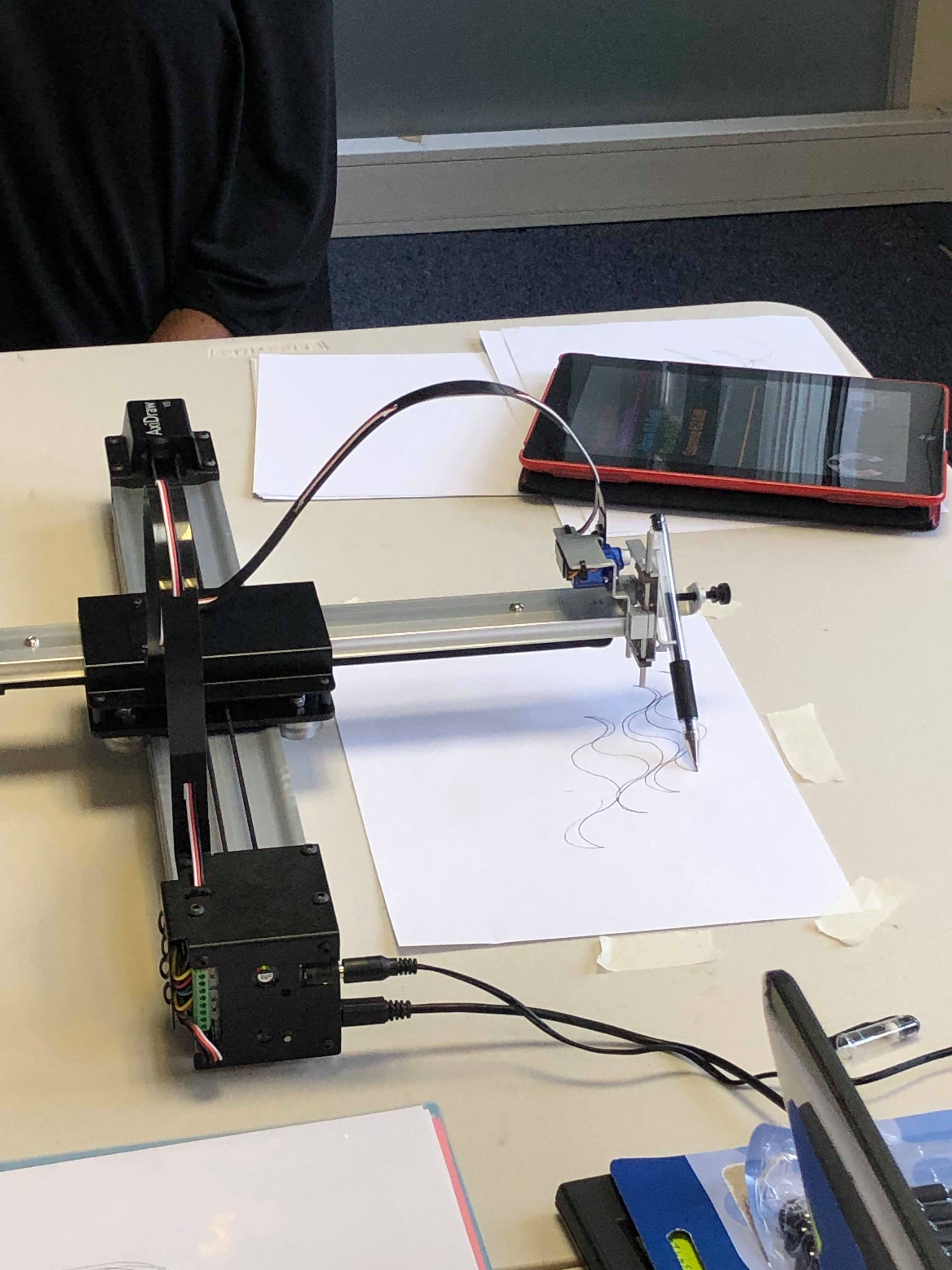
The residency was invaluable in that it provided me with the physical space to contain the machinery, but also gave me a space away from home where I was able to focus all of my attention on this project. Without time constraints and deadlines I was able to work freely without pressure, but the space still allowed me to stay motivated. Janet provided an incredibly useful sounding board, as did other studio holders in Eaton House where my residency was based. It was a wonderful opportunity to meet other local artists and connect with like-minded individuals, and I hope to stay in touch with some of them through the regular Artspace networking events.
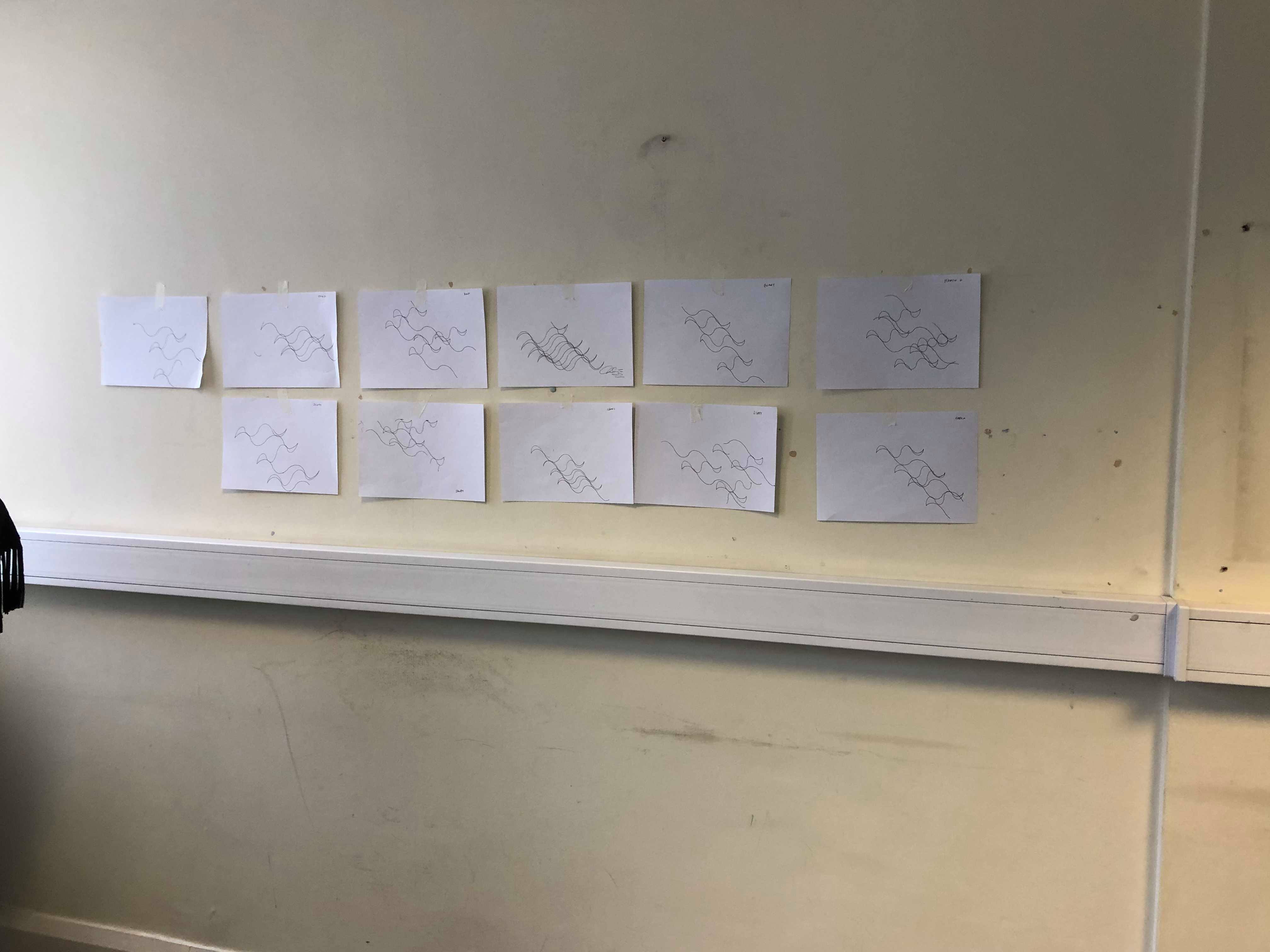
I was able to present a first draft of my project at the Hello Cov exhibition for Artspace studio holders at The Row in Coventry, and the response was overwhelmingly positive. Although at that point the drawings did not look particularly ‘pretty’, it was still fascinating to see how different people’s brains produced different drawings, and allowed me to build a portfolio to compare how the technology worked for different people in different states of mind.
Overall I am incredibly grateful for this residency. I feel that I have achieved more than expected in this project, and can now build on that knowledge even further.
You can follow Rosa on Instagram @rosafrancesca.art
The importance of Space and Place: from Coventry to Volgograd
Guest Blog by Nest Resident Artist Sylvia Theuri, reflecting on her Nest Residency.
I began this residency with the aim of further developing my artwork, in particular a project which focused on engaging with Coventry’s twin cities. The twin city that I was concentrating on during the residency was Coventry’s first twin city; Volgograd. I wanted to create new work outside of my home environment and discuss ideas with other artists. I was especially interested in having discussions with Talking Birds as they had previously created a project around twin cities with their “Twin Story” project.
The residency gave me space to think, which is so vital in being able to create interesting and insightful artwork. I was also able to spread out in the studio space, rather than be confined to the dining room table, which often happened when I worked from home. It is interesting that my work is all about spaces, yet I often have limited space to actually create the work.
 The residency also gave me the opportunity to talk. I talked with both Janet and Derek about the city of Volgograd, and because they had both been there, they were able to help me to understand the city better. I talked to other artists based at Coventry Artspace, my temporary neighbours. The residency became somewhat of a “third place” for me, somewhere away from my home environment where I could come and feel connected.
At the end of the 9 weeks, I felt like my work had developed, but more importantly I felt that the way in which I thought about my work had developed more. This was because I had focused time to read, and question myself and my work. Looking back on this residency what I am most thankful for is the “space” I was given to come and think about and engage with ideas about space, ironically.


Photo credits: Volgograd Photos by Nastya Tol; Studio photos by TBs; Postcard washing line and works-in-progress by Sylvia Theuri.
For more about Sylvia and her work, see her website [link to external site].
Climate Wednesday: #CultureDeclaresEmergency & Natural Climate Solutions launch
Two important responses to the climate crisis are launched today.
With a letter to world leaders, published in several newspapers, a group of notable scientists, authors, activists and artists calls for Natural Climate Solutions to create a better world for wildlife and people.
Continue readingWelcome to our first Nest Residents!
One day, (funding pending…) The Nest will be a real place. Until then, The Nest is wherever we can find a space to support our Nest Artists’ Residency Programme – and we’re really thrilled to announce that our first two artists have now taken up residence in studios at Eaton House (big thanks to Coventry Artspace for their help with this!).
Andy Sargent started last week and has already practically filled his studio with sketches, paintings and sculptures which are adding to his ‘Hidden Monster’ series exploring “the issues of loneliness, isolation, abandonment, negative reaction, pain, depression, physical instability, poverty, all created by sudden physical disability due to spinal injury.”

Digital artist Sylvia Theuri started yesterday. She will be using the residency to continue her dialogue with Volgograd (begun through her postcards project) and to make some pieces that respond to the photographs and messages from the individual in Volgograd that received and responded to Sylvia’s Coventry postcard.

We’re really looking forward to seeing how both artists’ works develop – and to the many interesting creative conversations we hope to have with them (without interrupting them *too* much!)
>> If you are a D/deaf or disabled and/or Midlands-based artist and are interested in applying for a Nest Residency, you can find all the details here.
Holding people to account over the choices they make, and helping them make better choices, works!
Today, in a Comment is Free piece in The Guardian, to coincide with the release of the ‘Sustaining Great Art & Culture‘ report, Nicholas Serota Chair of Arts Council England lists some of the headline achievements of ACE’s 10 year partnership with Julie’s Bicycle (a charity that supports the creative community to act on climate change and environmental sustainability.).
Continue readingWednesday Recommendations: Co-ops, artist-friendly cities & change-making football.
Here’s ‘Wednesday Recommendations’ post number 4 – this is some of the stuff Birds have been reading and listening to in the last couple of weeks that we found interesting, and think you might find interesting too:
LISTEN: Reasons to be Cheerful episode 41 – another cracking episode from Ed & Geoff! This episode explores cooperatives as a resurgent business model of choice, alongside other socially responsible models currently growing in popularity, such as community interest companies, non-profits & social enterprises. The second guest in particular (Joe Guinan from the Democracy Collaborative) describes the very clear advantages (think stability, stronger local economy & job security) of such socially responsible company ownership models to the areas in which they are based vs the de-stabilising effect of the constant change of ownership that happens with big corporations and the way that non-local ownership just siphons profits out of the business and out of the area, or even the country.
Slightly paraphrased, he says: ‘If you have a real stake in the business you work for, you tend not to export your own job overseas and are more aware of the environmental impact of your method of production because you also live there and so you’re unlikely to pollute the water or air your children are going to be drinking/breathing … it’s a more embedded form of ownership’
READ: Art hotel & the ‘artist-friendly city’ is a really interesting blog post from MAIA, who I’d not come across until I head Amahra speak at the a-n Assembly event in Birmingham the other week. One of the projects she’s heading up is working towards creating an Art Hotel in Birmingham. This paragraph rings really true, but also echoes back to a lot of things about co-ops in ‘Reasons to be Cheerful’. “We work with socially-engaged artists, practitioners and citizens with a deep-rooted investment in their environment. Fundamentally, given the broad parameters of which their work interrogates, when you make a city more equitable for artists and makers, everyone benefits. Of course, there is the awareness that in order to do that, it takes a societal shift, to renegotiate our understanding of what being an artist is. For too long, ‘artist’ has held definitions too contained, too narrow and too exclusive.”
READ: I’m not really into the football, but this article from historian David Olusoga totally shifted my perspective – if you’ve also been known to get slightly uncomfortable around a St. George flag, give it a read.
That’s it – as ever, let us know in the comments if you’ve followed any of the recommendations what you thought – and if you have any recommendations for us.
Wednesday Recommendations – stuff to read and listen to.
So it’s official, this is ‘Wednesday Recommendations’ post number 2, which means that <muted fanfare> Wednesday Recommendations has become ‘a thing’. Time will tell whether that is a good thing, or a bad thing, but here goes – this is some of the stuff we’ve been reading and listening to in the last couple of weeks that we found interesting, and think you might find interesting too:
LISTEN: Reasons to be Cheerful podcast episode 37 ‘Rethinking Economic Success’ – Ed & Geoff chat to Kate Raworth, author of ‘Doughnut Economics‘, recorded live in Hay-on-Wye. The basic concept of doughnut economics challenges the assumption that unlimited economic growth and ever increasing GDP is inherently good, but rather explores sustainable ways of increasing prosperity fairly for all the people on the planet. This is a really interesting listen – Kate Raworth describes the principle really simply and it just makes so much sense. There are some good, challenging questions from the audience too. Really thought-provoking and definitely worth a listen.
READ: Dear Ijeawele, or a Feminist Manifesto in Fifteen Suggestions by Chimamanda Ngozi Adichie is a pithily practical companion to her earlier book ‘We Should All Be Feminists’, based on her (highly entertaining) TED Talk of the same name. It’s a short, insightful and thought-provoking book, originally written as a letter to a friend who’d asked for advice on raising her baby girl a feminist. It also contains this lovely paragraph: “Teach her about difference. Make difference ordinary. Make difference normal. Teach her not to attach value to difference. And the reason for this is not to be fair or to be nice but merely to be human and practical. Because difference is the reality of our world. And by teaching her about difference, you are equipping her to survive in a diverse world. She must know and understand that people walk different paths in the world and that as long as these paths do no harm to others, they are valid paths that she must respect.”
LISTEN: The consistently entertaining and slightly irreverent Fortunately Podcast from Jane Garvey and Fi Glover has become required listening at TBHQ. Pick an episode, any episode, and enjoy…
That’s it for now. Let us know whether you followed up on any of our recommendations and, if so, what you thought – and if you’ve got any recommendations for us. Cheers!
 Words from the Birds