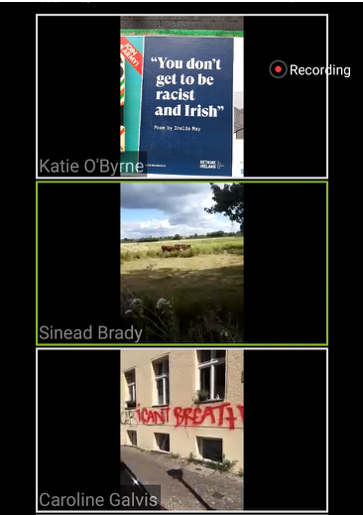
This is the text of an emailout from the Campaign Against Climate Change and, with permission, we have shared it in full here because it gives such a clear and succinct summary of the interconnectness of the fights for climate, social and economic justice.
Continue readingWednesday Recommendations: educating ourselves to be better allies.
“Because of the power dynamics in the world, she will grow up seeing images of white beauty, white ability and white achievement, no matter where she is in the world. It will be in the TV shows she watches, in the popular culture she consumes, in the books she reads. She will also probably grow up seeing many negative images of blackness and of Africans. Teach her to take pride in the history of Africans and the black diaspora. Find black heroes, men and women, in history….Teach her about privilege and inequality and the importance of giving dignity to everyone who does not mean her harm” (from Dear Ijeawele, or a Feminist Manifesto in Fifteen Suggestions by Chimamanda Ngozi Adichie)
In response to a couple of requests, this #WednesdayRecommendations post shares some of the resources that we’ve found particularly instructive in our continued efforts to educate ourselves to be both better allies, and pro-actively anti-racist. (If you are in Coventry & F13 and would like to borrow one of the books in the pic, please email us)
> TO READ (listed in photo order from the top of the pic):
What is Race? by Claire Heuchan & Nikesh Shukla
Dear Ijeawele by Chimamanda Ngozi Adichie
The Hate U Give by Angie Thomas
White Fragility by Robin DiAngelo
Americanah by Chimamanda Ngozi Adichie
Why I’m No Longer Talking to White People About Race by Reni Eddo-Lodge
Brit(ish) by Afua Hirsch
Me and White Supremacy by Layla F Saad
The Good Immigrant edited by Nikesh Shukla
Black and British by David Olusoga

> TO LISTEN/WATCH:
Seeing White (Scene On Radio series) hosted by John Biewen
The Colour Green by Julie’s Bicycle, hosted by Baroness Lola Young
About Race Podcast by Reni Eddo-Lodge
Trevor Noah on George Floyd, Amy Cooper & Racism in Society on The Daily Social Distancing Show
—
If you are an artist based in or near Coventry and you have an idea you’d like to explore, please consider applying to our Nest Residency Programme.
Brilliant Black Women Artists
Spotlight on some brilliant black women artists – friends of the Birds, collaborators, members of our Board or former Nest Residents. If you don’t know about them and their work, now’s your chance to find out…
Continue readingAliens, Autism, and Napping on the Floor
Katie Walters’ Nest Residency reflections:
For as long as I can remember, I have been obsessed with space! Although not so much in the way that you might expect from an autistic person; I have very little interest in the science of it all. I don’t know much about nebulae (I had to google for the plural), or space travel, or the names of any stars beyond our own. But my artist’s brain has always loved the *idea* of space. I like how big it is. The incredible potential of infinite planets! The possibility of aliens! And how very small and insignificant that makes our Earth.
When I was 15, my interest in space was thrown into starker clarity when I received a diagnosis of Autism Spectrum Disorder. The diagnosis itself was unsurprising. I’d always moved through the world in my own strange way, and by the time I was referred for diagnostic assessment, I was thoroughly alienated from my peer group. I already knew that I was different, and, more problematically, all the other kids knew too. But what did surprise me was how my diagnosis made me feel. Suddenly I was able to understand myself. It was like someone had turned on the lights. When I looked back over my life, for the first time, everything made sense. One of the many things I came to learn about myself was why I was so obsessed with the idea of other worlds. I wanted to believe in a world where I could make myself understood.
This is where Planet Alex came from. Planet Alex is a terrible novel that I wrote as a teenager in the aftermath of my diagnosis. And, thanks to my Nest Residency, it’s now a (hopefully less terrible) play!
Mainstream stories about autistic people usually have a few things in common: they’re about boys or men, they’re written by people who are not autistic themselves, and they address autism as a problem to be overcome. That’s a problem, because autism is not a monolith – the autistic community is vibrant, diverse, and thriving. I wanted to tell a story that was true to my experience of autism, which is strange and difficult, but ultimately very positive. As I grew older and moved on to other projects, I never stopped believing in the idea at the core of my terrible novel. I kept trying to find the right way to tell Alex’s story. My Nest Residency was the perfect opportunity to bring her to life.
I found out about Nest Residencies through a digital flyer on twitter, and knew right away that I wanted to apply. There was no pressure to produce anything, and the time was intended for experimentation. I didn’t need to worry about getting things wrong, so I was free to write something strange and new, and the opportunity was intended for disabled artists, so I knew that my access needs would be met.
As well as autism, I have a chronic illness called Myalgic Encephalomyelitis (ME). It’s a complicated condition, and how it impacts me can vary day to day. Because it’s so variable, it’s very important for me to be able to work flexibly, take regular breaks, and take time off if I need to. Talking Birds provided me with a private space to work in, where I was able to set up a makeshift bed so I could work lying down if I needed to, or even take a nap! They were also very understanding of my strange work hours, which I keep because my ME seriously disrupts my sleep and makes it very difficult for me to maintain a regular sleep pattern.
Because of the support that my Nest Residency offered, I was able to make a really solid start to Planet Alex as a play, and I have a great foundation to build on moving forward with the project. I’m really excited to find out what’s next for Alex and her alien friend, and I hope that I’m able to bring her story to as many people as possible.
If you are interested in applying for a Nest Residency, you can find more details here.
(re)valuing the labour it takes to breath, be, perform together
Melissandre Varin reflects on her Work From Home Nest Residency:
This text and selected moving and still images are an autoethnographic account of my first art residency with Eole, 16 months old. I would not have the pretention to speak for Eole, thus I wish to highlight that articulations are mine.
I discovered about home-based Nest Residencies offered by Talking Birds during the first F13 Zoom meeting following COVID-19 lockdown. I was immersed in the image of feeling/being underwater at that time. I was partly feeling this way because I thought that I will be incapable of managing my multiple roles. I was not wrong.
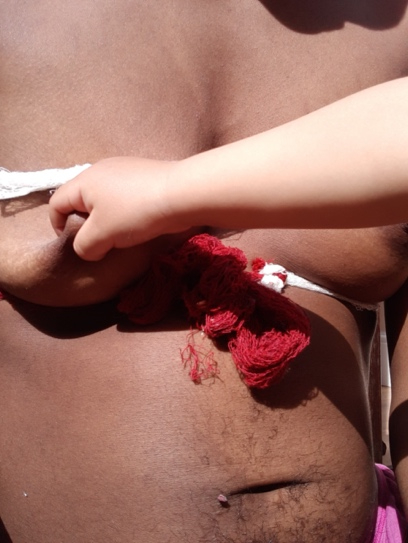
Making nearby Eole
(melissandre varin and Eole Varin Vincent April- May 2020)
I self-define as a Black queer artist-researcher PhD student doing Practice As Research while mothering 16 months old Eole. There is no strict order nor hierarchies to my roles, except that I am always other than a mother while caring 24/7 for Eole. COVID-19 lockdown forced me/us to act upon burning issues from the inside.
I re(-)member how it felt growing up both as a witness and a recipient of domestic violence – behind closed doors. Being/Feeling under the water I had to work around traumatic memories challenging the reasons why I would spend money I do not have in day care to maintain a distance between Eole and I or as I used to disguise it “to make sure that they have social interactions with other little ones”. I had to unpack the limitations of Eole’s and I’s mothering relationship, we played, with it during our residency. I ended up having a significant transformation of what I consider work, and how I perform, and I value it.
The experience of making nearby Eole was intense for the least. Eole and I were, in our own ways, challenging and articulating counter-hegemonic ways of holding conversations in Gayatri Chakravorty Spivak’s terms (2012). In doing so we were also (re)valuing the labour it takes to breath, be, perform, together, as I distanced myself from reading (except children’s stories) and writing (ethnograffiti-interruption) – weaving embodied dialogues instead.
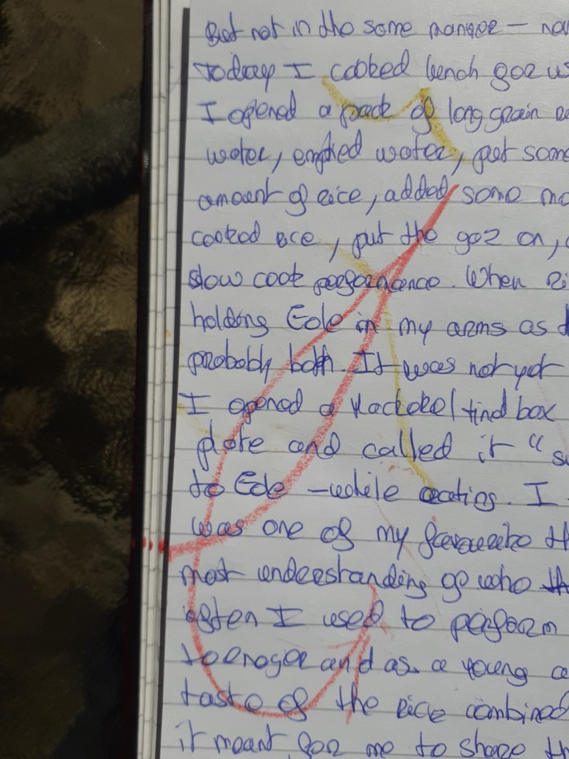
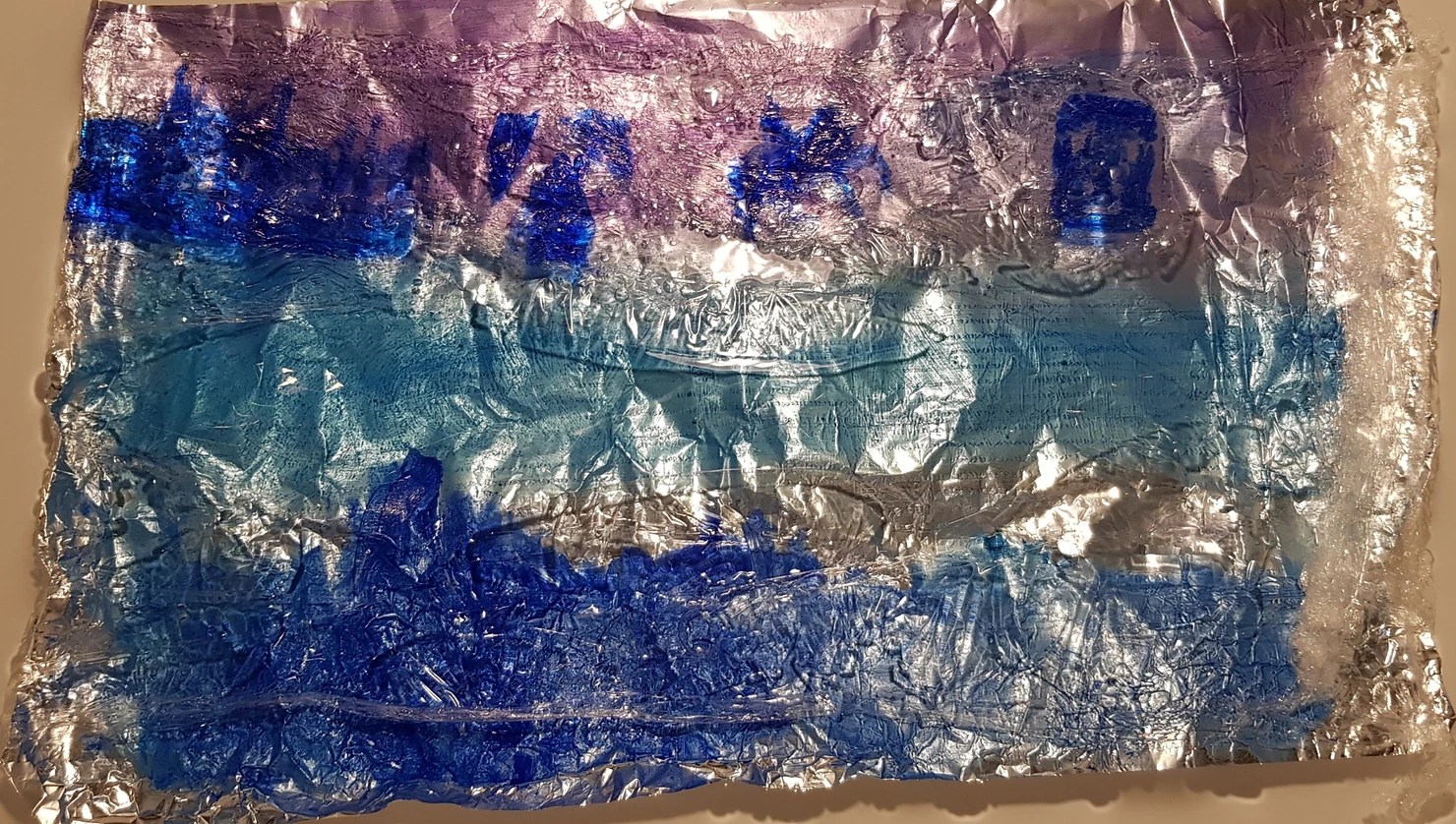
In this experimental approach to making nearby Eole, I facilitated ways for us to archive our work beyond our embodied memories. I took still and moving images alternatively with a smartphone or an old home digital camera as they were both sitting there, part of our home.
Jarring (melissandre varin and Eole Varin Vincent, 2020 + LaRi witnessing)
Early afternoon with Eole or late at night with Jb, my partner, we collected the remaining of our everyday performances at home gathered in ritualistic balayage (sweeping) followed by a jarring-process. We used a broom, a stainless dustpan and empty jars that were part of our home. This process brought me back to a master’s dissertation I wrote using a vibrant materialist approach when I was being trained in Environment and Sustainable Development. I have never undertaken paid work in this field but always felt that this baggage followed me in many ways. Here is another manifestation of it as Eole was leading the way in allowing me to lay down and critically observe the details of our living space and by extension of our relationships in/to the space.
Home was not the ultimate location of domesticity. I reduced its potential, as I (ab)used of this space attempting to domesticate it in order to construct a place where I finally belong. Divides between being with Eole in private and working in public were the heritage of a colonial/ capitalist/ white/ heteronormative/ patriarchal delimitations of my (im)possibilities. One of the roots of my complicity in partaking in this divide was my attempt to escape from what happened behind closed door during my childhood and still reproduce itself when I close my eyes.
My biggest challenge has been to have proper time to read and write. However, the fact that Eole have repeatedly negated me time to read academic books and articles gave us the opportunity to be attentive and focus on senses that I had underestimated in my artistic research. We sat together apparently doing nothing as we deepened our listening practice, listening to birds as spring unveiled, and we looked at each other. It can be framed as a political intervention into my PhD research journey as Jane Bacon write about her sitting practice (2010).
I noted that we share stories some of which have not yet been told but make us the different beings that we are. After Jenny Odell’s How to do nothing (2019), another book which I did not manage to read during the residency, but an online audio-visual presentation that Eole and I listened to, my practice is not so much embedded in a modernist idea of making but of finding. During this precious time, making nearby Eole, I found ways to take time and make space for us to be.
“I collect words from others’ mouth, fingers, and bodily performances. I re-call my present from observing my body and contemplating the most beautiful creation of mine/theirs be their own assemblages of us/them/its. I lay my body down and occupy space that I have had the privilege to imagine, to walk in, and I interrogate those who created them against marginalised others/us I ask – what if life did not have to be so complicated – for us too?
I thank you Eole for reminding me that there is more to life than throwing ‘garbage’ away by picking up, being amazed, paying your respect to the smallest, putting ‘dirt’ into your mouth, and protesting in front of me. What if I/They was/were wrong to forbid you/us to be, what if I had to learn from you to reconnect to our story, to the environment?” (nap time autoethnographic note, time: 11.23 date: 16/04/2020 location: CV56GQ)
Closely collaborating with Eole we worked around practice/notions of maintenance after performance artist Mierle Laderman Ukeles, in-betweenness both from Homi Bhabha and from Fleur Summers, and Angela Clark (2015) and deviant (Charles Esche 2011) mothering. My practice has been politically strengthened, gradually gained in gentleness and cracked into fluidity. Eole and I have started to pave routes for us to challenge gender norms as I walked/ran shirtless as a local urban intervention inside and outside during our daily physical exercises. We have contested monolithic discourse around figures of mother and on children inspired by Haircuts by children by Toronto-based Mammalian Diving Reflex. I have devised performances making visible gendered-racialised labours to which Eole added an extra layer of complexity https://vimeo.com/408973998.
We have immersed ourselves in flour and earth, queering conventional use of these materials to interrogate what life happening within four walls is ultimately about, drawing on racial, gendered, classist charges for a Black femme mothering a mixed-race being.
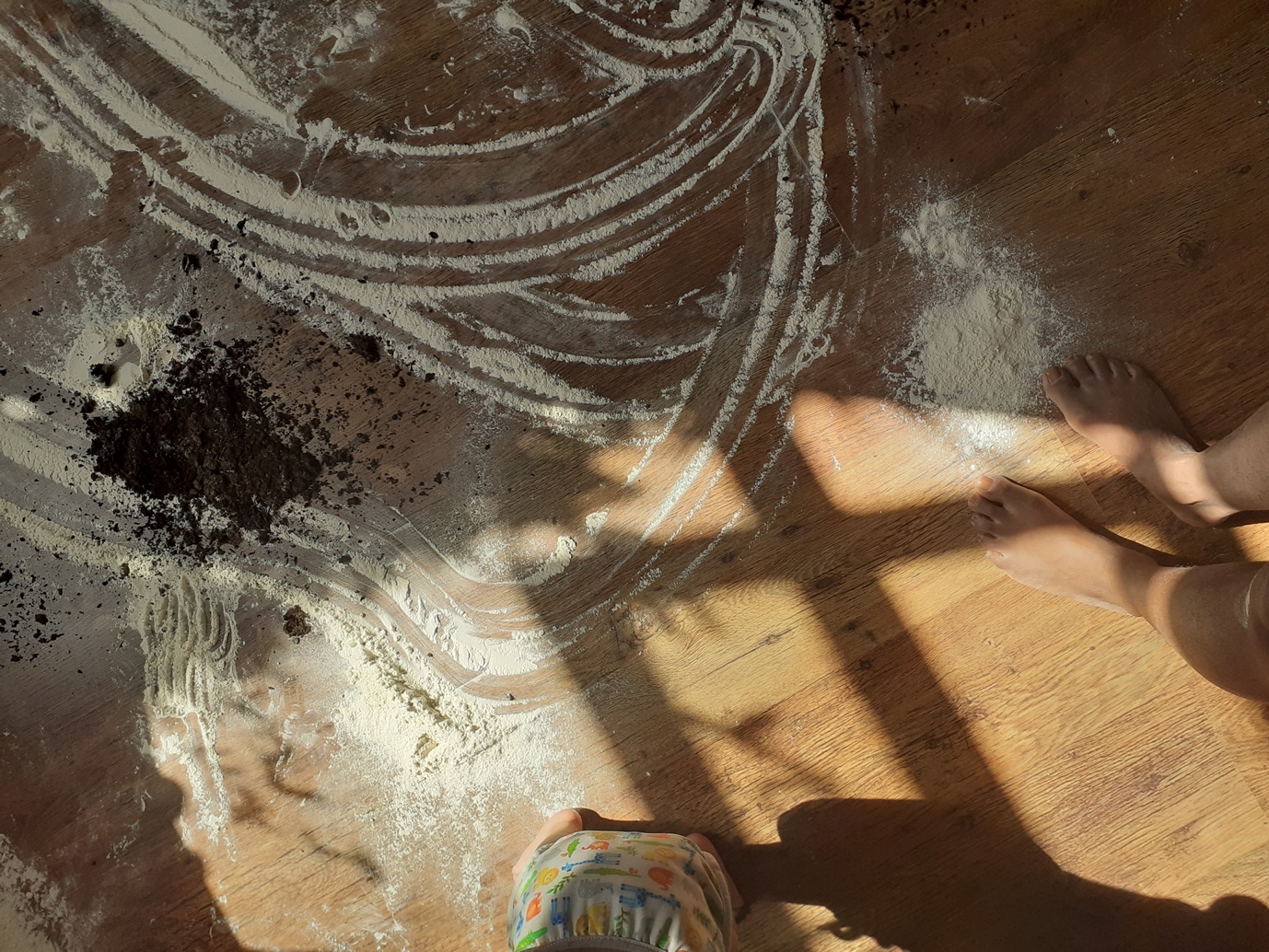
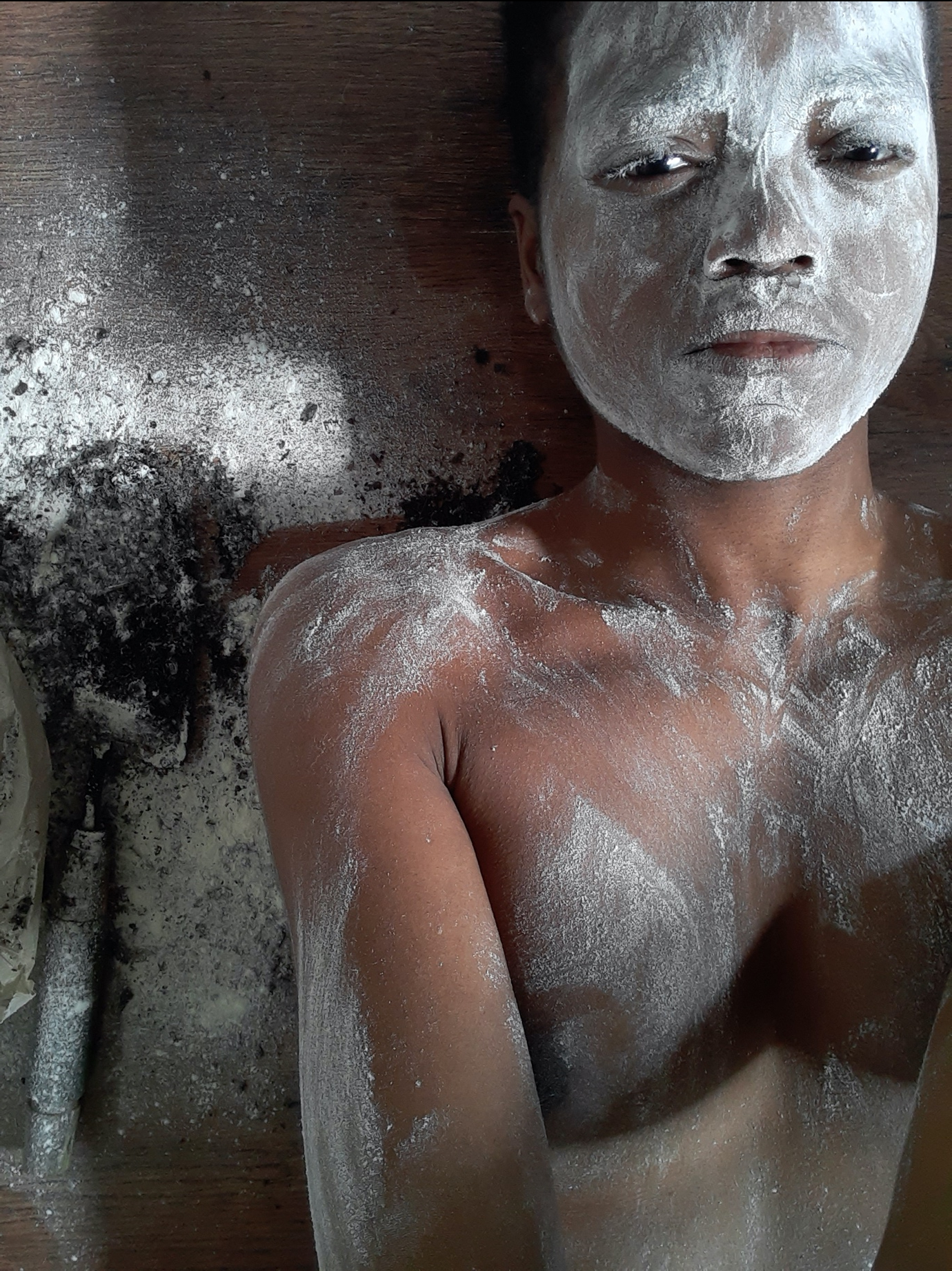
Documentation of “Of flour and Earth” (melissandre varin and Eole Varin Vincent, 2020)
We have performed for smartphone and cameras and for one another impatient to open the doors of this space to others when it is safe to do so. Eole and I spent a certain amount of time singing/screaming, laughing/crying, being as never before, and it seems appropriate to add that none of us have been hurt in the process.
I am extremely grateful for Talking Birds for supporting this deepening in my/our practice at the fictious interstices of public/private divides. Eole and I lived fully every moment of our first collaborative art-residency.
Sharing the love (chronologically):
Spivak, G. 2012, “Who Claims Alterity”, An Aesthetic Education in the Era of Globalization, Harvard University Press, Cambridge, Massachusetts, p. 57.
Bacon, J . (2010) Sitting/Walking/Practice: Reflections on a Woman’s creative process, Gender forum, an internet journal for gender studies, Gender and performance. Theatre/ Dance/ Technology, Edited by Prof. Dr. Beate Neumeier
Jenny Odell. 2019. How to do nothing: resisting the attention economy
2017. How to do nothing, online talk (57.29min) : https://www.youtube.com/watch?v=mNRqswoCVcM
Mierle Laderman Ukeles https://hyperallergic.com/355255/how-mierle-laderman-ukeles-turned-maintenance-work-into-art/
Bhabha, Homi K. 1994. The Location of Culture. New York and London: Routledge.
Summers, Fleur and Angela Clarke. 2015. “In-Betweenness: Being Mother, Academic and Artist.” Journal of Family Studies 21(3):235–47.
Esche, C. 2011, “The Deviant Art Institution”, in C. Esche et al. (eds), Performing The Institution, vol. 1, Kunsthalle Lissabon, ATLAS Projectos, Lisbon.
Holert,
Mammalian Diving Reflex https://mammalian.ca/projects/haircuts-by-children/
———————————-
If you are interested in applying for a Work From Home Nest Residency, you can find more details here.
“There are many ways of communicating…”
Emily Woodruff reflects on her Work From Home Nest Residency:
My artistic practice had always been somewhat loosely defined, dabbling in acting, performance art, spoken word and music. After receiving an ASD diagnosis in my late-20s I found new ways of working. I developed a better understanding of how I process information, allowing me to start the transition from bedroom-headspace-artist, brimming with ideas but lacking the navigation system to see any through to completion, to an early career artist with an active practice.
When I saw Talking Bird’s Nest Residency programme it seemed like the perfect first step into a more professional practice. The knowledge that the Talking Birds team regularly work with and offer mentorship to disabled artists gave me a sense of freedom and confidence in approaching them. Not only would it give me the opportunity to work alongside a team well versed in the arts sector and local arts community, but I would be given the space and time to develop ideas in an environment where I knew I’d be able to communicate any additional needs I might have.
By the time the residency rolled around the world was operating in a significantly different landscape. I was given the option to postpone my residency or continue as planned on a work-from-home basis. I decided to focus on an alternative project I had been developing in order to allow me to get the most out of my time with Talking Birds, whilst working at a distance and in the smaller space of my spare room, and pushed on.
I’ve always been intrigued by biology and how our anatomy plays a role in how people see their own role in the world. This has developed into bigger and more cohesive ideas about the dance between corporeal reality and our inner narratives. How do our bodies inform our sense of self and shape our identity? With neurodivergence salient in my mind I began to think about how experiencing the world through a ‘different’ neurotype might also hold its own geography for how an individual experiences their identity and how the world reacts to their bodily (neurological) configuration. It had become increasingly clear to me that there was a phenomenon to be further explored in relation to receiving a late-in-life diagnosis of neurodevelopmental disorders and shifts in an individual’s identity. I wanted to explore people’s experiences of this and identify key patterns or changes that seemed consistent throughout these experiences. In doing so I hoped to gather the qualitative and emotional data required to produce an artistic response.
The mentorship I received was invaluable. The advice encouraged me to approach my time management with a view for longevity. This is something I’ve often struggled with, so to have someone to check in with now and then really helped me to stay on course. I started to think about how to incorporate a dialogue that extends beyond the final display of a piece of artwork into the development phase of a project.
With this in mind (and having found that questionnaires often don’t translate well for neurodiverse individuals), I started to have conversations! I put out a call online and directed it towards the neurodivergent community. Fortunately I already had a few contacts who were happy to have a discussion with me and explore their own experiences of late-diagnosis of autism. I dipped into artist Rees Finlay’s book ‘Reaffirmation: Coming to terms with an autism diagnosis’, (title says it all really) and had a great extensive call with Rees to really dig into these experiences. I also discovered the video performance by artist Kimberly Gerry-Tucker (with credit to her son Silas for filming and producing the work), Mime Project: Masking. The piece deals with autistic masking and finding acceptance, and one line really stood out to me, a thread that runs through many of the conversations I’ve been having; “I paint the squelch of Broken Sounds and TRIBE, upon my face”.
TRIBE! A word that kept seeming to float to the top of these conversations, along with a sense of transformation in finally ‘finding your tribe’. I started to further explore these patterns.
I found L.A Paul’s book ‘Transformative Experience’ and started to delve into the nature of significant shifts in identity, or, transformation. In one passage Paul discusses how some members of the Deaf community do not support the use of cochlear implants in young children. Some feel the implants alter the sensory landscape that the child was born with and prevent the child from truly experiencing the world as a Deaf individual, a unique way of being in the world that allows shared knowledge and experience as a member of the Deaf community. I considered how this distinct sensory configuration for perceiving the world, and the value that is found in knowing others have this experience too, is akin to being neurodiverse. Just as “a deaf child constructs her world in a different way, perhaps radically so”, so do ASD individuals. Therefore, just as “participating in this unique and valuable community and culture gives a deaf person a unique and intrinsically valuable experience and fosters a community that provides support for a historically oppressed segment of society”, being able to access the knowledge that you are neurodiverse may provide similar experiences to such individuals. TRIBE!
After reading of published works that deal with the subject matter and some rich conversations about first-hand experiences I began to see several phrases/key concepts arising: tribe, grief, transformation, self-acceptance, revelatory experience and vindication.
I knew I wanted to capture these ideas in a visual way – neurodiverse individuals are often very visual thinkers and communicators, sometimes better able to capture emotionally complex responses in swashes of colour than structured sentences. I also wanted my depictions of these key concepts to both connect to the real-life human experiences I’d been exploring, whilst being relatively ‘faceless’. These are almost archetypal journeys that can be accessed through a wide array of human experiences, and I wanted a wide array of experiences to be able to be brought to the table by the viewer.
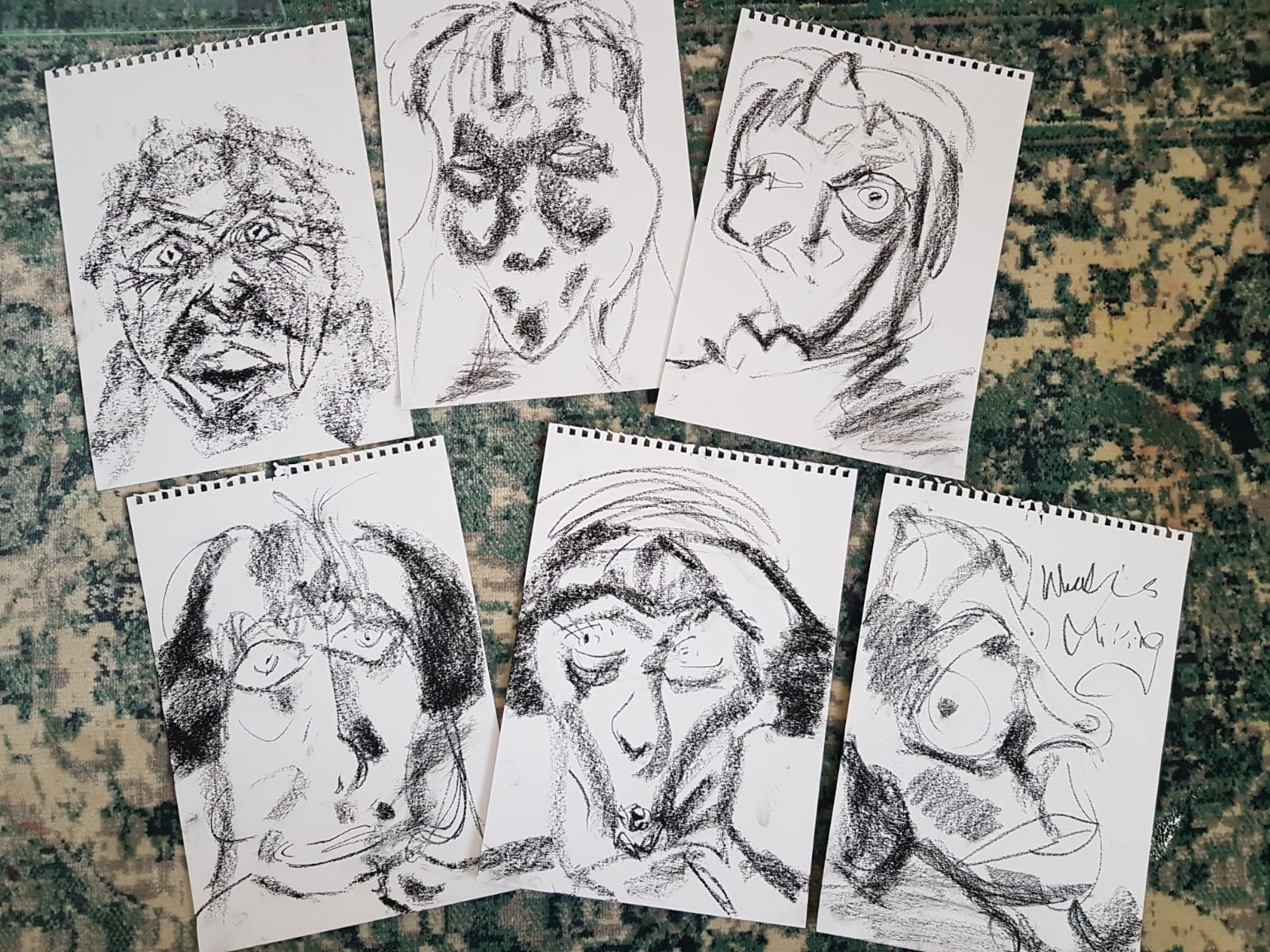
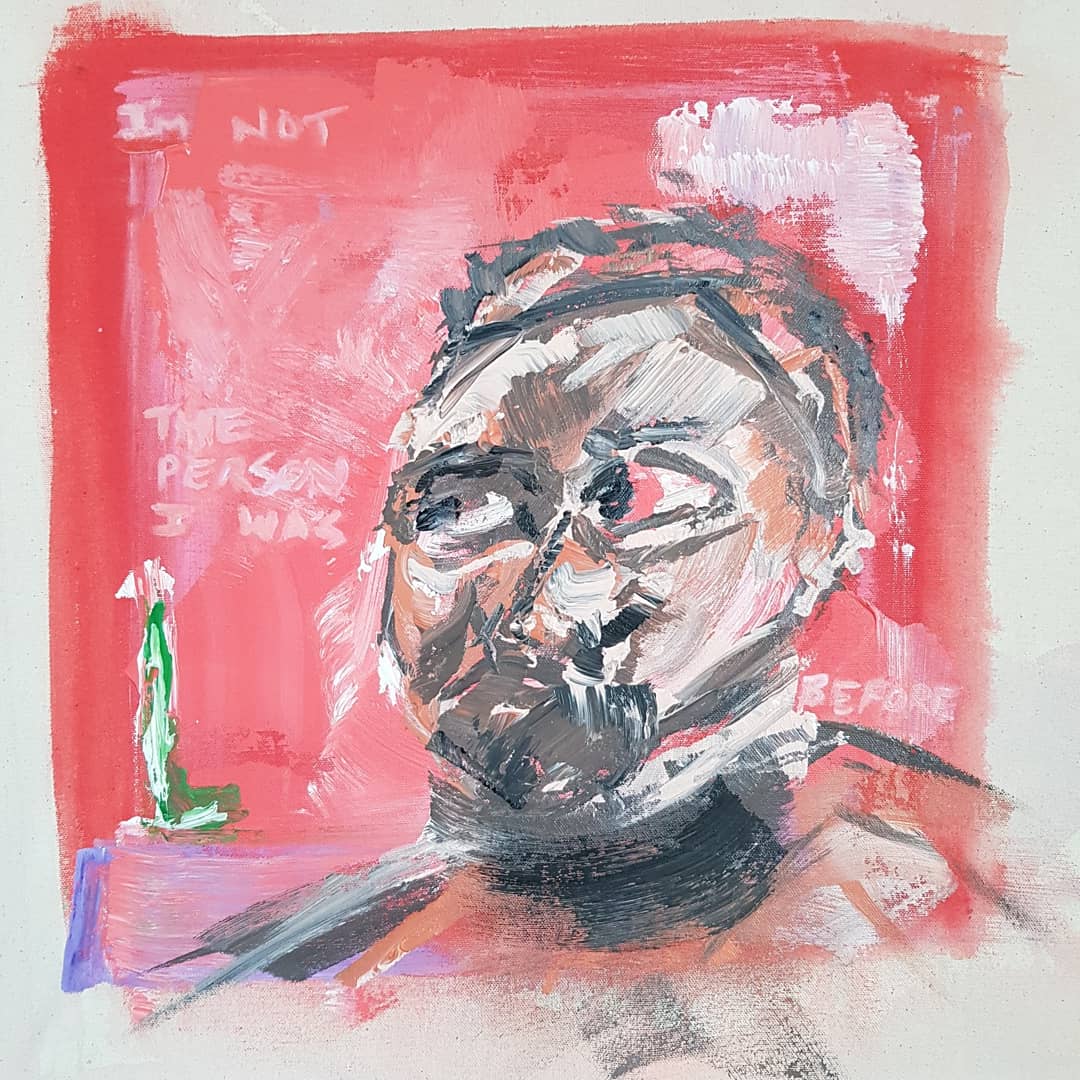
As such I started to experiment with abstract portraiture, capturing gesture and emotion, not ‘pinning down’ too many distinct facial features:

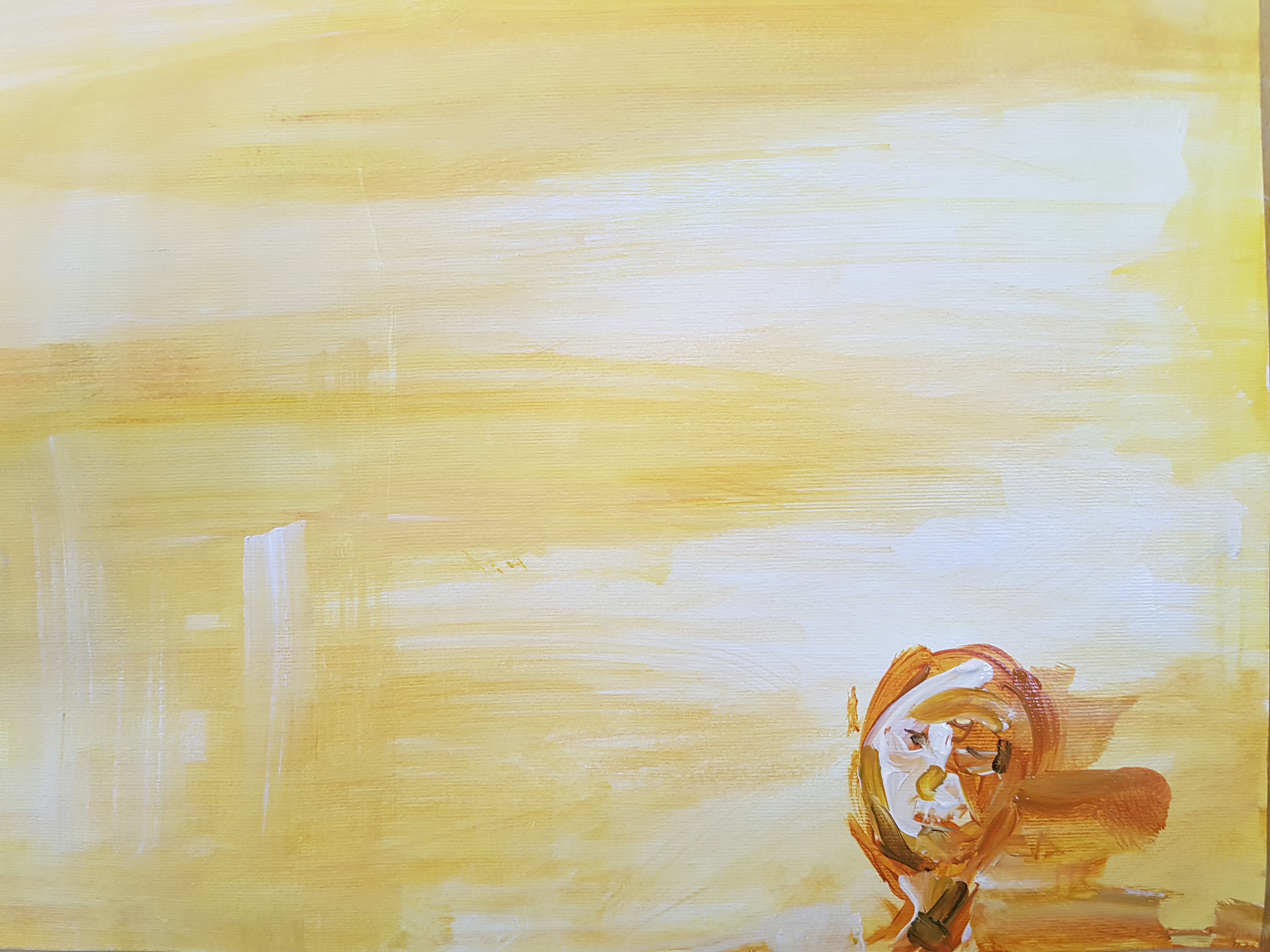
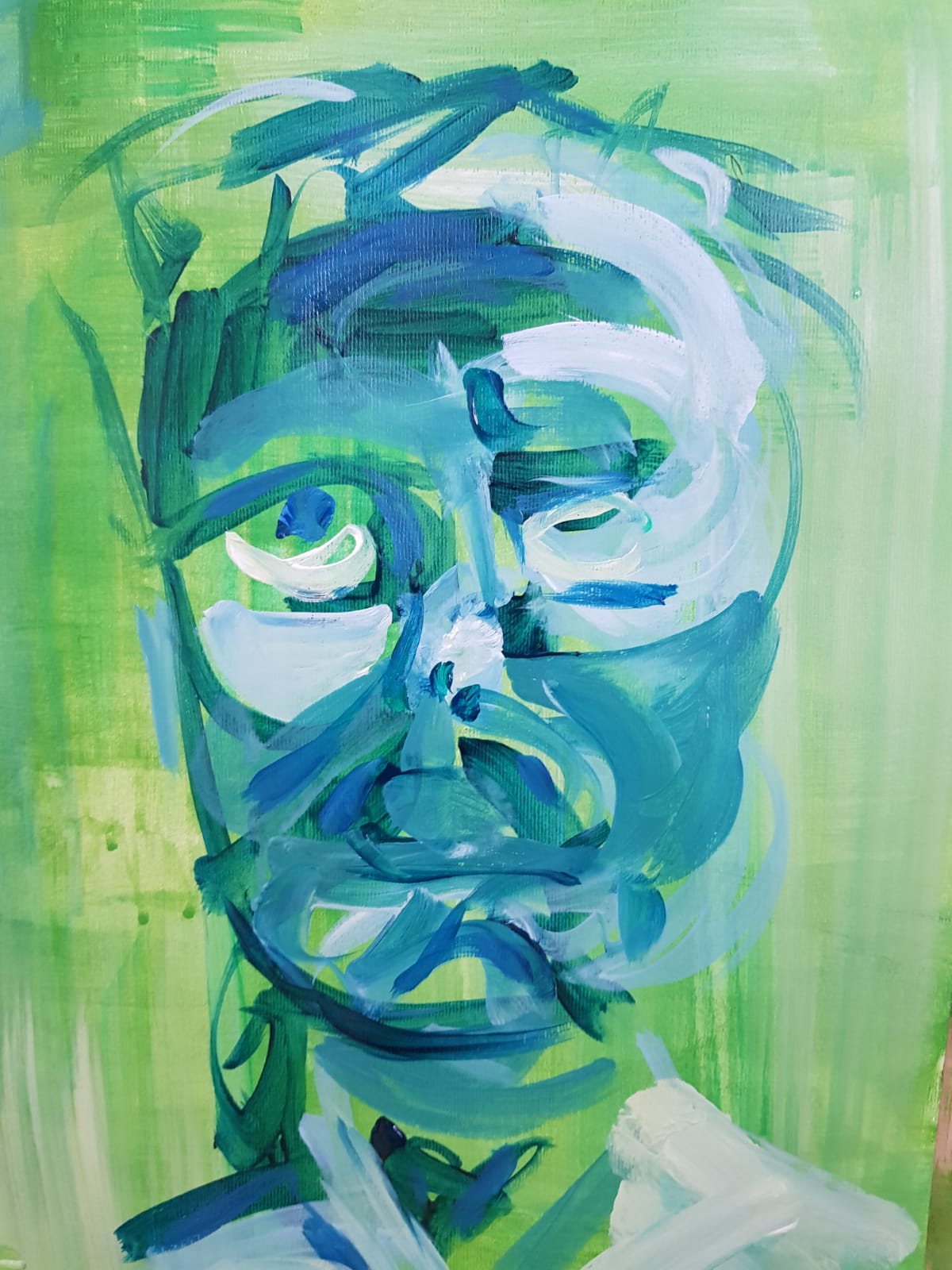
I also spent some time researching colour psychology. I drew inspiration from scientific data on the effects different wavelengths can have on the brain, historical artistic uses and regional/cultural associations to play with colour to create different sensations. For example, an overabundance of yellow can give a sense of sparseness, isolation and distance from society; it’s often been used to depict outcast figures. Green is often

considered to imbue a sense of peace and a higher preference for it is seen in ASD boys compared to ‘typically developing’ boys, it’s speculated for its calming wavelength.

With my mentor’s advice about thinking ahead ringing in my ears I put together a preliminary plan as to how I could produce the response, including potential funding sources and how the work might eventually be displayed.
After playing with some quotes I’d selected from my research by adding breaks in the sentence to create alternative or multiple interpretations, I produced a ‘sample’ that incorporated the abstract portraiture and colour techniques I’d been developing.

I spent a lot of time during my residency contemplating my own artistic practice, how I operate, what works well and what changes could benefit me. I had time and ‘space’ to explore and play with techniques I may otherwise have struggled to carve out the time for. Through this reflection and my mentor’s guidance I am also taking away a very clear understanding. Dialogue with the world and potential viewer is an inherent part of the making process, not a final event.
However, I’m also taking away a sense that there is still a hegemonic narrative, a script, for how these conversations should be conducted. These scripts won’t work for everyone. Some may deal with cognitive overload in face-to-face coffee mornings that doesn’t allow for authentic expression to take place. Some may be non-verbal. Some may not be able to physically access the designated space. There are many ways of communicating that are as rich and ‘on par’ as a spoken engagement that may not be accurately translated into language. When thinking about the experience of distinct neurological configurations, L.A Paul suggests it may “…give them a unique and untranslatable, hypervisual cognitive style…”
As access to the ‘art world’ is changing, we need to reconsider alternative modes of being, processing information and constructing dialogues to provide that access.
I’d like to thank Talking Birds for the opportunity and support, and my mentor for crucial and enlightening conversations!
Rees Finlay’s ‘Reaffirmation: Coming to terms with an autism diagnosis’:
https://www.amazon.co.uk/Reaffirmation-Coming-terms-autism-diagnosis/dp/1527251128
Kimberly & Silas Gerry-Tucker’s ‘Mime Project: Masking’:
https://www.youtube.com/watch?v=C1BYBxInZUg
L.A Paul’s Transformative Experience
https://www.amazon.co.uk/Transformative-Experience-L-Paul/dp/0198717954
“a demonstration of the importance of human connection”
Luisa Freitas reflects on her Work From Home Nest Residency:
“Let’s Talk” is a social art project focusing on human connectivity shaped in the form of a platform where the audience can express themselves in an honest way, joining together groups of people from different backgrounds and therefore allowing strangers to get to know each other and their stories, in a way that otherwise wouldn’t be possible. The final product consist of a series of audio visual work through individual interviews, where each person is asked a question that reflects their personal experiences. This project was developed during a Fledgling artist residency supported by The Talking birds Theatre company. I got to know of the Talking Birds during one of the “Artist drop-In” meetings at Coventry Artspace and was immediately captivated by their principles in accessibility, social and environmental concerns and particularly searching for new ways to aid emerging artists from all practices to have a space to create their art. Since I’ve only created work about individual interests and inside my house, I felt that this was a unique opportunity to expand outside my comfort zone and create with the audience in a public environment.

Initially the production was supposed to take place in the Talking Birds head office but due to the initial virus Covid-19 outbreak (uh-oh) I was relocated to an art studio The Row in Coventry, but then after the official quarantine all art studios closed and I was (literally) sent to my room. I was so close to having my “real” first art-residency and now I was isolated in my small space once again, which was precisely what I was trying to change by placing myself in the outside world and work with the public for once. But I didn’t let that discourage me and I continued the project by focusing on what I believed in and what I was trying to prove: Art connects! So I altered the live interviews into online call interviews, and proceeded with the project. This drastic change in production meant that the visual quality of my work deteriorated significantly but on the other hand my reach of interviewees expanded considerably, and I managed to interview not only people in the city of Coventry but also in other areas of the UK and even internationally. I want to give them all a special thanks for having given their time to make this work possible, despite the limitations and concerns of the virus and its impact in their lives.
Despite the fact that there are few – but good – interviewees, the result was a success, there are not only three but four videos exploring questions ranging from very personal matters to abstract concepts such as “inspiration”. Naturally, being an art-residency, this platform also touches on the art discourse, now debated not only by artists themselves but also by members of the general audience outside the field of Arts. This union between the “outside world” and art practice has always been a passion of mine and thanks to this project I managed to bring the arts to the non-artistic audience together and allow them to talk about their experiences and thoughts about art.
This Fledgling residency really helped me organise my thoughts on this project and understand how far I can take this subject within my possibilities, and made me realise that what I actually intend to do is create an online platform about the art discourse itself made for the public with the public, in an accessible way and in this manner break the existing barriers between the general audience and Arts. This new platform will take its identity as a YouTube channel, under the name “Art Chat”.

In many ways this residency was crucial for my development in thinking outside the box, exploring themes I never have before, finding solutions to the obstacles presented during unprecedented times and meeting so many amazing people, who inspire me to try new things and meeting many more strangers to come. The Talking Birds was also incredibly generous and patient in allowing an extension of my work due to the situation with the quarantine, and so my residency which started at the end of March 2020, ended almost at the end of April 2020. But perhaps precisely due to the difficulties presented by the virus this project was more effective in its function as bridge between various peoples and the demonstration of the importance of human connection.
You can watch the videos on Luisa’s website, by following this link.
TBs #SaluteToStratford
On the occasion of Shakespeare’s 456th birthday, we thought we’d join in the #SaluteToStratford celebrations by reminiscing (only slightly self-indulgently) about our various brushes with the town over the years. It’s (almost certainly) true to say that Stratford holds a special place in our hearts (and that’s not entirely because of the excellent coffee and percussion instruments we have purchased on Rother Street over the years…)
Continue readingOutbreaks of kindness
There’s been some great and inspiring outbreaks of kindness all over the internet this week, demonstrating just how amazingly selfless and supportive the arts sector is. So many brilliant people and ideas, giving us a glimpse of how humans can shine in a crisis, how much better we are when we work together, and how this worrying time could actually sow the seeds of – or even prototype – a better world.
Continue readingDiscursive Ability
Jazz Moreton reflects on her Nest Residency
Having graduated with First Class Honours in Fine Art from the University of Gloucestershire in 2017, I spent years finding my feet and doing little bits of (mainly unpaid) work in the arts. After moving back to Warwickshire, I began to network with artists in Coventry. When somebody mentioned the Nest residency in a meeting, I knew that I, as an artist with multiple disabilities, had to go for it!
My residency was jointly supported by Talking Birds, Coventry Artspace, Coventry Biennial, and Disability Arts Shropshire, and would lead to whatever my outcome might be being exhibited in Coventry Biennial of Contemporary Art 2019.
I proposed that I, as an artist who had never worked with or edited sound, would create a sound-based piece that showcased the abilities that people with disabilities have, in the face of a government, and a wider society, that discriminates against us in many ways (my bugbear since graduation was that people still often assumed that I was stupid due to my neurogenic stammer and dysarthric speech) and, after a nerve-wracking interview with a gatekeeper-esque panel of arts professionals (who, upon getting to know them throughout my residency, turned out to be some of the most delightful people I’ve had the chance to work with), I was thrilled to receive the news that I had been selected.
My piece, which I titled ‘Discursive Ability’ at the point when somebody asked me what it was called for an interim exhibition, was my first proper socially-engaged work. Making it involved me inviting people that I either knew personally or had found through networking to my studio or going to public venues, workplaces, and houses and recording one-to-one conversations about their experiences as people that have disabilities.
I have lived with multiple disabilities caused by a ‘massive’ stroke when I was thirteen, and I have faced a huge amount of discrimination in most situations. However, it was easy to feel saddened, shocked, appalled by the discrimination- and even abuse- that other people told me, during our recorded conversations, that they had suffered, and do suffer, week in, week out, in Coventry. It is absolutely vital to remember that the issue of Disability Discrimination, inequality, and abuse exists in every locality across the country if not the world, and the sample of Coventry people that I selected were mostly not connected (apart from in the respect that they all knew me). It’s a bit sad that it takes an artist to start to talk about this, rather than world leaders, but there we are.
After recording a long series of fascinating conversations, I had the huge task of editing them onto one soundtrack (which took about ten times longer than holding all the conversations). Thankfully, Derek of Talking Birds is a sound-editing pro (amongst his other talents), and he was able to offer really useful advice, such as switching to a different piece of software (it’s lucky I’m a fast learner)!
It was fantastic to have a studio space that I could use for up to eight hours a day (based on bus timetables) to edit in. At the time, I was living on a narrowboat and didn’t have facilities (or, in fact, electricity and broadband) to make any sort of digital work, so the Nest enabled me to work in a way that I otherwise would not have had the chance to.
I showed the final version of ‘Discursive Ability’ in Coventry Biennial of Contemporary Art, which was my first major exhibition. Having my audio work displayed in ‘the Row’ has led to other opportunities, and I am currently working on an engagement project for the Midlands Arts Centre, for which I was head-hunted after their curator heard the work that I made in residence during the exhibition.
I’ve also been working really hard on scoping out other opportunities, and I have one or two personal projects at quite a conceptual stage. All I can say is that I will be back!
Jazz Moreton (see Jazz’s AxisWeb profile here!)
‘How fragile time is…’ Chloe Allen reflects on her Nest Residency
I first learned about Talking Birds when my friend told me about her Nest Residency at Eaton House. I decided to look them up online and was pleased to discover that they aim to make residencies more accessible to people with disabilities and conditions like myself. I graduated from Coventry University in 2018 with an MA in Contemporary Arts Practice and, until my Nest Residency began, hadn’t had access to a space to be able to make work for a whole year – so I knew that this would be a perfect opportunity for me and was so pleased when my application was accepted. My residency began in December 2019 and finished in February 2020, during this time I was able to further explore the effects that Narcolepsy has on my life. In 2012 I was diagnosed with the chronic sleep condition Narcolepsy, this causes me to experience Excessive Daytime Sleepiness and so I can have a sleep attack at any time anywhere. Due to my constant fatigue I often don’t leave the house for weeks at a time and so to have a work space away from home was a great motivation for me to actually get out of bed because I knew I had the chance to actually make work again. During my residency I felt content in the knowledge that I could take naps and not be disturbed, I was safe inside the studio space, I wouldn’t be in anybody’s way, taking naps allowed me to gain just that little bit more energy to then continue to make work once I’d woken up.
This residency has allowed me to further explore my ideas in relation to time being wasted due to Narcolepsy. For the past 5 years or so I had often used raising awareness for Narcolepsy as the main idea for my work but once I had graduated this all came to a sudden halt. Being in a studio space has allowed me to spread my work out across the floor and experiment with different ideas, having this space gave me the motivation to push myself further with my work thus I created 366 clay circle ‘time tokens’, had I not had the studio space I wouldn’t have been able to do this because creating something like that isn’t too easy on a cramped bedroom floor!

To begin I started creating work in my comfort zone of acrylic on canvas, I’ve often used text art in my previous works and so knew that this would be something that I’d be pleased with aesthetically. I worked on canvas boards and the pieces were relatively small, after reflecting on this I decided that I wanted to make work on a larger scale especially since I’d got the space in the studio and so I got some plastic sheeting and bought some clay. The image of a circle was at the forefront of my mind, based on a clock. I began by creating rings from the clay with circle cutters, then cut segments from these circles based on how much time I’d wasted napping, I then used metal letter stamps to press words in to the segments, the words were the things I’d missed out on by napping e.g. family dinners, however, despite these turning out well I knew that I still wasn’t entirely achieving what I wanted. I researched into artists that created work based around time and came across Alyson Provax, her works in ‘Time Wasting Experiment’ really inspired me, she would state how many minutes were wasted and what the time was being wasted on. I could time every single nap I’d taken but because of my condition I don’t always get to choose when I nap and sometimes I don’t even know that I have napped – it’s sometimes hard for me to tell the difference between my dreams and reality because I nap do frequently. Narcolepsy affects me all day every day so I decided that I would make a circle for every day and instead of cutting out segments I would create segments on the circles with glitter. I created 366 (as 2020 is a leap year) circles, using different coloured glitter for each month. Each circle had ’24 HOURS’ printed on to them, each a token of time that we choose how to spend, the circles weren’t fired and so could very easily break, should they break this will only demonstrate how fragile time is.
The Nest Residency was so valuable to me, I was able to explore ideas, set myself bigger challenges and my importantly create work again. I also found it very useful to be at Eaton House and attend the First Thursday Drop-in, this gave me chance to network with other artists and instead of just explaining about my work as I had previously I also got to show people my studio space to that they could see the processes I was going through to create my work.
Reflecting on Cinematica at Arcadia
Rosa Francesca reflects on her recent Nest-supported exhibition at Arcadia Gallery
From January 11th-16th I was at Arcadia Gallery in Coventry for a second showing of my project Cinematica, which uses an EEG brain monitor in combination with a pen plotter to create brain-controlled drawings. Members of the public were invited to come in to the gallery and have a go at creating a drawing by trying on the Muse headband and watching the plotter work. Drawings were either kept by the participants, or displayed on the wall.
For this second exhibition I changed the design to a sort of geometric flower that moved in a clockwise direction. I found that having a circular design benefitted the project as the pen was far less likely to travel beyond the limits of the plotter and therefore I didn’t have to keep stopping the program to reposition the pen, but also because moving in a repeated clockwise motion meant it was easier to spot variations in brainwaves. I continued to alter the design during the exhibition between visitors, changing the size and shapes slightly. I also found that there was a lot of variation between my brainwaves and brainwaves of participants, so on the third day of the exhibition I began to spend more time on calibration; I would set them up with the brain monitor, look at the programme for a while to see the values coming in from the EEG, so that I could figure out the range of their waves and adjust the programme accordingly.
One of the most interesting findings was when a man brought in his eight-year-old daughter. Although her brainwaves showed on the Muse Monitor app (the app I use to read the EEG waves via bluetooth), no data appeared in the computer programme that the brainwaves are streamed into and therefore I was unable to draw anything. Numbers either displayed as 0 or ‘-inf’. Initially I considered that this was because children’s brains are known to have vastly different EEG results than adults, as their brains are less developed. However, the next day I saw a young child of around three years old who had very clear results in a similar range to some of the adults who had visited. From this I can only guess that the first girl had just not been able to fit the monitor properly, for example if it was not tight enough or not positioned at the right height on her forehead.
For the next outing I would like to improve some of the technical aspects; I need to get used to the routine of calibrating and making sure I explain properly how to wear the brain monitor, as some people had difficulty fitting the headband and therefore there was a weak connection (and in one case, non-existent). I would possibly use better quality paper, and better pens. Sometimes the ink came out too light, partly because of bad quality pens, but also because I needed to adjust motor speed so that the pen was spending long enough in one spot for the ink to reach the page. I also need to work on getting the drawings more centered so that there is more consistency when comparing drawings. It was suggested that I pick shapes such as lines that are easy to compare as well, which is something I intend to work on throughout this year.
There was an overwhelmingly positive response to the work. The majority of visitors were other artists who had found out about my work through Twitter or Instagram, and a couple of people who also worked in the City Arcade also came in to try it out. Some visitors had specific interests in plotters and fabrication so they were particularly excited by this project. I felt that it was a great opportunity to network with Coventry artists and get to know the scene. I’m excited to continue developing this project as the years goes on!

[Photos from Rosa’s Twitter Feed @RosaFrancsArt]