The Nest is a home base and shared workspace for Talking Birds, a company of artists based in Coventry, England, known for their “gently provocative projects which explore, and seek to illuminate, the profound and complex relationships between people and place”(1). This week I completed a two-week, funded residency inside The Nest, in the wonderful studio called ‘Helloland’.
In June and September of 2022, B.O.O.K took part in a two-week residency at Talking Birds focusing on access riders.
B.O.O.K (Building Our Own Knowledge) is a working group of Black artists, curators, and researchers based in the West Midlands which re-distributes resources via artist residencies, commissions, and projects – with an emphasis on building sustainable ways of working/living and nurturing the development of ‘slow art’ practices.
Corinne and Daisy reflect on their Remote Nest Residency.
I’m Corinne, a disabled self-portrait artist. This year marks my fifth year of spending almost every day confined to the same 2 by 1.5 metre space, my bed. During my residency my only childhood and imaginary friend Daisy helped me transform a vintage dolls house into our childhood home. I’m Neurodivergent and was never encouraged to read as a child, but at the age of 15 read my first book Charles Dickens’ ‘Great Expectations’. It was a struggle and both my family and teachers discouraged me.
Rob Coletta and Craig McKay reflect on their Nest Residency
We are The Killer Show and we have been for some time. A surreal comedy sketch show that formed long ago in the hallowed age of 2007. We began working together while studying at Coventry University before going on to perform various shows at a variety of venues and events. The shows produced were often a mixture between live sketches and filmed material that would often collide with absurd consequences. Our material is often concerned with universal truths with existential stakes. With a large back catalog of shows including Picasso Did It, Mummy, Can you hear a Bin? and Diseased Rainbows we were riding high.
Andrea Mbarushimana reflects on her Nest residency
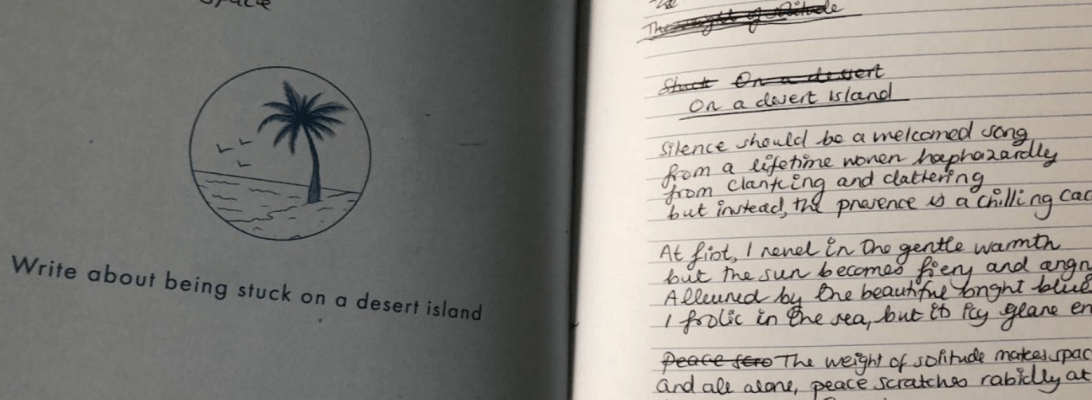
I’m a writer and artist. I have mostly written poetry and my third pamphlet was published last year by Knives Forks and Spoons Press. I was also a core poet for the BBC Contains Strong Language Festival last year. This year, to capitalize on that success, I quit my day job to become a full-time freelance writer. Over the course of this year, my overwhelming desire is to focus on fun, risk and exploration in my work, in order to revive my poetry practice and write a novel.
When I think about the trail of events that led to this amazing opportunity at the Nest, I feel so grateful, and awed by the way the Universe works. After being one of many who lost nearly 2 years’ worth of self-employed work during the pandemic, I was steadily pulling myself out of the flunk, and the wheels were in motion again, though any creative spark or motivation had withered, as it tends to when you’re in survival mode. I’d pretty much abandoned all hopes or aspirations of pursuing my screenwriting. After everything that had happened, it seemed like a Peter Pan-ish dream, and any time I’d try to sit down and work on a project, I felt pangs of anxiety and disheartenment, and hear the voice inside telling me I, ‘ought to be doing something else, something useful, making money!’.
Whilst racing against the clocks as the last semester of my final year at university came to an end, I had this idea jumping around my mind. At first, I didn’t really know what to do with it but as time quickly went by this idea kept growing – as ideas often do.
‘Mom, I’m going to write a book’
It became too big of an idea in fact that I figured I had to get it out of my brain and place it somewhere else. A jar? Cake dough? Nope, that would make it grow even more…hmm a… book? A book! That’ll work!
Having a background in Illustration, the idea of illustrating a book had been planted during first year, but eventually whilst navigating my creative practice, that was something that was sort of left lingering inside, a possibility for the future.
A new routine
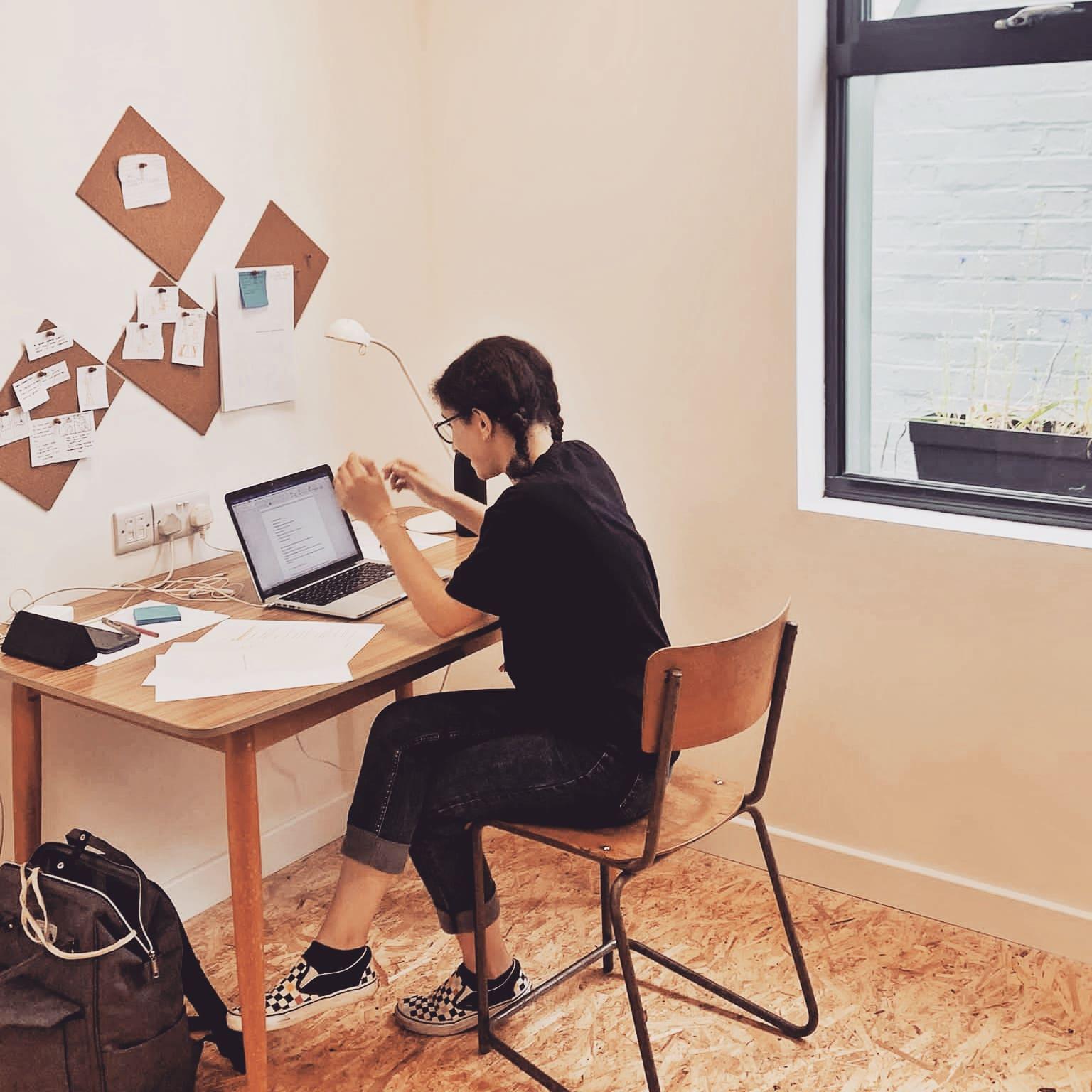
Applying for a residency came out of the necessity to establish a new routine as a recent graduate, the need to leave the house and work from another place. The need to focus on developing this idea. Going to the residency, was in a way a method to hold myself accountable and get started. Eventually, I’d go back and pick up the pace and further motivation as ideas started flowing onto the page.
Sticky notes and creative community
Being surrounded by fellow creatives was another key-element. Leaving university means in some ways parting with a creative community that one could often rely on for feedback, I knew that in order for this project to be further developed, I had to seek that source of feedback, the Nest was a great place for this.
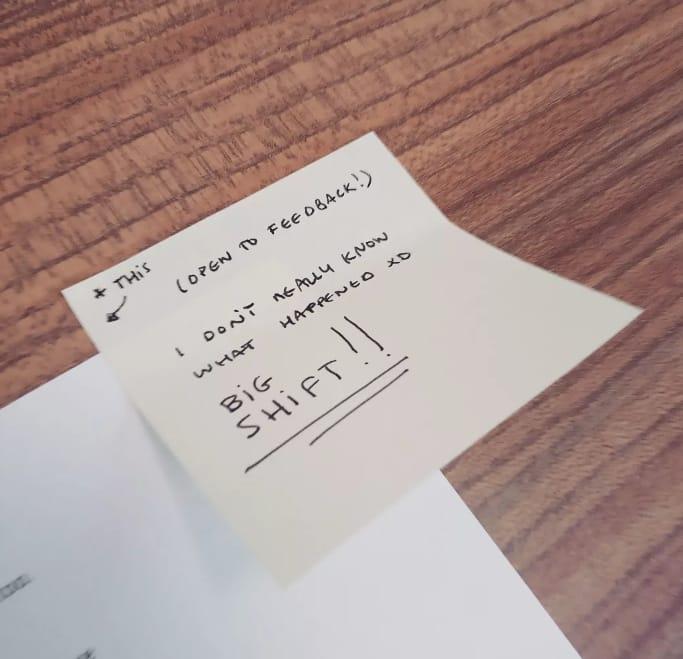
I shared the Solid Blue Studio with Sarah Owen and even though through the course of our residency we didn’t meet, we’d leave sticky notes around about our ideas. Being able to talk to fellow residents inspired me greatly in terms of taking things forward and look at different approaches or possibilities.
The F13 meeting was particularly important for this sense of community-building. It enabled me to reach out for feedback once again and present myself as a picture book maker for the first time.
Productivity and it’s absence
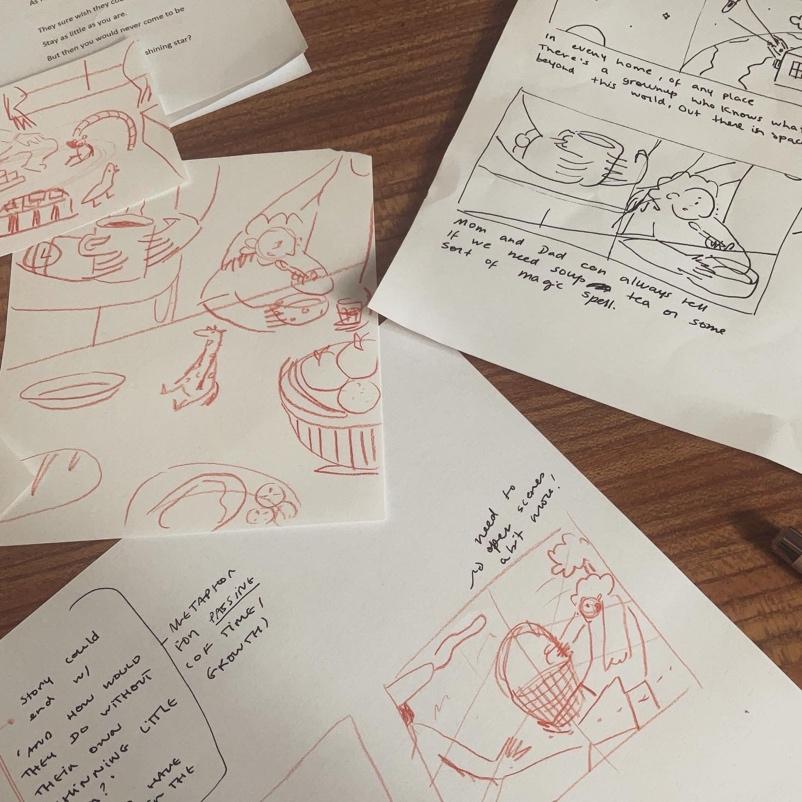
Writing the picture book has been an interesting journey. At first, I decided to just throw it all onto the page, evict it from my mind at once but, as creatives often do, I found myself using all kinds of different hats and this meant shifting from writer to editor to illustrator which, as one might imagine, made the whole process of passing the idea from mind to the page rather slow.
Something that this residency provided was the time to navigate my own creative practice in all its overthinking glory and in my own terms. During my time at university, I learned how to simplify instead of overcomplicating an illustration but when it came to writing a book, as I’ve come to understand during my time at the Nest, I’ve yet to learn how to efficiently tell a story. The Nest allowed me the time and safe space to go through this new challenge with lots of trial-and-error opportunities.
What’s my title?
4 script changes in, I still found myself in search of a title and, in a way, a sense of direction. I knew the message I was looking to convey, the audience, but struggled to simplify it, to narrow it down to a picture-book friendly type of format. Then I decided to distance myself from what I’d written, get more feedback, do some research, read and listen to other picture books – Oliver Jeffers and Christian Robbinson are having a great impact on the way I am approaching this project – and once I came back to my story, I started to notice a pattern, a sentence that kept repeating itself:
‘as little as you are’
Was this the title?
It sounded like it!
‘as little as you are’ conveyed perfectly the message I was trying to put across but still leaving enough room for the curious minds to wander – an invitation into picking up the book, I suppose.
Feedback feeds forward
Oh, the irony of having a title be ‘as little as you are’ and a story that still felt quite big! I was trying to narrow down the story to 1000 words and it wasn’t until I gave it a title that things started to fall into place…sort of. After some further research and analysis on other picture books and how they were narrated, I gathered I wanted this to both be an experience for the listener as for the storyteller – children and grownups. Feedback was key to this narrowing down and making sense of what would be the next steps for the picture book script.
I’m really grateful for everyone who took some time to help me tell this story, to all of you a big thank you, for all who read it this will make sense: A thank you as big as the grownups in my story!
A big shift
I decided to step away from what I had written once again.
Stared at a blank page for a while and then allowed myself to start over.
‘In any home, in any place…’
This time around, things seemed to flow a lot easier.
There was some sort of rhythm and direction that made it all flow a bit better. The story started to unveil through rhymes and short sentences rather than the traditional approach I was going for until this point.
This big shift for ‘as little as you are’ become what indeed made it as little as I’d initially hoped it to be. Moving forward I’m going to once again take in the feedback provided on my last day at Solid Blue and try to step away from the rhymes, but with this newly found sense of direction.
Thank you, Talking Birds, for enabling me to hatch this idea at The Nest!
It’s been a little while since I completed my two week Nest Residency at Talking Birds. Two weeks of support and freedom, where I got to switch off from the world and focus solely on the things I wanted to create.
As I was in a Nestival Residency, I already had a slightly fleshed out idea of what I wanted to do during these two weeks. I had a novel I’ve been wanting to write/and had been writing but wanted to really give structure and shape to. I always thought I could create wherever, whenever, that when it comes to writing all I need is something to write with and a head full of ideas but these two weeks slightly shifted my perspective.
I learned the importance of space. A space to create in. A space to get away from the world from. A space to be myself, without restrictions, with trust and a space where I could pop downstairs and talk to a supportive community. A group of fellow residents and the wonderful people at Talking Birds. We discussed ideas, why we were there, where we were on our journeys as artists and figuring it all out. It was so precious to me, especially as a recent graduate to have that community to bounce ideas off and be inspired by. In a way that was another type of space that I realised was important to me.
As for what I actually got done during those weeks, although I put pressure on myself to create something to make the most of the time I had there, everyone around me told me to just relax and take it at my own pace. I think I did this, recognising that letting go might actually be better for me and my art.
I wrote/rewrote the first chapter of the novel I was finally content with, although I’m still working up the nerve to share it to get feedback. I have a more carved out timeline for the events of the story to take place and a folder full of different plot points and their resolutions, as well as research that I need for background information.
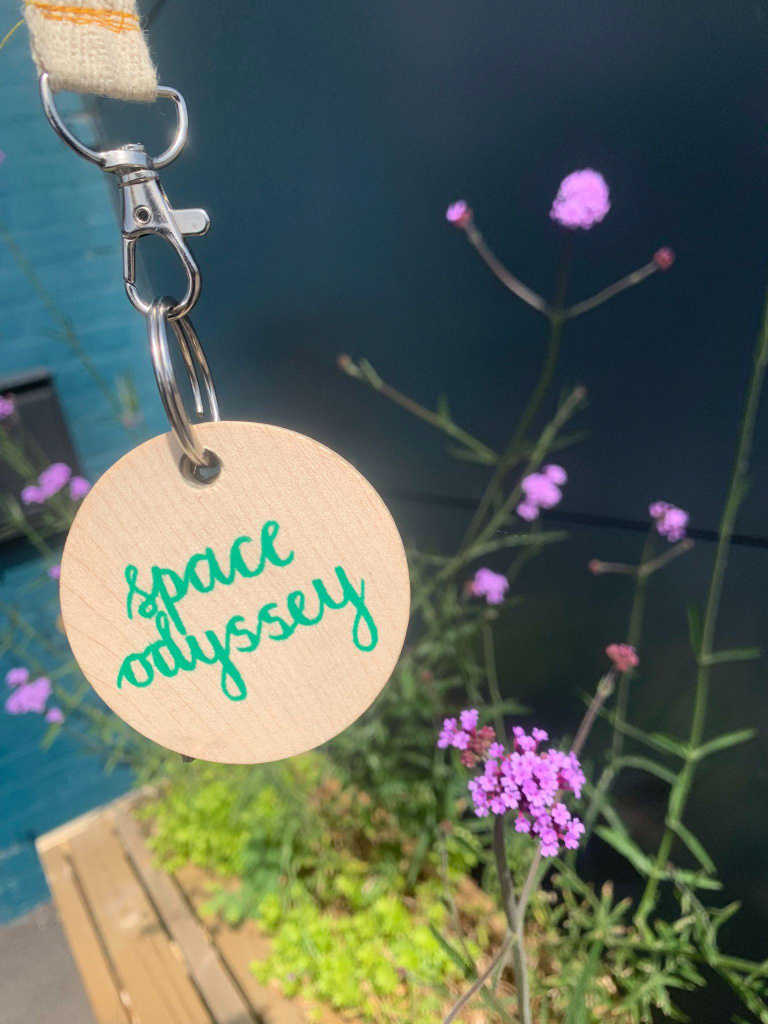
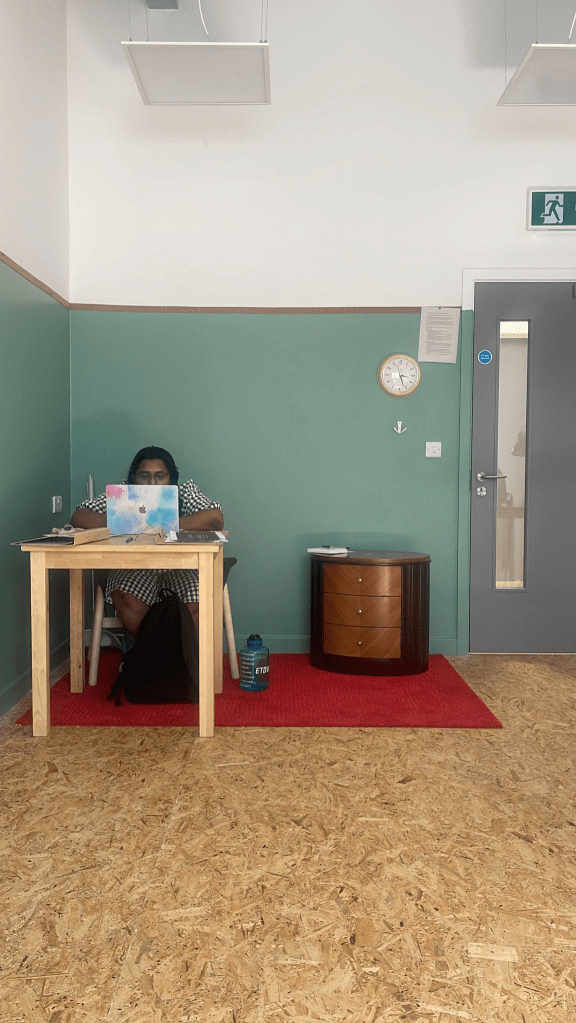
I definitely made progress, and I got very comfortable in my little Space Odyssey office. So much so, I still miss it. I think it’s rare to get an incredible opportunity like this and I’m so grateful for everyone at Talking Birds, for supporting me and for my nestival residency that has taught me the importance of space, as I set off on my writing journey.
The nest is a wonderful, comfortable place to create ideas and develop theatre. It is environmentally friendly too, nothing is thrown away but recycled. I am a theatre maker and performer who is aiming to intergrate BSL into my devised theatre production by forming a new character. Name of the production is DDDivas, which is exploring gender, female impersonation and my lived experience of being a neurodivergeant woman with long term health conditions. Me and Pierce Starre, a solo performance artist whom is also neurodivergeant, were both placed in the Space of Possibilities, a bright airy space where the sun can shine through the glass entrance and windows. We were very close to the kitchen too which is always a plus.
It was a wonderful space to explore and develop a character (as in the role of Ben, the stage manager). I wish to make my devised piece of theatre accessible so that any disabled member of an audience can attend any evening rather than attending a designated evening where BSL interpretation is available and another evening where captions, and then audio description is available. Relaxed performances need to be available during a full length of a tour too.
Me and Pierce came up with some wonderful ideas regarding the inclusion of BSL within the production, which is going to be developed further in future. I did have a meltdown midweek as was very tired, which effected my blood sugar levels too. Scribing was wonderful from Charlie as well as videos provided, but I realised that me and Pierce had slightly different needs, so it may have been really helpful for me to have further support regards my disabilities, as I do require additional breaks which I take when needed. I sometimes forget to take them due to effects of my dyspraxia so often need reminding to take a break, often due to stressful situations I will carry on working.
A lot was learned during the week which has changed my perspective positively, I feel I can take ideas forward which will be great to share with rest of team and those within the arts that can offer assistance. I am developing other ideas too related to aspects of theatre and story telling, but I am placing focus on DDDivas currently, as due to covid and being on the shielding list, I had to hold back on this project for some time. All the staff and artists at Talking Birds were very interesting and supportive, and it was great to meet them in such a warm friendly space.
It’s so lovely that Talking Birds is placed near the canal, a pleasant, quiet walk which is useful for head clearing on the way to the space and back. So kind of Philippa and Charlie to give me a card before I left, saying thank you for using the space and spending time at Talking Birds. Me and Pierce were very appreciative and grateful. And like it says on the front of the card, I have met more of my flock. Thank you so much Talking Birds.
One morning in February, Lauren was doing her usual aimless morning scroll through instagram. As she was flicking past all of her cats with hats accounts and insta feminist quotes, she noticed that Talking Birds had made a call out for the Remix Residency at The Nest. She saw a huge variety of props in a picture and was drawn in immediately. There was something about that telephone, that explorers hat! The bucket and spade. It sparked off ideas which started to whirl through her brain, so she messaged Izzy and Ruth.
“I think we may have a shot at this!’
Fast forward to a week later in Gails Balham (a local haunt of ours) Ruth and Lauren discussed ideas that were stimulated from the picture. Coventry’s female and industrial history, the idea of legacy, what Coventry means to us. What would happen if we created a dystopian world filled with time travel, with women at the core? These were just a few topics that we indulged in. We knew we wanted movement at the heart, with small pieces of text to lead the story forwards. Pumped up from all of these tangible ideas, we set to work applying for it. Janet saw something in these mini moments we had created and would you believe it, we were accepted! Now the real work begins…
Before we knew it we arrived in Coventry for our first section of the Residency. It was a lovely sunny day in May. Lauren and Ruth entered the bright blue gates of Sandy Lane Business Park. We began our work in ‘The Space Of Possibilities’ room in The Nest. It was bright and spacious, with so much room for us to create. Within minutes we knew we would feel very comfortable in this space. It felt like our little home for the week.
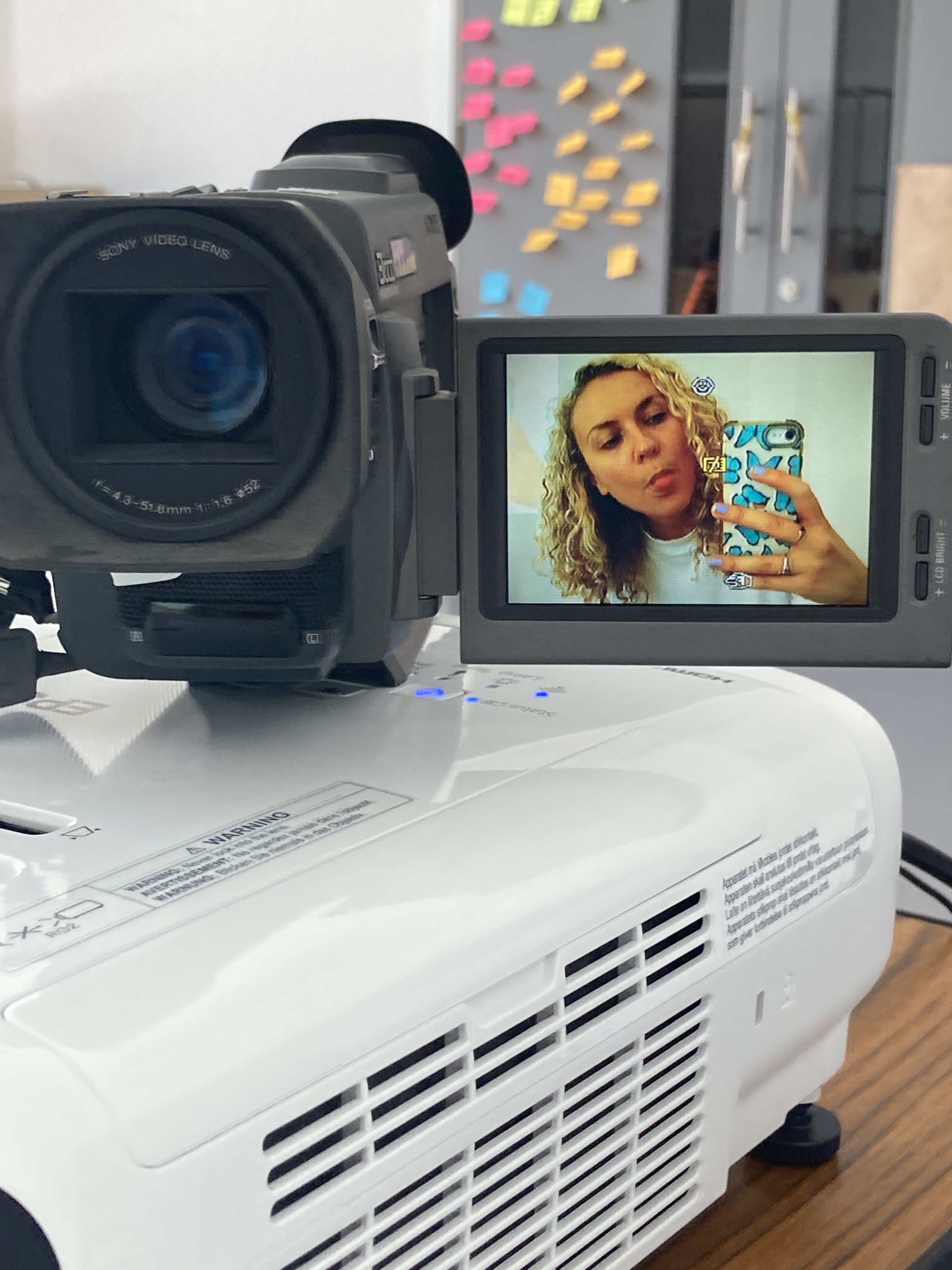
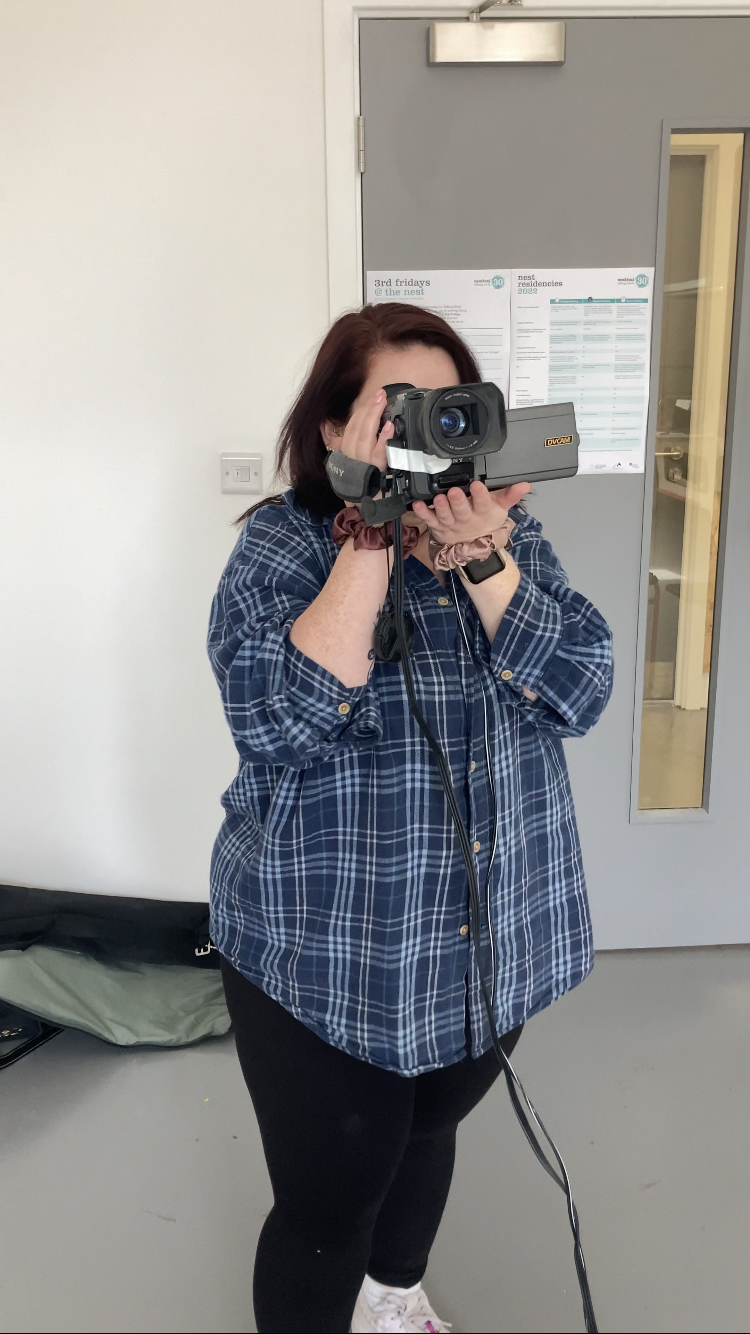
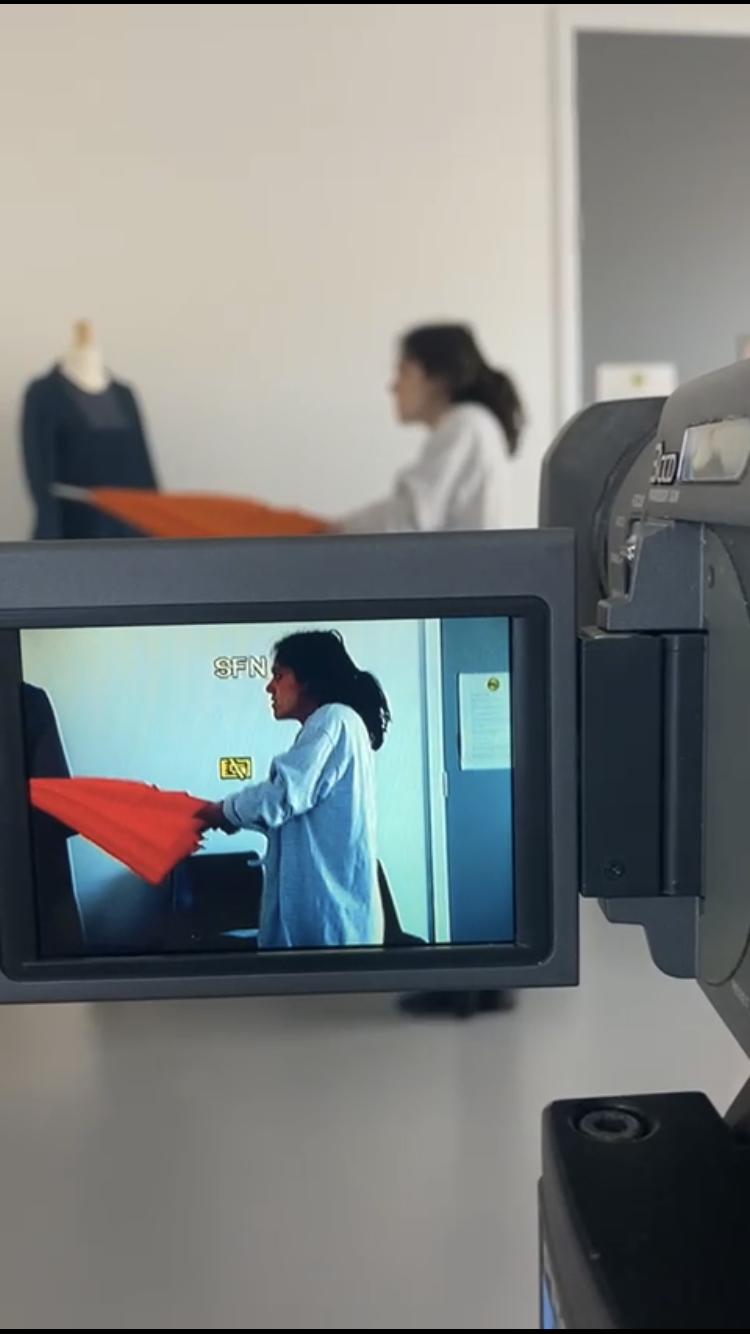
For the first week we just allowed ourselves to play (something which feels so rare in this industry!) The pressure was completely off, so we messed around with tech we’ve wanted to work with for years. Trying out different ways we can use projection, live camera feed and sound. It began to spark so many new ideas for what this project could be. We tested an idea (which came from the projection) about the audience’s perception. What would happen if we projected an image onto the umbrella, but behind it was something completely different? Or a different part of the story being told? We found a bit of magic in this idea, so we ran with it.
Our next stage was to figure out what story we wanted to create. We knew we wanted it to be about Women of Coventry and the stories that seem to be forgotten. We’ve all heard of Lady Godiva, but who else gets to be or should be just as iconic? And you know what, we just couldn’t think. We couldn’t think of any other woman who is allowed to be a figurehead like she is.
So we took to our laptops and began our research. Straight away a name popped up, a woman called Alice Arnold. The first ever female Mayor in England. We couldn’t believe it.
The more we researched her, the more we fell in love with her story. She felt so real to us. Even though she was born in 1880, Alice felt like a modern woman. With real hopes and dreams. Her progressive views and big dreams for gender equality, education and to end poverty just proves that she’s the kind of woman we’d love.
The next woman we researched was a little closer to home and more of a household name. Pauline Black. Visually recognised for her androgenous style, she was a woman we wanted to know more about. Hailed as the Queen of Ska, Pauline became an icon of her music genre. And of course, she is the lead singer of the band The Selecter. Black has also been an actress, with roles in films and television.
Our research came to an end when we found our third female story. Lisa Lashes. Known for being a hell raiser in the rave scene in the 90’s, Lisa was one of the first female DJ’s to break out of Coventry. We loved these women so much already.
We flung post-it notes on the walls of the room, scribbling down our findings and our ever growing questions. The room felt mighty. We were both fueled up with these stories. We played Lisa and Pauline’s music and filled the room with their words and beats. Messing around with movement and tech, we began to create a rough structure for the world we wanted to create.
In our second section of the residency, we introduced two ensemble members to the room. Julia and Sinéad. We wanted their role in this section to enhance our findings and embody some of our ideas further. Extra bodies in the room are always great for storytelling. Oh and for games. Grandma’s footsteps just doesn’t do itself justice with only two players. And we’re super competitive. (Ask Julia and Sinéad).
Over the next few days, we set to work discussing some themes we wanted to work with and some free writing tasks.
‘When I think of Coventry I think of…’ ‘A woman can be…’ ‘Home means to me…’ ‘To f*ck with form you have to…’
These were a few of our free writing starting points. From this, we began to create small pieces of movement involving the props given to us. We all chose two items from the prop box, a section of our writing and 8 movements to create mini pieces. We then watched and gave feedback on moments we’d love to push more. As Ruth is a Movement Director, she then cast her eye over the work we had made. Ruth pushed us for more ensemble moments and different ways Lauren, Julia and Sinéad could connect.
It was such an eye opening exercise. We really felt each other’s warmth in the room, as cliché as that is to say. Hearing different points of view on the city, on what it means to be a woman. It was lush.
Ruth and Lauren then put their heads together at the end of this phase to figure out how we wanted to tell this story. With some time in between, we allowed some dust to settle and to search for the core of it. Tuesday of our final week Ruth and Lauren looked back over bits of writing, videos and also came back to our key themes. And then a line from Sinéad’s free writing drifting into our memory.
“Dreaming alone isn’t enough”
By this point we had learnt so much about these women and we had celebrated their amazing triumphs. But it dawned on us, they’re the first women in their field. They’re singular.
To be honest we feel in history, and the systems that inform it, we often only allow one woman to be held up high and remembered. Like Lady Godiva on the horse “there is space for us all” so why do these women feel isolated? This pushed us to think about the arc of the show. What would happen if the camera and projection only showed one of the performers, not them all. Would it feel more invasive?
We had been playing with video and the camera throughout the process and we wanted to challenge ourselves as a company this week. To move past ‘it looks cool’ or it allows us to play with space. We always knew that the camera felt like it represented much more than just a piece of tech. So we decided to give it a role. We cast it as History.
These were pretty big ideas so we got stuck in practically, pulling together bits of our writing, research and improvisation to make a draft script that we worked on for the next day. Then, Izzy joined us! All of the ideas rattling around Ruth and Lauren’s brain finally had a fresh pair of eyes. Then it was about getting it up on its feet. Sculpting moments through improv, discussion, exercises and best of all collaboration.
On the last day of the residency, we shared our 20 minute piece with some of the Talking Birds team and community. We had a small Q&A at the end and got to hear what resonated, what people felt and thought.
This residency has allowed us to grow as a company. By meeting new people, involving collaborators and working with tech from the seed of an idea. But most of all, giving us the space and support to play. We have continued to learn about our methods as a company and as individual artists. All whilst keeping the core of SpeakUp shining bright at the centre of the work, amplifying untold stories.
We had such an absolute blast, thank you for having us, Talking Birds!














 Words from the Birds