Emily Payne reflects on her recent Hatching Residency at The Nest
Day One:
The Vain Swan: a Backwards-Haiku and a Bio
Hatch slowly in the quiet.
Dried shell picked away;
folded wings creased, and useless.
I’m on a writer’s residency in the Solid Blue room at The Nest, beside the Canal Basin in Coventry city centre. A hatching residency. Bird words. The Nest. Hatching. Like swans do. Like birds do. If I squint my eyes I can see my own reflection in the laptop-black either side of the Microsoft word white page. Bright cheekbones, dark eyes. My mouth, pursed and scowled, thinking of the next sentence as the last one is typed. It’s mostly stream of consciousness, even the more formal stuff. It sort of flows out of me like blood – like snot.
I just heard about a swan that lives in the Canal Basin here, according to legend. It’s not just any swan, of course; they never are in folk stories. This one stares and stares at its own reflection, in the water and in the windows of the industrial buildings. Big glass windows for a long, bright neck. Like laptop-black-reflections except she looks at herself and sees only herself a swan, sees herself only beautiful, for the animal of her body.
Catching sight of my own face in the laptop-black screen reflection, I cringe. My beady eyes furtively try not to be caught face to face with myself. A human-again child of Lir, ageing and blinking surprised in the half-light of midlife. It’s just vanity, I tell myself. Would you stop being so vain and just get on with the important things. The sack in which my bones are carried does not need to be beautiful, and beauty is not helpful. This old bone sack itself is not particularly helpful anyway.
I can’t help but think of this Vain Swan resisting the shame of her vanity; she is a swan, so why should she be otherwise unimpressed by the strange feathered length of her body and what it can do? Her mate swims beside her, and he watches watches, her but not himself. She is not Leda, and neither am I; he has no interest in passers-by. Time’s up on that shit even for the birds too I suppose.
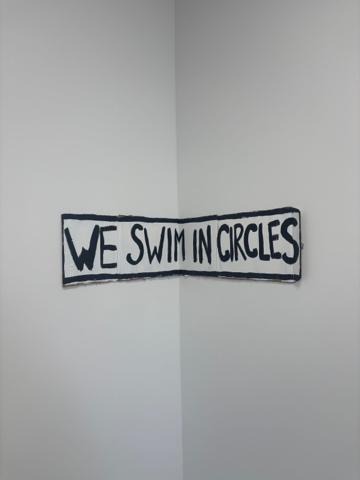
Is he basking, though, in her reflected ego? Is he even aware of it? Does her mate know how much she loves the bones of herself in these stolen moments on the towpath on the water by the windows? The beautiful mundane is not enough what else what else what else. Traumatised by fears of beauty and jealous for it we swim in circles.
Maybe I’ll hatch out of this egg and become her.
Day Three:
There’s a Clock in This Nest and It Has Cured My ADHD
There a clock in my room
Yellow on solid blue
And it pricks me roughly
But I love it
This little room is only mine
Wooden chairs and wooden tables
Minimalism at the cost of comfort
Or ought I say
Aesthetics at the cost of my spine
Sensory deprivation at its most useful
This little clock is the only sound
And it doesn’t really tick tock tick
It’s not a wide oscillating sound
And it doesn’t go the whole way round
It’s metronomic but more of a thud
A dull duh duh duh duh
Standing over me
Duh duh duh duh duh
Do some work
And somehow
I actually am
Day Five
Points of Access, points of fact
The part of the writing process that has never really revealed itself to me before is having no way to access a piece. I’ve always written what I wanted, when I wanted, and the words came fluid and soaking wet.
But this practice-based-research plan of mine, for this residency, has called for some thematic diversity and content outside of my control, if I want to stay true to my proposal aims and present a folkloric encounter with Coventry city. And what is Coventry city without Coventry City? I’m writing this blog on day six, parade day. CCFC back in the premier league and the roads all closed and lined with pale blue t shirts and banners and balloons.
Finding a route into a poem about football was too difficult. For me.
I couldn’t ignore this huge part of the city’s culture, and the folk stories that exist within something that so many people collectively worship. Collective worship is an important part of the seed of folklore. I sat and stared at a blank page for a very long time.
I went to a Cov City match once. My friend bought me a ticket when he discovered I’d never been before, and I went as part of this big group and saw the ferocious glee of it all. It might not be for me, but that doesn’t matter because it’s hugely important for so many people. So I tried to think of a way into a poem about it, one that wouldn’t feel forced or trite or lazy or terrible. I tried to look at historical football matches, and found one on Mayday 1920. Cov City avoided relegation. Huge crowds.
Huge crowds? That made my brain tick. 1920. A couple of years after the war. Impressive, then, to see so many there – 23500 people. I wondered how many men 18-45 were in the crowd. Not many, I guessed.
Then I wondered how many players had been sent to fight and die; many fought but three Cov City players were killed in action or succumbed to wounds. In 1915, the club didn’t have enough players for matches.
I found my way into the poem, found a story and made it into a folklore about the club’s history and the sacrifice of those three men, and all the others.
Day Six
ELEVEN POEMS SO FAR. Unheard-of production levels. Hitherto unseen levels of sustained research-based-practice. It’s Bank Holiday Monday, won by worker’s strikes, and I’ve finished a poem on the Keresley miner’s strikes of 1985. I came in late this morning because of a punctured tyre – a slow puncture that got a bit faster over the weekend. I’ll pretend my late arrival was solidarity for the strikes 100 years ago that earned us the bank holiday off.
Day Eight
The thing that has struck me most about this residency is my level of productivity. I have AuDHD, and I struggle with demand and motivation, oscillating wildly between paralysis and mania. I seem to have the ability to hyperfocus, but usually in a broadly conceptual way (thematic life interests, but not hunched-over-obsessive-researching type of hyperfocus. My lifelong research interest and thematic ‘flow state’ has always been in genocide studies, and I am currently a research fellow for a genocide prevention institute. I’ve always been an activist; but I have never really finished a whole start-to-finish project for myself. I have a 45000 novel languishing in my google drive, and lots of poetry in pieces scattered across my adult life. I decided that I am ready, now, to pour into my ambitions everything that seeped out in the nine years of motherhood where I poured from the holy well of my own creativity until it ran dry.
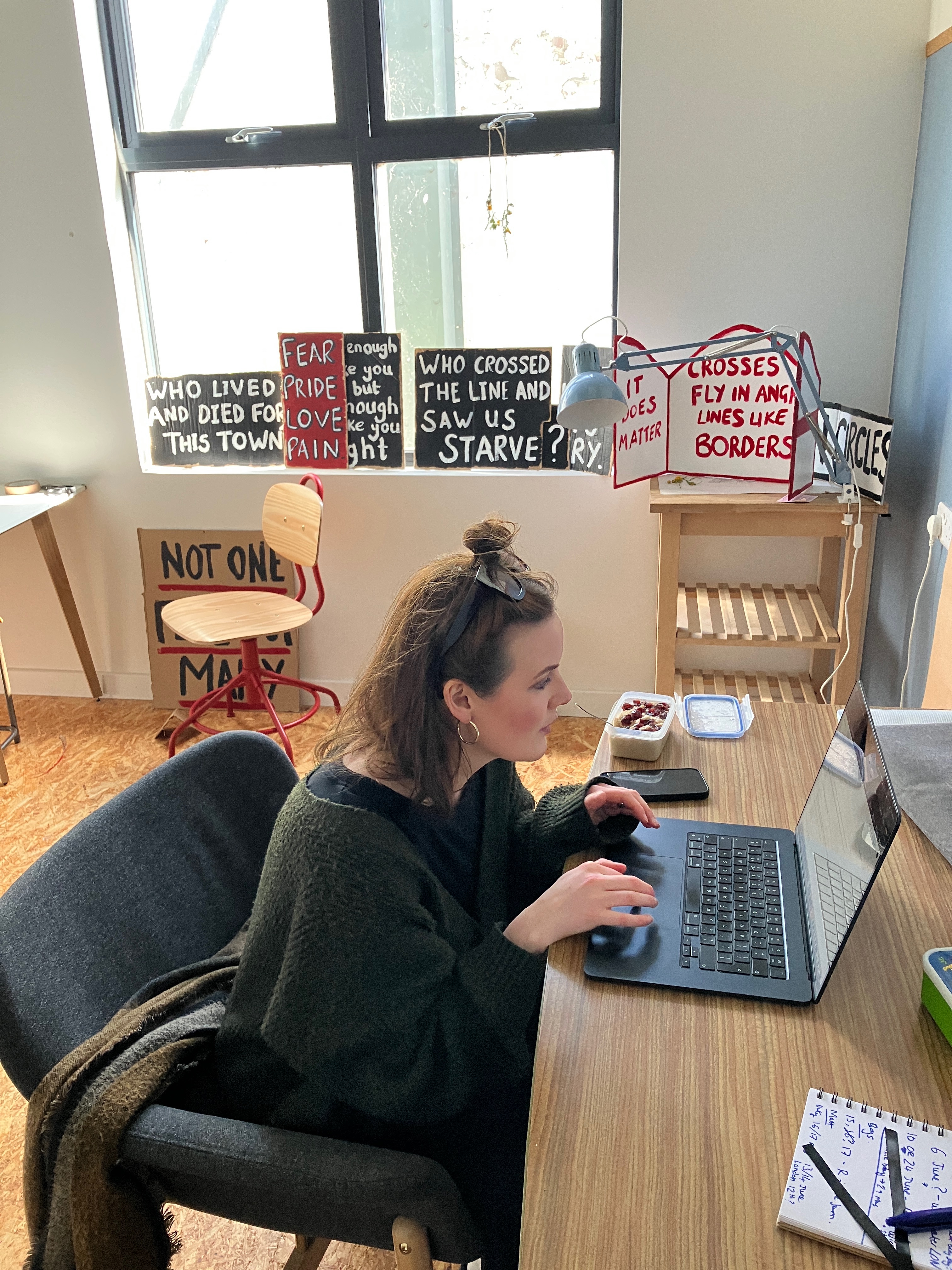
This residency has given me space to make mistakes, abandon ideas and reject perfection. I wanted to do a rubbing, one piece of frottage per poem I had written, rubbed on the place the poem was written about; however, when I did a few, I realised that they were not for me. I am not precise, or careful, or graceful or gentle. The wind tore the paper and my impatience scraped the graphite too hard. My haste made the lines too sharp, or not sharp enough. I felt a bit sad, last week. But then it hit me, one evening, hanging my old protest banners on the wall by our staircase. I already make art – protest art. Banners and signs, painted and huge letters screaming meaning from rage. I paused and wondered if I could make my protest signs into something that linked to my folk story poetry collection, and of course it could.
The same radical dynamism that calls to slogan and chants is in folk storytelling and it has the same thread of resistance running between both. I rescued cardboard from our recycling bin, and liberated some acrylic paints from home. I borrowed my children’s paintbrushes, and I created a protest-style banner for each poem, using a line from the poem itself. The lines self-selected; it was obvious to me the difference between what made a good poem title, and what made a good banner sign. I can’t academicise it, because it was just a feeling – leaning my hips over the back of the chair to read each poem through and a terse, hard breath out each time I chose the lines. It would not have been real to create the poem after making a quote for a banner; doing it the way round that I did made it authentic but it also made it part of the lore of the folk story I was retelling.
Day Ten
As a neurodivergent fella, I struggle with transitions. Between activities, between weather states. Between sitting and standing, even. I find it hard to exit a conversation even to go to the bathroom. It’s getting worse with age, or I’m getting better at spotting my own struggles and naming them.
I’m struggling today with the end of the residency. I’ve got a full and complete collection, all my art is photographed and I’ve imported images and formatted them to the best of my (limited) ability. I’m happy with it; I’m rarely wracked with self-doubt so I’m comfortable with the physical pieces of ten days’ residency exploration. Ten mornings, ten afternoons. Ten lunchtimes, talking and sharing and joking and learning with Janet and Derek and Melissa and other resident artists. (Talking and talking and talking, in my case).
Everything is done. My room is tidied. My friend is going to be moving into Solid Blue on Monday, and this gives me a beautiful reprieve. I can leave my protest banners here, and I can pop back on Monday to collect them, and help Natalie move her amazing artwork for display. A soft-finish.
I leave a little bit early because I need to perform at a storytelling evening. I’m a bag of nerves and incompleteness, not fully finished or fully present just skimming the surface like a stone, each skim buying time but soon I will sink. I will be back, I joke with Melissa. It will be hard to get rid of me.
Day Ten-Point-Five (Day Eleven But Not Really)
I’m back to collect my protest-style banners. It’s raining for the first time in my two weeks here and I’m worrying about getting the acrylic paint wet. I hand a copy of Solid Blue, my printed-out and stapled-together poetry and art collection, to Janet for Talking Birds to keep. Not as evidence of what I did on residency, as a testimony to how much I got out of it.
I help Natalie move her pieces downstairs, and I sit down to write the end of my blog. Finally, I am ready to be at the end, and it feels done. It feels like the end of something, but much, much more than that, it feels like the start of something else.